Browsing articles from "January, 2006"

Latest, greatest thinking from business blogging thought leaders

Jan 8, 2006   //   by Stephan Spencer   //   Blogging  //  1 Comment

It was an honor and a privelege to share the virtual podium today with some of the greatest minds in business blogging, indeed some of the greatest minds in marketing — period. This morning I led the MarketingProfs Thought Leaders Summit on business blogging, with panelists Seth Godin, Doc Searls, Robert Scoble, Steve Rubel, Debbie Weil, Toby Bloomberg, Shel Israel, and BL Ochman. We discussed some important issues in business blogging, such as:

  • how to make a solid business case for blogging for marketing purposes
  • how to manage upper management’s expectations for the outcome of blogging
  • no-nos and potential hazards when blogging
  • issues with hiring a professional blogger / blogging consultant / ghostblogger
  • how to promote a blog
  • how to influence other bloggers to blog about one’s own products/services
  • most effective business blogging tactics
  • blogging heroes/mentors
  • where the blogosphere is heading over the next few years

Great stuff!

The audio should become publicly available in a couple weeks time. We will make the MP3 available to all MarketingProfs members, not just Premium members, for four weeks. I’ll blog to let you know when it’s been posted to the MarketingProfs.com site. From the audio recording a transcript is being prepared as well, which will be available only to MarketingProfs Premium members. From the transcript, I will be preparing a synopsis report, summarizing the main points and takeaways from the Summit.

Big thank yous to our esteemed panel of experts!

Yahoo! buys Flickr. Damn that was a smart purchase!

Jan 8, 2006   //   by Stephan Spencer   //   Blogging, Content, Search Engines  //  1 Comment

No secret that I think Flickr is hot stuff (just refer back to my recent posts about Flickr here and here). It’s definitely Web 2.0 material. Flickr investors like Esther Dyson must be pretty happy right now, but Yahoo! stockholders should be even happier. John Battelle says his sources estimate the deal to be worth around $15-$17 million, while Om Malik says his sources figure $35 million. Either way, that’s one hell of a deal for Yahoo!, particularly when you consider that Ask Jeeves also just got bought — for over $1 billion! Jeremy Zawodny at Yahoo! has some interesting things to say about the Flickr acquisition.

How to make a website with personality

Jan 8, 2006   //   by Stephan Spencer   //   Content  //  No Comments

I’ve just been to Woot! How refreshing to find a company’s website that has a unique, memorable personality to it. It’s been months since I’ve bumped into a site like that. Last time was last year when I discovered Mailinator (and man, was that funny!). Here are a few highlights from Woot’s FAQ page:

We anticipate profitability by 2043 — by then we should be retired; someone smarter might take over and jack up the prices.
[...]
You should google for the manufacturer contact to get product answers – we suggest a dating service, magic 8 ball, or ouija board for general life solutions.
[...]
If you buy something you don’t end up liking or you have what marketing people call “buyers remorse,� sell it on ebay.
[...]
I SEE SOME KIND OF WEIRD-LOOKING POPE HAT ON THE MAIN PAGE. WHAT’S THAT ABOUT? A Pope hat? Oh, that. It’s supposed to be a rocket ship. In any case, that’s our LAUNCH EVENT indicator! And boy, are you a lucky cuss. Spying the LAUNCH EVENT indicator is like catching sight of a leprechaun, or the elusive white whale.

Bloggers don’t seem to have trouble injecting personality into their blogs, so why are traditional websites almost always so flat? We just fall into the status quo trap. Here’s how to break out of it (and yes, I do suggest you read every book I’ve linked to below):

  1. Relate to your reader as a human being. People talk to people. Companies don’t talk to companies. “We are not seats or eyeballs or end users or consumers. We are human beings” – Levine, Locke, Searls & Weinberger
  2. “Say something worth talking about” – Nick Usborne
  3. Poke fun at yourself. Don’t take yourself/your company too seriously.
  4. Be happy. Happiness is contagious. “Many people don’t allow themselves the luxury of being enthusiastic, light-hearted, inspired, relaxed, or happy-especially at work” – Richard Carlson
  5. Learn improv. You’ll think better on your feet, and you’ll be more lucid when you talk or write.
  6. Be remarkable. “The opposite of remarkable is very good. Very good is boring.” – Seth Godin
  7. Start fires. “Markets are conversations; and conversations are fire. Therefore, marketing is arson.” – Doc Searls
  8. Share the love. “Share your knowledge. Share your network. Share your compassion.” – Tim Sanders

Personality isn’t something you just add to your copy. It should come from your company’s DNA and flow through to your website.

Does Google deserve a top 10 spot for “britney spears”? I don’t think so!

Jan 8, 2006   //   by Stephan Spencer   //   Search Engines  //  1 Comment

According to Wordtracker, “britney spears” is the 16th most popular search term on the Internet. That adds up to a lot of search traffic. (Yes, “sex” is #1, in case you were wondering…) Now I don’t make it a habit of searching for “britney spears” (although I do think Britney’s Guide to Semiconductor Physics is a thorough yet approachable primer on the subject). In fact, it was my colleague Brian Klais, a VP here at Netconcepts, who actually made this discovery. (Purely research, Brian assures me!) And the discovery is this: Google.com holds the #7 spot in Google for “britney spears”, with a totally irrelevant, useless list of misspellings of Britney’s name. This page is a dead-end for users, and even borders on being “spamglish.”

How did this happen? Well, the sheer weight of Google’s PageRank score from the Google Job Opportunities page combined with the link text used on that page (namely: “Britney Spears”) has propped this page up to a top slot, undeservedly so. This situation emphasizes the need for Google to evolve their algorithm so that the link juice has greater dependency on topical relevance. In other words, in the case here of Britney Spears pages, Google should have given more ‘Googlepoints’ to links from pages/sites that actually have something to do with pop stars, music, etc. In the meantime, I think it would be in good form for Google to add a rel=”nofollow” href attribute to the Britney Spears link on their Job Opportunities page and let some other, more relevant Britney fan site have that #7 slot. For those who don’t know, the nofollow link attribute was a recent invention by Google to thwart blog comment spammers. But it can also be used to stop the flow of the link juice (PageRank) to ANY link. Google should use it on their own links in cases when they know that not doing so will pollute the SERPs with irrelevant results from Google.com pages. In fact, I think ALL PageRank 10 websites, due to the powerful PageRank that their sites wield, have a responsibility to employ nofollow when linking to useless pages.

My podcasting article on MarketingProfs

Jan 8, 2006   //   by Stephan Spencer   //   Podcasting, Shameless Self-Promotion  //  1 Comment

At long long last, my article on podcasting has been published on MarketingProfs.com!

The article looks at the potential for podcasting as a marketing channel. I’ve included an explanation of the technology, plus some potential applications, along with some interesting quotes from podcasting pioneer Doug Kaye and branding guru/author/blogger Laura Ries.

In conjunction with the article, MarketingProfs has posted 3 audio interviews that I conducted (podcasted through MarketingProfs’ RSS feed):

Internet word-of-mouth marketing

Jan 8, 2006   //   by Stephan Spencer   //   Blogging, Online PR, RSS Marketing, Shameless Self-Promotion  //  1 Comment

This week I spoke at the Strategic Branding conference in Auckland about word-of-mouth marketing over the Internet, and how blogs, forums, RSS, wikis, and search engines play a role in the process. I shared tips on how to harness “word of mouse”, discussed success stories and flops, and in general described how to enhance existing relationship marketing programs and one’s brand using new technologies — technologies that most brand marketers don’t understand. Feel free to peruse my Powerpoint slide deck from the conference. Enjoy!

eMarketer report on why people click on paid search ads

Jan 5, 2006   //   by Stephan Spencer   //   Search Engines  //  No Comments

eMarketer has just released a new research report, Search Engine Marketing: Search Users and Usage. The report gets inside the heads of searchers to better understand why people click on paid ads.

David Hallerman, eMarketer Senior Analyst and author of the report, states:

“The good news is that the growth of paid search ad spending is flattening out. Yes, you heard me right. That’s good news. In an industry once-burned by bubble-and-burst expansion, Internet advertising is best served when its most effective vehicles show steady, and less hyped growth.”

“As the paid search market matures, involved companies will look for additional ways to build their bottom line through search. This will include greater spending on tools such as search engine optimization, which boosts organic search rankings, and broadening the paid search base with superior implementation of local search, contextual advertising, and vertical search.”

New MSN Search officially launches. What does it mean for you?

Jan 5, 2006   //   by Stephan Spencer   //   Search Engines  //  No Comments

Microsoft officially launched their new MSN Search today, as anticipated. Bill Gates makes the announcement on the MSN home page with a prominently positioned “Letter from Bill Gates,” complete with photo. (although I prefer these photos of him).

This is good news for marketers. Microsoft’s new search technology offers a new channel for reaching your potential customers. Taking advantage of this new channel isn’t hard, either. The tried-and-true search engine optimization tactics work as well if not better on the new MSN Search as they do on Google and Yahoo. These tactics include keyword-rich title tags, keyword-rich body copy, links from ‘important’ sites and keyword-rich text in the links from those sites.

In my just-published article on MarketingProfs, I reveal some critical factors for success in the new MSN Search, including:

  • the power of the anchor text of inbound links (“MSN bombing”)
  • MSNbot’s level of tolerance for complex URLs (i.e. how many parameters in the “query string” are too many)
  • how to obtain a list of backlinks for your site
  • …and more

You’ll need to be a MarketingProfs premium subscriber to read the article. A version of this article is coming out in this month’s issue of Catalog Age magazine. It’s not online yet on Catalog Age’s site, but I’ll post a blog entry once it is.

Gizoogle – Fo all you who wanna find shiznit
Jan 5, 2006   //   by Stephan Spencer   //   General  //  1 Comment

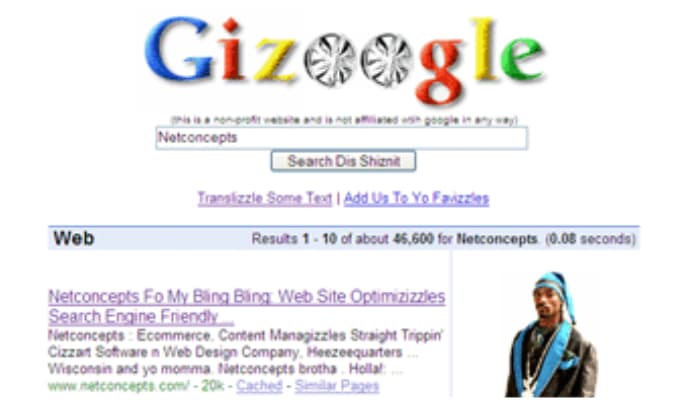
Gizoogle is fun search page that uses Google’s results to populate its search results. However, the fun part is that Gizoogle translates the page excerpts into gangsta-speak. Have a look! But watch out, you only get three searches a day, so use them wisely.


gizoogle

Once you’ve had enough gangsta’, try The Dialectizer, where you can see your website translated into redneck, Swedish chef, hacker and many other dialects. Check out what our testimonials page ends up like, hacker-style! For example…

stephan spencar dsi vary kNowledgealbe 4nd an expert in th3 fei;d if udecide to meEt w1th hi,m ypuo ////////ill not be disapopint3d… lololol!!!!!!!!!!!!!!!!1~~~

Catalog Age article: Microsoft is “Gunning for Google”

Jan 5, 2006   //   by Stephan Spencer   //   Search Engines, Shameless Self-Promotion  //  No Comments

My article, “Gunning for Google,” has just been published in this month’s issue of Catalog Age magazine. As of today, it is now live on their site. Enjoy!

Pages:12345»