Brian: Welcome, everyone. I’m going to let people filter into the room because we have a lot of people joining us today. So we have a very special treat in store for you. And please close the doors, get your snacks and make sure that you are ready to engage because this is going to be an interactive learning experience. Every single thing we do today will have applications and implications for your business. Let me get you thinking about something. Getting traffic to see you is the lifeblood of any business. If you have any challenges being seen or finding clients, wouldn’t it be easier if clients could find you? And so that is the speaker we have with us today.
Stephan Spencer is one of the top researchers, thinkers and writers in the AEO and SEO space. He is a three-time author, an avid blogger, an international speaker, and a consultant on all things SEO. Over the course of his 30-plus-year career, he founded an SEO agency and even created a unique pay-per-performance SEO technology. And the thing I like about Stephan Spencer personally is that he invests all of this thinking, all of this tech, in thinking about meaning, in how all of this technology matters to you, to your clients, and how it impacts their lives. So we’re not just talking about making it easier for your clients to find you. We’re actually talking about the connection that matters to your clients, the one that helps you convert people so they get more out of their lives and their relationships. You get more out of your technology, your SEO, and something we’re going to address today, right, Stephan? The AEO. So Jay Abraham is also with us today to introduce and talk a little bit more about Stephan. So I’m going to turn it over to Jay before we get started.
Jay: Well, sorry, I had my audio off. So everybody, welcome, and it’s good to have all of you. We have almost an annual or semi-annual tradition of having Stephan really benevolently gift a half-day of his time to our audience to try to do workshops that are much more than just actionable. Still, they’re much more specific to real-world scenarios and very bespoke. So he doesn’t really just dole out a lot of academic ideas. He takes a person’s business, their homepage, their site. He slices and dices and deconstructs and reconstructs and walks you through all these amazing tools that can help you, first of all, see the gaps, the exposure, the underperformance, and then he helps you find ways to improve them, and he does it freely and generously here.
So I’ve known him for many years. I’ve known him to be, first of all, top tier, preeminent, a cutting-edge thinker who is on the leading edge of whatever he is focused on. He was a pioneer in SEO, and he’s helped more large and dominant companies. He also helps entrepreneurs. He is very masterful. Stephan can, if you are a good prospect for him, transform your business. One of my relatives engaged him a couple of years ago. It was a law firm in a very cluttered category, and they had never done any marketing. And within about 6 months, they became the go-to source organically, and their business just exploded. And I’ve seen him do it over and over again.
But today he’s going to take you into a world most of you aren’t very familiar with. Most of you aren’t really set up to address. And, more importantly, he’s going to walk you through an area with a duality of relevance. To make this opportunity pay off for you, you also need your SEO to be in alignment. And he does this for me more in contribution than anything else. He’s a very top-tier person. His services are very successful for the recipients. He’s not inexpensive, but he freely gives his expertise for four hours. And if I were any of you, I would encourage you to participate to the extent you can. I hope many of you sent him your sites and businesses to use as case studies. And I just adore him because he’s got integrity. He’s got almost an unending flow of contributions, and he’s very masterful. So, it’s a privilege, and I’m grateful on behalf of everybody. I’m going to be on the sidelines watching. He’s done this three or four years in a row for us, and he’s done SEO, and now he’s going to introduce you to something that you probably can have a massive advantage over your competitor if you really pay attention. I hope you’ll stay on for the whole clinic. Stephan, take it away.
Stephan: Thank you so much, Jay. It’s a pleasure to be here. I’m really grateful for this opportunity to share some insights and actionable takeaways, and hopefully, you’ll get some breakthroughs and epiphanies from the time we have together. Now, one thing that Brian alluded to was this idea of finding deeper meaning and purpose and impact in your life, and so I’d like you to do that at the very start of this workshop. Think about who you can impact with what you have learned. Your retention rate will typically be around 30-some percent. Not very high, but if you take the intention of helping someone, perhaps a loved one, perhaps a colleague, or a former business partner, or whoever, and help them with things that you learn today, your retention rate goes up past 90%. So think about somebody today, right now, that you could assist with the things you’re going to learn and be able to apply.
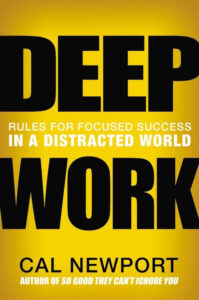
You’re going to learn immediately applicable techniques in today’s master class. So that’s the intention. There’s also attention. So, intention and attention. And of course, these two things together make for a great life. If you are distracted, if you are, let’s say, on multiple devices, or you have multiple windows open, or you allow your notifications to interrupt the stream, the flow state. You will be operating at a suboptimal level. There’s this thing called attention residue. I learned about this from a book called “Deep Work,” which was really impactful for me. So the idea here is when you take your attention off of your task at hand, maybe just check your phone for two seconds. Well, you saw something, you didn’t act on it, but now it’s occupying brain space. And guess how long this attention residue lasts for? About 20 to 25 minutes. So you have just been hijacked.
So please turn your phone off. Move it to another room if you have to have it on in case an emergency call comes in. But just be Indistractable. That’s actually a book, a really great book by Nir Eyal. I interviewed him on my “Get Yourself Optimized” podcast. Indistractable means you cannot be hijacked by someone else’s priorities, including those of social platforms. Right? So Mark Zuckerberg is not your friend. So let’s take this attention and intention and apply it to upleveling your business, your organization, your life, and someone you care about. Okay.
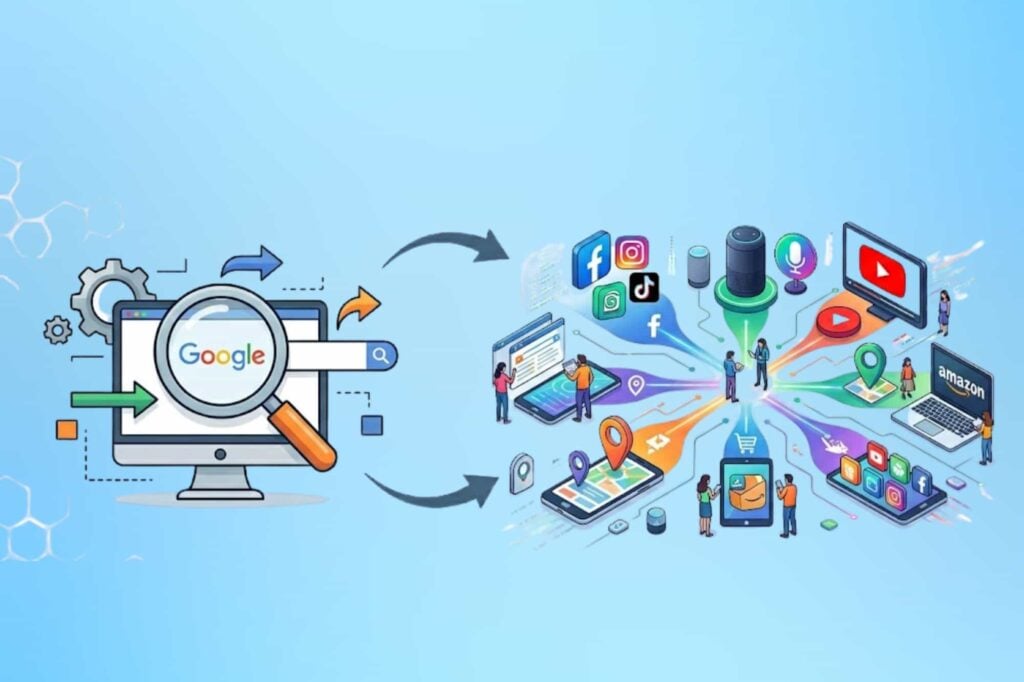
So with that, let’s start with a definition of AEO. So AEO (Answer Engine Optimization) isn’t really an evolution of SEO; it’s more of a component of SEO. And I like to reframe SEO not as Search Engine Optimization, but as Search Everywhere Optimization. Because people are searching on Amazon, on TikTok and on YouTube, and of course, they’re searching now on the LLMs, on the large language models, which include, of course, not just ChatGPT, not just Claude, but Grok and Perplexity, and there’s a number of these answer engines out there, and you should become familiar with the majors. Not just your favorite one or two, but you should be regularly using multiple of these. And I would say if you aren’t paying for a plus, pro or advanced account on at least two or three, you’re not playing at full capacity. Okay? And you also need to allocate at least 15 minutes a day to experimenting, playing, learning, trying new things in the answer engines, in the LLMs, because you’re going to get left behind if you don’t. Right? This is a pivotal time.
Vishen Lakhiani, founder of Mindvalley, wrote an article that was published a couple of months ago, and it’s like this 2026 is the last normal year. Or actually, 2025 was. Think about that. This is crazy to imagine, to kind of wrap your head around. But at today’s rate of change versus, let’s say, 100 years ago, it’s so much more rapid now. If we were to take the last 100 years and see today’s rate of change, how long the next 100 years would take in terms of technology, change and advancement, it would actually fit into the next 20 years, not 100. So you go back 100 years, and they were just inventing the toaster. You’d still see horses in the street in major cities. You’d see cars, too, the Model T or whatever, but you would see horses and buggies still. Not all the buggy whip manufacturers were out of business yet. Now, 20 years into the future, is going to be that different. But there’s a caveat, because today’s rate of change is not stagnant. It is continuing to accelerate. So this is the law of accelerating returns. It’s Metcalfe’s law, it’s Moore’s law. So Moore’s law states that computing power doubles or the price per computing unit halves every 18 months. Metcalfe’s law states that the power of a network is proportional to the square of its size. These work together in other areas as well. You have these huge leaps in advancement, like molecular nanotechnology, which is coming. Quantum computing, that’s already kind of here, but coming big time soon. So 20 years? No. 100 years of technological evolution will actually fit into the next 12 years.
Brian: Wow.
Stephan: 12 years feels like 100 years ago, but in reverse. So when you read online that they predict 90% of jobs will be gone, or 50% to 90% of jobs will be gone within three years, you cannot think linearly. That’s how our brains are wired, to think linearly. You have to think exponentially. So this is a tumultuous, pivotal time to be alive and to be in business. But it’s also an opportunity of a lifetime, of a millennium, of the history of the universe. This is amazing. So I want you to come with excitement and not fear. Fear is the dream killer, false evidence appearing real. And you know what another kind of fear is? FOMO. FOMO is another form of fear, because fear of missing out is still fear. It’s still the opposite of love. So when you have fear of missing out, you actually create the missing out. Now, this is kind of a spiritual, out-there concept for many of you. But if you think about this game that we’re playing called life, called reality, it’s rigged in our favor. And when we believe that we’re going to be missing out if we don’t do something or just because of the nature of the way things are, we’re going to miss out on stuff, then we will miss out on stuff.
But when we just trust and have faith in our higher power and the divine guidance, there is no missing out. The stuff that you’re meant to get, if you’re meant to meet somebody or to get some nugget of wisdom or whatever, even if you could only attend 10% of the event. I’m a member of Genius Network, for example. And there are times I can’t attend the whole event. And I pay a lot of money to be in the Genius Network. And if I had FOMO, I’d be concerned that, well, what if the stuff I could have attended on day two but I’m not there would have changed my life, would have changed my business? It doesn’t work that way. The people, the events, the things, it’s all a conspiracy in your favor. So just relax and trust. Do your 2%, leave the 98% of the remaining to your higher power, but you have to do your hard yards as well. That means taking notes, having your Remarkable tablet or your iPad or whatever handy, or pen and paper, because this is an interactive experience.
So we have AEO and GEO as subsets of search everywhere optimization. GEO stands for generative engine optimization. If you’re old enough to get this analogy, it’s like a Betamax or a VHS sort of thing or CDs or no, DVDs. There was Blu-ray, HD DVD or something like that. So this is another one of those acronym battles. And it looks like AEO is going to win this one. GEO is kind of an early leader, generative engine optimization. No. People are not using that as much. Okay. So why do you care about GEO or AEO? Because you want to be recommended by the answer engines and LLMs. So let me show you something, though, because this might shock you. I’m going to share my screen.
Brian: Stephan, how do you survive with only one tab open?
Stephan: I cleaned things up. The sign of a creative person is having lots of tabs open. But here’s the problem: if you keep that as a constant, as I cleaned things up before the master class today, you’re treating your brain as a warehouse instead of a factory. Because all that should go into a trusted system, a second brain, and be categorized, organized, prioritized, all the “ized.” So that you can be in a flow state, not trying to retain, like, “Oh, I got to pick up milk before I get home today.” This is not how your brain is best utilized. So, anyway, this is something that I think will maybe shock you. ChatGPT was all the rage, and now it seems like Claude is, too. But in the larger scheme of things, and this is recent from this year, ChatGPT has only 12% of Google search volume, and yet we have Google sending 190 times more traffic to websites. So we think ChatGPT is catching up to Google in terms of usage. But what’s the bottom line value if nobody’s coming to your site and nobody’s buying your product or service, right? So we need to keep this all in perspective. Google is still the biggest game in town by a landslide.
It is the most popular website on the planet, followed by YouTube. Also, it just happens to be a Google property, right? So if you want to invest in social media, actually invest in YouTube, because those videos, whether they’re short-form or long-form, have staying power. They’re evergreen, many of them, most of them. A 5 or 10-year-old video can still get massive amounts of views and watch time. Since when can you achieve that with Instagram, Facebook or TikTok? You don’t. Or LinkedIn. To really focus heavily on Google and YouTube, I know we’re here for the shiny new thing, which is AEO for ChatGPT and Perplexity and Claude and all that, and don’t lose sight of where the real money is. And you might think, well, eventually Google’s going to lose this race. I do not think so. You can quote me on this. If I were a betting man, I would put money on this.
See, who owns all the infrastructure, all the technology, all the know-how, over decades, on how to crawl, index, and continuously refresh the entire world’s website content at massive speed and scale? No one can match Google. Bing is a far cry from Google. And so if an answer engine tries to compete with that and build its own infrastructure, good luck. See, what happens is that most prompts typed into an LLM or an answer engine require grounding. What is grounding? I need late-breaking information. I cannot rely on your pre-training data or your old repository. Maybe for that rare query or prompt where I’m asking for something so basic and unchanging as the height of the Eiffel Tower. But most prompts require grounding, require going to the web and getting late-breaking information. And guess what the LLMs do instead of rebuilding all of Google’s architecture and infrastructure? They partner with Google, and they pay Google money. Bing’s a lot cheaper, but the quality sucks compared to Google, so they all end up going back to Google, even if they started with Bing. So who holds all the cards? It’s Google. So let me explain how it happens that you get grounding incorporated. Grounding, if it’s a prompt that requires grounding, how do the web queries get incorporated into the whole process? This is something called query fan-out.
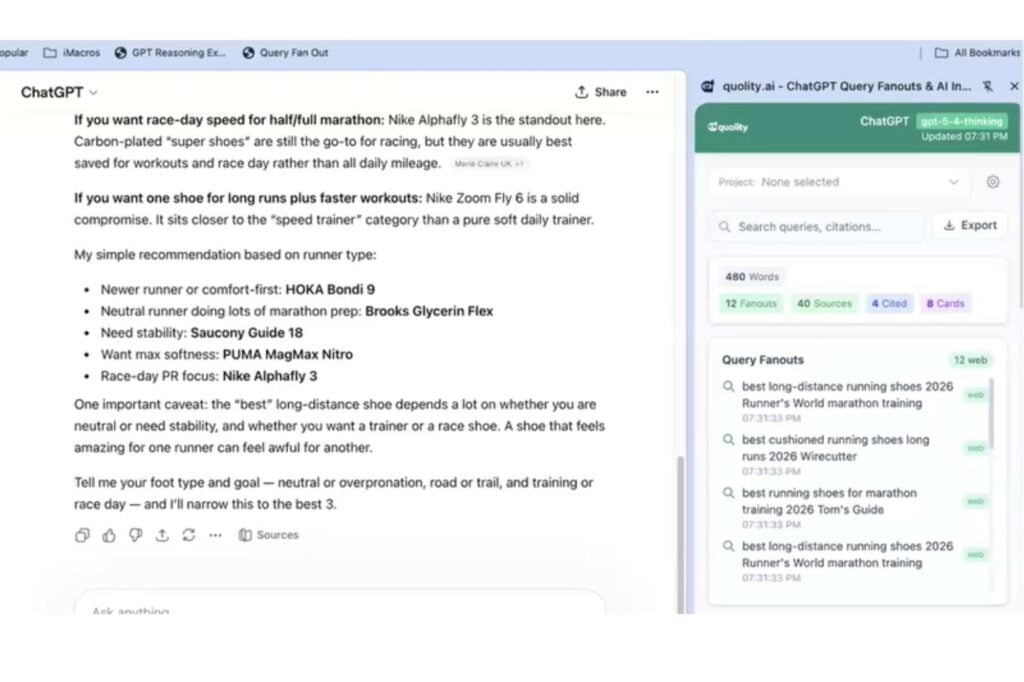
So if I go to ChatGPT, and this works with other LLMs, like if I were in Google AI mode or using Gemini, this query fan-out is a pretty common thing. So it means that for one prompt, one kind of expansive query that you’re typing in, the LLM will come up with a set of sub-queries. It might be just a few, or it might be more than a few, but those sub-queries, sometimes, depending on the LLM, and your technical abilities or the tool that you’re using, are available for you to see. So I just typed in “best running shoes for long distances.” So if I were to view the developer tools in the Chrome browser, I could go to the spot that allows you to see the information that’ll show you here. Don’t write this down. You don’t need to do this, okay?
Basically, what you’re doing is, I’m going to refresh. I copied the code or whatever, the slug part of this URL from ChatGPT. I copied it. Now I’m going to paste it in as a filter, and I’m going to take this one here. I’m going to click on that. And I’m going to search, and I’m going to use the Find command (Command + F), and I’m going to look for queries or query, quote, and then a colon. And then that’s how I can see the queries. Look at that. These are the sub-queries that are the query fan-out. “Runner’s World’s best long-distance running shoes.” I didn’t ask for Runner’s World. You saw my prompt. I may not even be a reader of Runner’s World, which is a magazine for runners.
How about Wirecutter? The New York Times has a brand and section of its site dedicated to product reviews. That was another query: “Wirecutter best running shoes long runs 2026.” Then “Fleet Feet best marathon training shoes 2026.” So this helps us understand what those sub-queries are and the query fan-out for an LLM like ChatGPT for a particular prompt we might be typing. But recognize that this set of sub-queries changes every time you rerun the prompt, and not everybody’s going to type in the same prompt as you. And even if they did, their history, the memory, the context, everything would be taken into account, and they would get a different output from ChatGPT than you would. Not only that, they will get a different prompt each time they type the same prompt. If they copy and paste that same prompt tomorrow, they get different sub-queries, different query fan-out, and different output.
Brian: Stephan, what you just did here was I just want to make sure I’m understanding, is that you actually kind of allowed us a peek into ChatGPT’s brain. I thought we were searching for shoes, but it was searching in places I had no idea about. Am I on track? Am I following?
Stephan: Yeah. If you’re a geek like me, you can do this sort of stuff. Go into Chrome Developer Tools. This isn’t just looking at the HTML. This is way beyond that because a lot of times you’re dealing with JSON-LD files and very techy stuff. So the best way to handle this is actually to use a Chrome extension, and you don’t have to even think about all this and how it works. You just use the Chrome extension, type in your prompt, hit go, and then all that detail shows up in the sidebar. So this tool, for example, I’ll give you a couple of them. So there’s ChatGPT Search Insights. That’s a free Chrome extension. Quolity.ai, don’t know how to pronounce that, but that’s another one. Okay? So these are two extensions. I’m going to focus on this Quolity extension. So the way it’s going to show up here for you.
So we’re going back and opening that extension. It’s going to open a sidebar. Okay? And nothing’s showing up yet because I had it closed. So now I’m going to reload this chat. And there we go. See that? The query fan-outs include the three that I already read. So the Wirecutter one, the Runner’s World one, there was Fleet Feet, that was in there, too. But now you can see there are other ones as well. You can have, as I said, up to a dozen or even several dozen, depending on which LLM we’re talking about, sub-queries. So when you understand what’s happening and how fundamentally different this is than a Google search, where people are typing in shorter queries, they’re not long, expansive prompts with dozens and dozens of words. There are some of those kinds of prompts put into Google as well, even when you’re not in AI mode. Google AI mode. But for the most part, they’re more similar to each other, and your rankings and the regular organic results tend to be more stable. The fact that you are an AI overview, cited source, or a recommendation tends to be much more stable as well.
So if you’re in Google’s AI overviews or in Google’s organic results, okay, so let me show you what that looks like. If we go to a new tab, go to Google, and type in, I don’t know, let’s say, Jay Abraham. So this is not coming from AI overviews. This is what’s called a knowledge panel, and it used to be just over on the right-hand rail of Google on the search results. Now it kind of spills over onto the top as well.
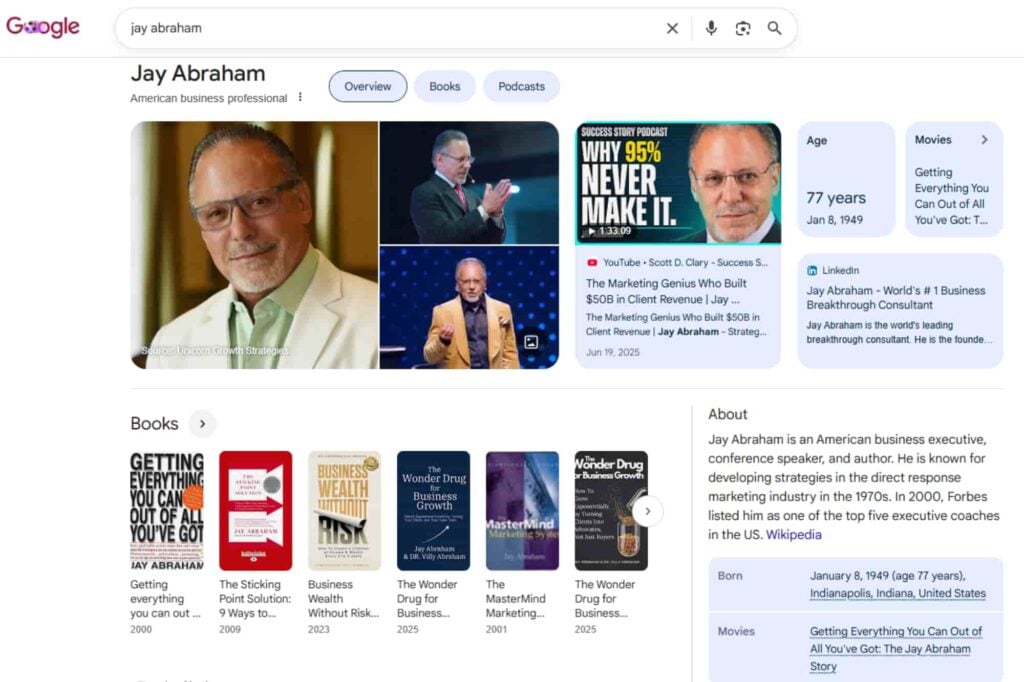
That’s really helpful to have if you have a Google Knowledge Panel. That definitely makes you look larger than life. So I’ll show you another one. This one’s mine. See that? So that’s a knowledge panel. It’s not an AI overview.
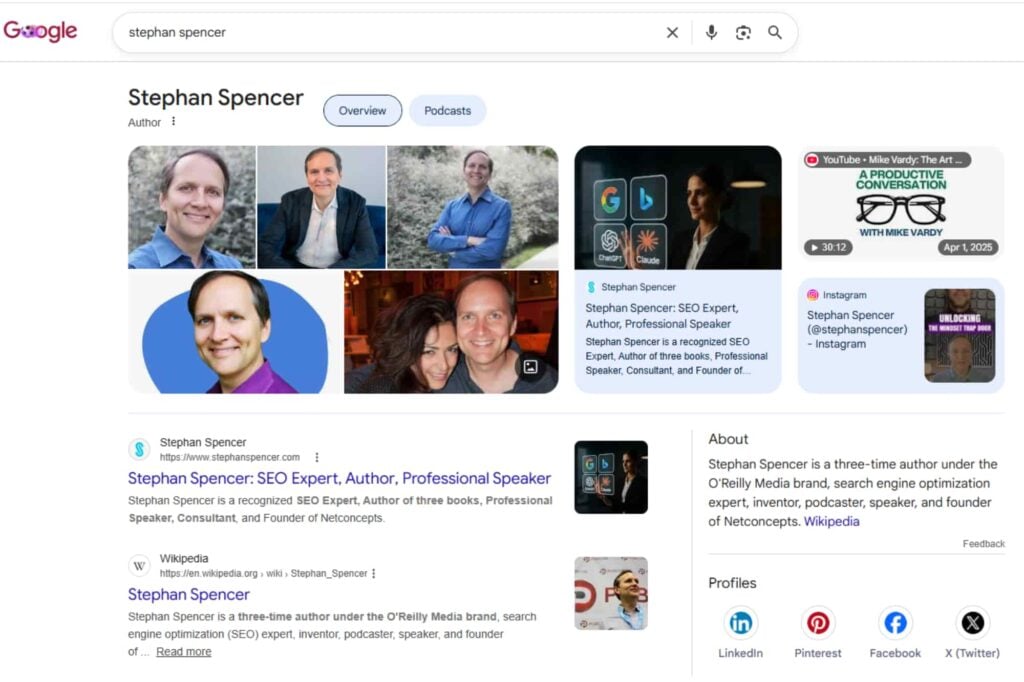
Companies, by the way, can also have Google Knowledge panels.
Brian: Stephan, there was a question in the sidebar here. How do you get a Google Knowledge panel?
Stephan: Well, the short answer and the short but hard way to do it is to get into Wikipedia. If you’re in Wikipedia with an article, almost certainly you’re going to have a Google Knowledge panel. So that’s the short answer. There’s a longer answer we could circle back on if we have time, where you can get visibility for, let’s say, a book you published or authored, and having your bio in Google Book Search can help trigger a knowledge panel. There’s a lot of nuance to this, so I don’t want to get into the weeds right now. I want to kind of stay focused. But great question. So, the short answer is to get into Wikipedia, which is not easy.
Brian: We can talk about that later, too.
Stephan: Okay, so curiously, these two examples did not have knowledge panels. Let’s try, oh, I don’t know, Netflix. Interesting. So it seems like Google has turned the dial down on companies having knowledge panels. It seems less frequent than person knowledge panels. But Google’s constantly testing and refining, so it may come back anytime soon. So let’s do one more. Name a company, like a favorite client, a brand or whatever.
Brian: This is to you, audience. Put a company or favorite… What was it, audience?
Stephan: A brand or a client of Jay’s or a favorite tool, vendor or something like that.
Brian: So we have been submitted to National Geographic, Nike, First Farm and Coca-Cola.
Stephan: All right. Let’s do National Geographic first. Okay. Yeah. So we’re not getting them. I’m curious. So you might wonder, well, how do I track these things that are coming and going, rankings and appearances in what’s called the People Also Ask box and things like that? Like, wow, this is a lot. This is a lot to keep track of. Well, you’d use a tool. You don’t do it manually. And what are some of the best tools out there? There’s Semrush, there’s Ahrefs.
Brian: Stephan, to avoid some panic here in the chat… Oh, can we get that link? We’ve done this before. Will you do this again this time and send out that list of links in case I’m not able to capture it fast enough?
Stephan: Absolutely.
Brian: Yeah. Oh, thank you.
Stephan: So stick it out to the end, because if you stay to the end, you will get a replay, you will get the list of links, you’ll get another cool gift, an actual book that I authored that you would otherwise pay for on Amazon. So all that’ll be at the end. And by the way, Brian, can you keep track of the time so we can make sure breaks are built in so people can have a bio break, a water break or whatever?
Brian: We can do that.
Stephan: Thank you. Okay. Because I tend to be in laser focus mode and won’t be taking a single break. But if you tell me to take a break, I’ll take a break. Okay. So this is another tool that’s kind of a gold standard in the industry for SEO and AEO. So these tools will track things like where you appear in the organic results on Google, whether you’re showing up in Google AI overviews, and whether you’re showing up in the people also ask box. Let me show you what that looks like. So we searched for National Geographic, and in the Google search results, the people also ask section has other question-based search queries that, if you click the down arrow, give you an answer. And the answer is like a snippet. It’s not an extensive, comprehensive answer. It’s a snippet, but you can click through to the website where it was sourced.
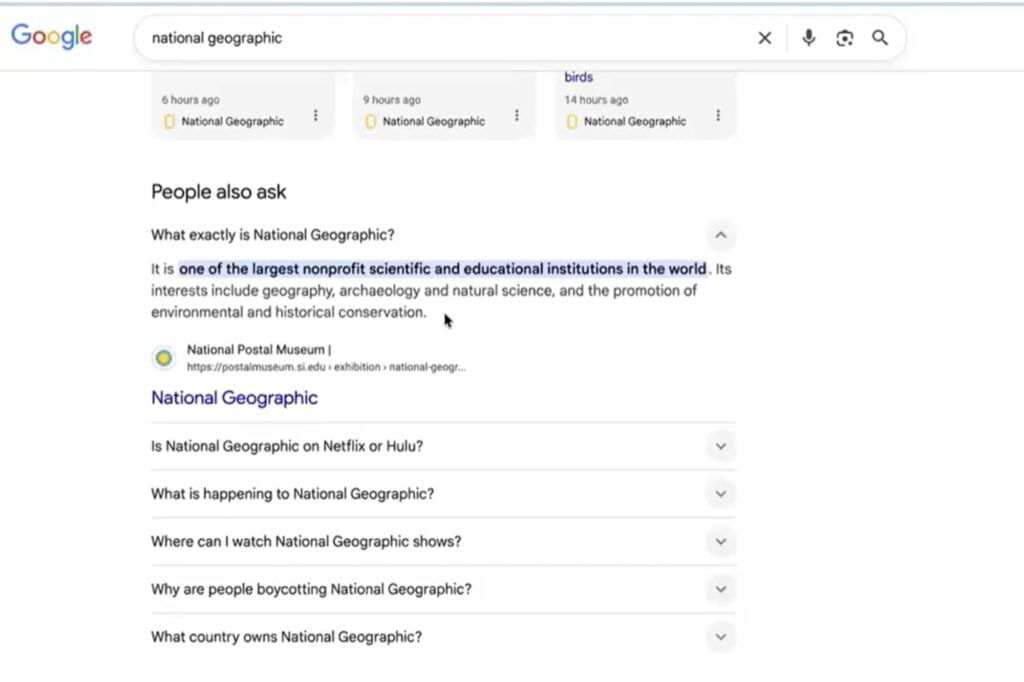
So this is all part of the mix. When somebody is maybe hearing about your brand for the first time, your company, your organization, from, let’s say, a trusted friend, they just got referred to you. What did they do first? They don’t go directly to your website. They don’t typically have your website URL. Even if they did, guess what they’re typing with that website URL? Guess where they’re typing that into? A Google search box, probably. So, the first experience, the first impression the prospect has, even after a referral, will probably be the Google search results. Or if they tend to be heavy LLM users, like ChatGPT users, it will be ChatGPT output. And whether you even know that referral happened is heavily dependent on what they see in that output, whether it’s from Google, ChatGPT, Claude, Gemini, Grok, Perplexity or whatever.
So you’ve got to control the narrative. You have to build brand awareness within this ecosystem. If you don’t like what shows up when somebody types in your brand name, like, well, that’s not really… Oh, there are mentions of some sort of SEC thing that we got a little bit in trouble for and da, da, da. And I’d like that showing up on page one in Google, or that’s getting incorporated. Oh, yeah, we mentioned in our K-1 filing, or we mentioned in whatever, and it ended up getting out onto the web and then incorporated into the LLM’s output that we had a tough quarter, or that we are bleeding customers, or that we are having to pivot or revise our strategy or whatever. And that’s right there in the first or second paragraph of ChatGPT. Why is this happening? Because you didn’t control the narrative.
If there’s an earnings call for your company, I was just talking to Jessica Bowman, another SEO and AEO person in the industry, yesterday. I was interviewing her on my podcast, “Marketing Speak.” And we’re just talking about this. She has clients who are big brands. I’ve worked for many big brands as well. Still, on a client or investor earnings call, if you talk about something being soft or the problems we are experiencing. These are not things that are being buzzed about on social media, on sites like Reddit and Quora and so forth, but you’re surfacing it, you’re shooting yourself in the foot. Because guess where all that revenue softness talk in your earnings call that gets recorded and transcribed and put on the web, and guess where that ends up? ChatGPT. So, control the narrative, and if you aren’t tracking it, I don’t know who actually said this. It was misattributed to Peter Drucker, but what gets measured gets managed. What gets measured gets managed. So if you are not using a tool, or you’re not using an agency that uses a tool like Semrush or Ahrefs.
These are gold standard tools that will allow you to track SEO and AEO. And by the way, if your SEO is terrible, guess what happens? You become invisible in AEO. Because all the foundational stuff that you should have done as far as the architecture of your site. See, there are three pillars to SEO, and these three pillars are pivotal, are essential for AEO as well. And these three pillars are the architecture, the technical side of things, the content and the links or links and citations. The authority. So if you have two of these, but not all three, you’re essentially trying to sit on a two-legged stool. You can’t pull that off. You have to have all three: the architecture, the content, and the links and citations. All three of those need to be very strong. And if you don’t, you won’t rank in Google, you won’t show up in the organic results, where people will actually find you, because they don’t go onto page six. Right? And you won’t appear in AI overviews on Google, or in answer engines like ChatGPT.
Because remember, most of these queries, I’m going to type in a prompt like, “What are Jay Abraham’s latest strategies for an AI-driven world?” I just made that up. I could type that into ChatGPT, but one thing I guarantee without even doing that is that that prompt requires grounding. It’s going to go to Google or Bing, whatever, depending on the LLM. It’s going to go fetch some web search results, and not just one, but a bunch of them, and assimilate that, aggregate that, analyze that, and come up with a cohesive, singular answer for you. But all that stuff happening behind the scenes is pretty much invisible to you unless you’re using a Chrome extension like I just showed you or another tool. And then you have what seems like the definitive answer, but it’s not. It’s got hallucinations in it. Do you guys know what a hallucination is? Say more. Yeah. If you think of a generative engine, an answer engine, as a sophisticated form of autocomplete, you won’t be wrong. Right? So, autocomplete, as you’re typing in a Google search query, we’ve seen this for many, many years; it gives some autocomplete suggestions underneath. Like maybe there’s 10 of them. Well, autocomplete also happens on a larger scale. And guess what ChatGPT is and all the other generative engines? They’re sophisticated autocomplete engines. So if I say to you, “Complete this sentence.” Maybe just the next word. “Once upon a…”
Brian: Time. Thanks. Spam.
Stephan: Right. So the predictive engine to figure out what would make sense as the next word and the next word and the next word and the next word, you think, “Wow, that’s pretty basic.” But if you amp it up to a vector space with an unimaginable number of parameters, it can sound like a human. It’s like, “Well, I’m going to pretend to be Jay Abraham here for a minute, and I’m going to tell you exactly what you should do with your failing business right now.” Do, do, do, do, do, do, do. And it’s like, “Wow, how did Jay get into that little computer?” He didn’t. The autocomplete pretended that it was Jay Abraham. Once upon a time. So if you don’t like the results that people are seeing when they’re typing in their prompts into ChatGPT when it relates to your brand or to your industry, genre, whatever, then you’ve got to take strong proactive action to fix your SEO, as well as do AEO-specific tactics and use AEO-specific tools.
So let’s take one of these three pillars. Let’s take content as an example. So let me get an example from the audience, and we’re going to go do hot seats in a little bit. I wanted to get this foundational stuff out of the way first, so you know the framing. So I need a website. I’m just going to do a quick little thing. So this isn’t like a full hot seat.

Brian: All right. So, put your website link in the chat. And if you can make it a live link, even better. So we have Roger coming up. Can you?
Stephan: Okay. So, all right. I’ll use Roger. Wow. Okay, let’s go to a product or service page. I don’t really have… Oh, yeah. Here we go, okay. So this is a game, and there’s not much content here. So this isn’t going to bode well for Roger in terms of SEO and getting this page to rank highly on Google, because there’s not much content on it. If I type ‘police simulator’ into Google, even though that’s the exact name of this game, it may not even rank well. I don’t know yet because I haven’t typed that in. But the idea here is that when you only have a couple of dozen words, that’s by definition thin content. I didn’t make up that phrase, nor did the SEO industry. That actually is Google terminology. Thin content. What’s thin? You hardly talked about the product. 20 words or whatever it is, 30 words? That doesn’t really give enough meat to Google to sink its teeth into to figure out what this is all about.
So, how do we build on that from an AEO standpoint? From a content angle, one thing you’ll see is that there are these TL;DR (too long; didn’t read) quick summaries at the beginning of longer articles. Now, this page is basically TLDR. That’s all there is, right? But if you had, let’s say, 1,000 words, you’d add a TLDR in front of it. Now, this is a product page. Product pages tend not to be as long as articles, but how would you expand that for SEO and for AEO simultaneously? Add frequently asked questions. So if you had frequently asked questions only on an FAQ page, you are missing the boat, because the answer engine isn’t looking at your website cohesively or comprehensively. It’s looking at an individual page, and it’s not even looking at the whole page. It’s kind of processing snippets, chunks.
So if we added an FAQ section to this product page, a landing page, a sales page or a service page, we’d now have a page on steroids that’s much more effective at AEO and SEO, especially if we’ve also simultaneously quashed some of the buyer objections in the process. Right? So these aren’t just how many players and what’s the release date and so forth, just regurgitated stuff as Q&A. No, these are the real-world buyer objection-type questions. So what does this look like? Well, let’s go to my site as a quick example, my personal site, Stephanspencer.com. We’ll go to, let’s say, my coaching page. And then these FAQs tend to be at the bottom of the page on most sites. So if you want a more extensive set of FAQs, you don’t put 10 pages’ worth at the bottom of your sales page, right? You could use a tabbed approach as I did here.
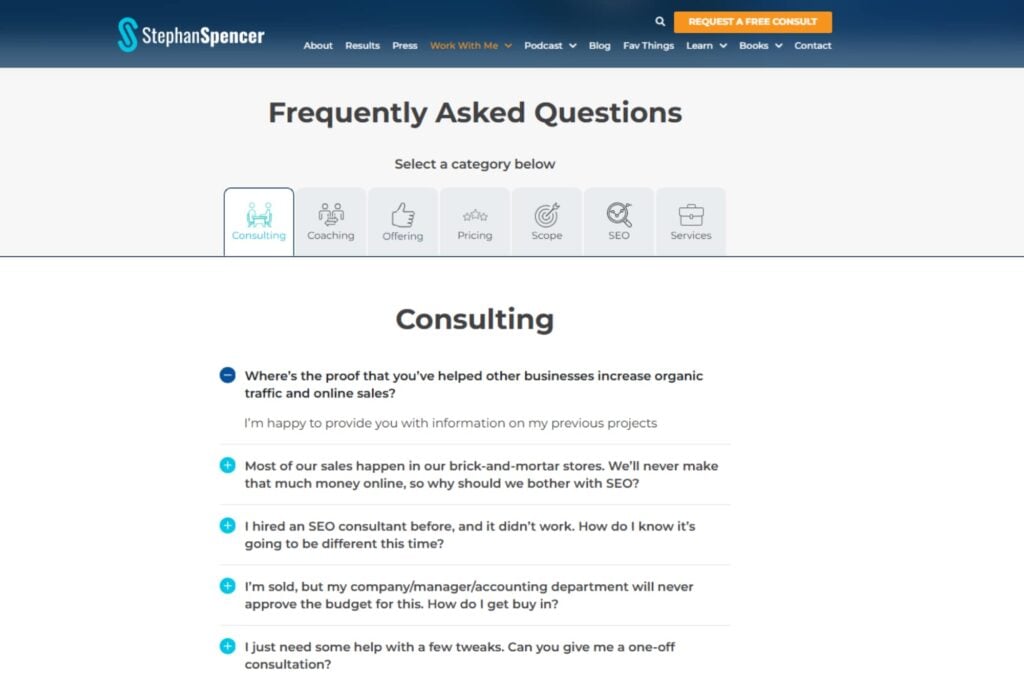
There are seven categories, including pricing, scope and services. And one of the common questions is, ” How much does it cost to hire you? Or how much does it cost to hire your agency, Stephan? And another question might be, well, you’re much more expensive than the other folks I’ve spoken to. What makes you different? What makes you worth it? So these are buyer objection-type questions. Nail these, and you’re much more likely to get the lead. Now, remember the scenario where a trusted friend referred someone, then Googled you, or ChatGPT’d you? Whatever that output is determines whether they pick up the phone, or they send that email, or they fill out that contact form, not what went on your website. That was if you passed the sniff test with whatever engine they used.
And now we’re heading into a world where you’re going to have a personal agent that is your representative, has your credit cards, has your authorization and a certain budget assigned to it. Like, “Hey, you can make decisions on your own AI agent for Stephan to purchase things for Stephan as long as these criteria are met.” And what is going to be more efficient for a personal agent with buying power and autonomy, with guardrails and constraints? To operate as you, it has your medical details, it has all the stuff that you trust it with, but not Mark Zuckerberg, not Bill Gates, not Elon Musk, and that personal agent negotiates, researches, buys, returns things, et cetera. It’s not efficient for it to go surfing around your website, clicking buttons, scrolling, zooming and all that. It’s much more efficient for it to work with another agent.
Brian: So Stephan, I’m just getting a sense that people are getting lost in the alphabet soup. A couple of questions led me to believe we need to get everyone re-engaged. So let me ask a couple of recent questions that have come up. Yeah. Someone asked, Andy asked, “Do you have any tips when vibing a website or landing page for AEO? And can you talk about what that is before you address it?”
Stephan: Yeah. So vibe coding is where you speak into existence; it’s kind of a metaphysical thing: speak a website or an app into existence, and you are not a coder. Okay. The problem with this is these websites that you vibe code, prompt by speaking or typing an explanation of what you want, and you’re not a coder, you’re not into HTML, you’re not choosing WordPress plugins and configuring them. None of that sort of stuff, you’re handling none of it. The problem with it is that these websites tend to look very cookie-cutter. Okay. And I think people can sniff that. You get a credibility hit. So, on previous hot seats, I’ve recommended Studio1 Design for web design. I’m going to plug them again because I love them.
These guys do not make cookie-cutter vibe-coded-looking websites. These are beautiful, highly optimized for conversion, and when we partner with the client together, which we’ve done dozens of times, then it’s highly optimized for SEO as well. Nice. This is what you need to do to take your web presence seriously. Now, to circle back for just a moment. You know the Wayne Gretzky quote, right? “Skate to where the puck is going,” Right? Yeah. Where’s the puck going? It’s not going to make websites even more interactive, engaging and fun in three years. We’re probably heading to a world where your agent mostly communicates with that brand’s agent and handles all its stuff in a short-form format. That we can’t really unpack, watch or understand. Right. But that’s okay, because we’re going to get the outcome that we’re after. Like, “I want a new pair of running shoes, and these are the things I care about. I’ve got a flat foot,” or, “I have a bunion,” or, “I have shin splints,” or whatever. “Handle it for me, agent.” You got it. Doing its thing, and you don’t need a website for it to do its thing.

But we’re not three years into the future right now. We’re thinking about skating to where the puck is going, but we’re also operating in 2026 right now. So we still need to care about our website being optimized for conversion, SEO and AEO. And so back to this idea here of this particular product page. Adding a well-thought-out FAQ section definitely beefs up the page for AEO purposes. So, his question was around vibe coding a website. My short answer is you can play with that, but that’s not for prime time. That’s like saying, “I’m going to vibe code an app and make it production level, and run a billion-dollar business off of it.” Today, that can’t happen.
Brian: And then the follow-up to you just mentioning the frequently asked questions. Is there a great way that people in the audience can do that? How can they identify better buyer-framed objections to address in their frequently asked questions?
Stephan: Yeah. Well, in prompt engineering speak, it was a term that was very popular a year or two ago. It’s kind of waned in popularity. But the idea here is that you want to get really good at prompting the answer engine, prompting the LLM. If you’re a great questioner, you’re going to get great responses. There’s a programmer term that’s been around for a long time. It’s called garbage in, garbage out.
Brian: Yeah.
Stephan: Right? But it also, I think, applies on the reverse, that gold in, gold out.
Brian: Ooh. I love that.
Stephan: So let me show you, speaking of Studio1 Design, something super cool that helps them get massive value and alignment from their LLM, from ChatGPT, Claude, et cetera. So this is a Google Doc, and they feed it as additional context. So give me a second. I’m going to pull it up here. This document is called a brand book. In this case, this is by far the most extensive brand book I’ve seen. I haven’t seen a ton of them, but look at this 109 pages. What’s the internal narrative going on in the buyer’s head? What are their hesitations? What are the disqualifiers? What are the risks? What’s emotional relief look like? It’s not just the demographics and psychographics of the ideal client avatar. This is 109 pages of absolute depth. How do you create something like this? It’s a lot of work, even though you’re using AI to do it. You feed it a lot of your internal documents. If you have sales call recordings and webinars that you’ve recorded, podcast interviews, or you’ve been on other people’s shows, et cetera. You feed all this data into the LLM, like Claude, and you prompt it to create a brand book, and you tell it, “These are the parameters, these are the things I’m looking for. This is the depth I want you to go.” Maybe even if you have an example. That always really improves the output, like, model this. Here’s a voice-and-tone guideline. Here’s a one-page marketing plan. Here’s a whatever. I want something like this, but tailored specifically to me and my business.
So this brand book, you feed it to, let’s say, Claude. You upload that, and then you provide the prompt that says, “Hey, reference this document and do your magic. Come up with frequently asked questions for this landing page. Come up with a set of videos that I should produce for my YouTube channel. Create an editorial calendar for my blog for the next quarter. Come up with a one-page marketing plan for 2026 for my company.” Do, do, do, do, and off it goes.
Without this, you’re kind of rolling the dice to see if it’s going to be hallucinated. In other words, just made-up answers. I’m sure you’ve heard horror stories of lawyers representing a client, only to cite case law that doesn’t exist because it was generated by ChatGPT, which made it up because it didn’t have it. So that’s a hallucination. So you might end up getting hallucinations. It’s about 10-15% of the time, and it can be as high as 30% of the time that you get hallucinations. So you have to fact-check everything and be careful and thoughtful with your prompting. But yeah, this is the secret sauce right here. This sort of stuff massively improves the chances you’re going to get a high-value response or piece of content from the AI. All right. Was there another question you wanted to surface from the chat?
Brian: Actually, what I was thinking of doing is, so I currently have it so that everyone can make comments to me. I’m opening it up to everyone, so you can respond to everyone now. I want you to capture something you’ve learned so Stephan knows you’re actually processing this, because it’s a lot to take in. So if you could respond to everyone in the chat right now and talk about one thing that’s really hit home for you. So I want to make sure we take a breath and start digesting, because you’ve shared so much, Stephan.
Stephan: It’s like drinking from a fire hose.
Brian: It really is. So I’m seeing people wrestling with Claude’s skills in auditing websites. You have to be multidimensional in your marketing efforts because a lot of these are still coming through just to me. Building a brand book, cool. Adding those frequently asked questions as content is a killer. Ahrefs, yeah … brand book. Lots of these brand books. Loved, if you’re not winning at SEO, you’re not going to win in AEO. Thank you, Myron. Basic idea, need to try things. SEO is the father of AEO. SEO is still important. So it looks like people are really getting it. A confirmation that Google is number one. Huge importance to SEO. What are some other things?
Stephan: Yeah. This is all great stuff. Yeah. So I heard a mention of Claude’s skills, so I want to surface this that I haven’t shared yet, but it’s a great resource. Eric Siu, an SEO and marketing guy, runs a competitor agency, and he released a bunch of marketing skills for Claude that I think you’ll find quite helpful. It’s publicly available on GitHub. And I found out about this because he posted about it on LinkedIn. So let me just recap some of the key points we’ve discussed over the last hour. Thank you. Things that we didn’t get from the chat. So there are the three pillars to SEO: content, architecture, and links/citations. All three of those have to be strong.
So when you’re using Ahrefs or Semrush —here, let me show you something. What was that website from earlier? Gosh. Was it Roger? Oh, yeah, Aesir-interactive.com. Here we go. Okay, I’m going to show you what you get from a tool like Ahrefs or Semrush so you can see how valuable it is. It’s not just kind of hypothetical. It tracks whether you’re showing up, with which keywords and positions, and whether you’re in the AI overviews or not, et cetera. So I’m going to put in the Aesir Interactive URL here. Put in the domain. I also do this on Semrush, so you can see the differences. A lot of similarities. One tool has the keyword gap analysis. Another one has the content gap analysis, and they basically do the same thing.
Right. But they are different, so they’re not just knockoffs of each other; at least one, I would say, or an agency with a subscription. So here you can see something pretty fascinating, specific to AEO: this box of AI citations. Ahrefs’ Brand Radar powers this. Now, Brand Radar tracks several hundred million, look at that, 357 million prompts every month, and it’s broken down like this. So ChatGPT, 14 million. Gemini, 14 million. Google’s AI mode, 38 million. Google’s AI overviews, 262 million. Perplexity, 14 million. Tracking and looking for citations, mentions of you, your company and your URL in the output.
So going back here to the Ahrefs dashboard for Aesir-Interactive. You can see that, out of the 14 million prompts it’s tracking, these are synthetic prompts. It made up the prompts. So it’s not real people typing these things in. It’s synthetic. Nonetheless, it’s a good indicator of whether you’re really visible or you’re pretty much invisible, and this looks pretty much invisible. Zero mentions, zero citations, with zero pages. And that’s the same with Perplexity, Google Gemini, and Microsoft Copilot. Aesir Interactive is mentioned a few times in the Google AI overviews. So if we’re typing in, I don’t know. I’m not saying they have a flight simulator; I’m just saying they have a free flight simulator. How to play a flight simulator. Trying to get a Google AI overview triggered. Here we go. So if you have visibility into the Google AI overviews, that will be tracked and reported in Ahrefs. And so you can see four mentions, which is an improvement of three. They only had one last month and three pages. Three pages, four citations, four mentions
So remember, what gets measured gets managed. If you have no idea whether you’re visible or invisible in ChatGPT, Perplexity, Gemini, et cetera, here’s your starting point. Backlinks, that’s where, if people link to your site from their blog, from their podcast website or whatever. Let’s say you were a guest on their podcast, and they link to your socials, they link to your homepage, and they link to the book that you authored. All that stuff will be visible to a tool like Ahrefs or Semrush. You can see what keywords people have typed in to get to your website. This takes a little longer to load.
I mean, the database, the massive amount of data that it’s churning, is pretty mind-blowing. So here you can see that pretty much branded keywords dominate. Only a few keywords that are not specific to the brand, the overall brand. Actually, I’d say all of these are brand keywords because they’re the names of games they’ve released as well. So if you wanted to show up for non-brand keywords as well, you need to see that you’re not ranking for them and you need to start targeting keywords, doing keyword research to identify which keywords and which prompts are the things that you’re going to chase after, and then start building content to match that. So this is Ahrefs. As I said, Semrush is very similar. Let’s see what that looks like real quick.
Brian: And there was a quick question. What are organic keywords?
Stephan: Yeah, so that’s the regular 10 blue links that are not part of the AI overview section or the people also ask box, or there are other kinds of what are called SERP features, search engine result page features, that will show up. Like you might have news items, shopping results or whatever that are kind of embedded little boxes. Mm-hmm. The regular organic results are everything but that, okay? It’s just the regular blue links. So if I’m searching for a flight simulator, I’m going to see Microsoft Flight Simulator, GeoFS, a Reddit thread and the Xbox page. Right? This video section doesn’t count as a regular organic result. This is called a video one box. The people also ask box. That doesn’t count either. That’s a separate thing. That’s a SERP feature, search engine result page feature.
Oh, let me show you a really cool free tool, which has a little freemium, kind of a little $10 a month thing that you can pay for more usage. But it’s a tool called AlsoAsked. I love this tool. If I wanted to type in– Someone give me a keyword in the chat. Something related to your products or services, your industry. Okay. Let’s use… Oh, this is a fun one. Funeral. Don’t take the fun out of a funeral. I just made that up, by the way. Okay. So let’s not go to the UK. Let’s do the US. And I’ll refresh this here. And look at this. It’s like a beautiful-looking tree graph here, and I can zoom in, and I can zoom out. I could click one of these, and it would recenter on that question, and then all these other sub-questions would come up.
And you might wonder, well, how did this come about? Well, it scraped Google. If I go to search Google for funeral, and I check the People also ask box. Oops. I know that guy, so that’s why. All right. So yeah, we got an AI overview. We got organic results. We got a people also ask box. Check this out. I start expanding the questions to see the answers. Do you see what happens? They get bigger. They add more. It’s an infinitely long list. Is there a nicer word for funeral? That was never a question I’ve ever had in my entire life. Do they remove teeth before cremation? Okay, this is getting dark fast. Let’s move back to the tool. Okay. People also asked: “What powers this tool inside the Google results?” So it’s scraping that and putting it into a beautiful visual hierarchy, like a tree structure or a flowchart. I can also download it to load into Google Sheets or Excel if I, for example, come up with an editorial calendar for my blog, YouTube channel or social media, based in part on this research. Like, what questions are people asking?
How can I address those on my FAQ page? How can I address those on my blog and on my YouTube channel? This is such great fodder for planning your content and enhancing your content. Okay. So, Semrush, let’s go back to that for a second. We have a similar layout here with an AI section. Right? Brand Radar from Ahrefs, and here is Semrush’s AI search version of it. We don’t have as many of the engines being tracked. We don’t see Perplexity here, for example. But we do get a sense of whether there are mentions and citations. So, just to distinguish here, the ways that you can be talked about on a platform like ChatGPT.
One is a citation that includes a link. People can actually click on that link and end up on your site. So that’s a citation. Another is a mention, an unlinked mention, so that’s another way. So they’d have to copy and paste or type your brand to reach you. They can’t just click on it. Another is that they actually stripped your name out of there, or stole your content without attribution, so “Hey, those are my words,” or “That’s exactly what I say about this topic.” ChatGPT just basically lifted it without attribution. So that’s another way, you get paraphrased.
Brian: Stephan, Robert was asking, why is there a difference between Ahrefs’ LLM mentions and Semrush, as not being different for the same client?
Stephan: Yeah. Because they’re going off different databases. Okay. They’re building a database of synthetic prompts, scraping outputs from various answer engines, tracking them over time, and they’re not the same. Three hundred fifty-seven million prompts for Ahrefs, you don’t have the same prompts, and it’s not the same number of prompts, and it’s not the same engines. There is some overlap, but yeah. That’s why, as you can see, I have two tools.
Brian: Right.
Stephan: I don’t just rely on one tool. Sure. Yeah. All set. And so you can see here, going back in time, how things have progressed. You can go to All Time. This is organic traffic. If I turn off branded traffic, I can just see organic traffic in blue, and there’s no paid traffic, so they’re not doing Google Ads. So that’s the overall time if I go to two years, a little bit of growth, but not much. Pretty stagnant over the last two years, and very small traffic numbers. So if you contrast that with, here’s one of my clients who is a top 3,000 website in the world. They’ve been a client continuously since January of 2017, and as you can see, there’s been massive growth. When we started working with them in 2017, they were at two million. Now they’re at 13. Now these numbers are estimates. They don’t jive with Google Analytics and Google Search Console. Those are much more reliable numbers. But for a third-party tool that’s estimating the stuff, that’s pretty darn good. But again, I’m looking for a corroboration between the tools that, hey, this is a trend that really is real, so I’m seeing it in both Ahrefs and Semrush, and that gives me some level of confidence even if I don’t have access to their Google Search Console or their Google Analytics. By the way, Google Search Console, if you’re not familiar with that, looks like this. Now there are many features.
I’m not going to go into all the weeds, all the details of it. But you can see the top queries for a particular time period. You can see the top pages for a time period, top countries, top devices, etc., and can filter. You can say, well, for this particular… This is a podcast interview I did with Peter Antoniou, who is a pretty popular mentalist. He did really well on “America’s Got Talent,” I think. Anyways, if I click this, I’ve added it as a filter criterion, and now, when I look at queries, all the queries are specific to that particular page on the site. And this is real information from Google. This isn’t made up, synthesized or estimated by a third-party tool. This is the real deal. So whenever you have Google Search Console access, you have a new level of intel. But that’s only if you’re an agency and this is your client, or it’s your company, and you’ve signed up for Google Search Console, which is completely free, by the way. And I’m just scratching the surface. There’s so much capability in this tool, Seth. It’s really awesome.
Brian: So Stephan, I’m going to pump the brakes because we’re approaching the 90-minute mark, and most people need a break by now. But I do want to mention some things because I saw a few questions about where to invest, and I’m going to break this down for you. The best place for you to invest is with Stephan Spencer. It does have a sizable investment, but that gives you access to all the tools he’s been working on to put in your favor, without you having to go through all of these steps to do this. And yes, the next best thing is to actually pay for some of these tools. Make the judgment call of which is better for you: Semrush or Ahrefs? That’s your call. But investing in these tools will give you access to their robust nature. So it’s worth making some investments, but really, that’s your call.
The last tier is to look for free tools. But trust me, that anything is better than nothing. So even if you just do a few things from today’s event, of creating a back link or just adding some frequently asked questions to every page on your website, those things will organically strengthen your site so that more eyes are getting there, and hopefully more buyers, and those buyers are going to give you the budget to invest more. So I hope that one insight from today makes hiring Stephan make tons of sense for you, so you don’t have to do all the purchasing, investments and factoring of all these things. But with that, I’d like to give you guys, what do you think, five, 10 minutes, Stephan?
Stephan: Let’s do five minutes.
Brian: Okay. Let’s do five minutes, then come back. I’m going to open this up again to everyone, so please capture an insight in the chat: something you’ve gotten from today, some value, a tool you’re going to apply, and maybe a question. So I need to take a break. I know Stephan may not. So I’m going to close off my screen, but make sure that you come back refreshed. But process. Really, this is your moment to digest some of what you’ve gotten, and it’s okay if you feel like you’re in alphabet soup because there are a lot of acronyms. Take a breath, and we will come back here on the Pacific Coast. I’m going to say [10:36]; we will be back, engaging with AEO, and so much more. All right. Let’s take a break, and so that’s five minutes. In five minutes, I’ll see you in the chat. Starting a little while ago. All right. So I’ll see you in five. If you want to play some Jeopardy music, you’re welcome to do that. All right.
Stephan: I’ll go off camera myself as well and do a little stretch break. Thank you.
Brian: All right. Start coming back into the room. We have a minute to go. Bring your tea, coffee, snacks, pens and notebooks. So Stephan, I did you a disservice. I talked about how awesome it is to work with you and how it would save people time by giving them a shortcut to getting all of this done. How would someone actually go about doing that? No. Which one of your sites should I send them to?
Stephan: Okay. Well, thank you. Stephanspencer.com is a great one. My agency is called Netconcepts, so they could go to netconcepts.com as well.
Brian: All right. So there it is in the chat. Give that a look. And after this, really, I highly recommend going to his About page because it really is a little bit of a history of all things SEO, and it’s a fun read. Getting to know Stephan as a human being is nice to see, because we’re talking technical today, but there is a really cool man behind all the acronyms. So, I highly recommend, even if you don’t invest in a consult with Stephan, that you get to know him as a human being, because he’s super cool.
Stephan: Oh, thank you.
Brian: You’re welcome.
Stephan: So, this is actually a good kind of best practice for About pages, and I have to give credit to Studio1 Design, and in particular, the founder of Studio1, Greg Merrilees, for this idea. It’s a timeline. If your About page doesn’t have a timeline, you are missing out.
And this is also helpful for AEO, because we want to provide a lot of detail to the answer engines about us, our history, our milestones, and our hero’s journey. Plus, people buy from people whom they know, like, and trust. And if they can get to know you and they find commonalities, the unity principle of the principles of influence, Dr. Robert Cialdini‘s work. If you have someone rooting for you, like, “Oh, wow. I can’t believe he overcame those obstacles, and punched above his weight and did all these cool things from humble beginnings,” whatever, they feel resonance and relatability, and that helps them to want to work with you. So this is an approach I highly recommend using a timeline. So this is my timeline. If you want to see another example, this is my wife, Orion’s, website, on her About page. She actually has two About pages. One is for her personally, and then one for her Orion’s Method.
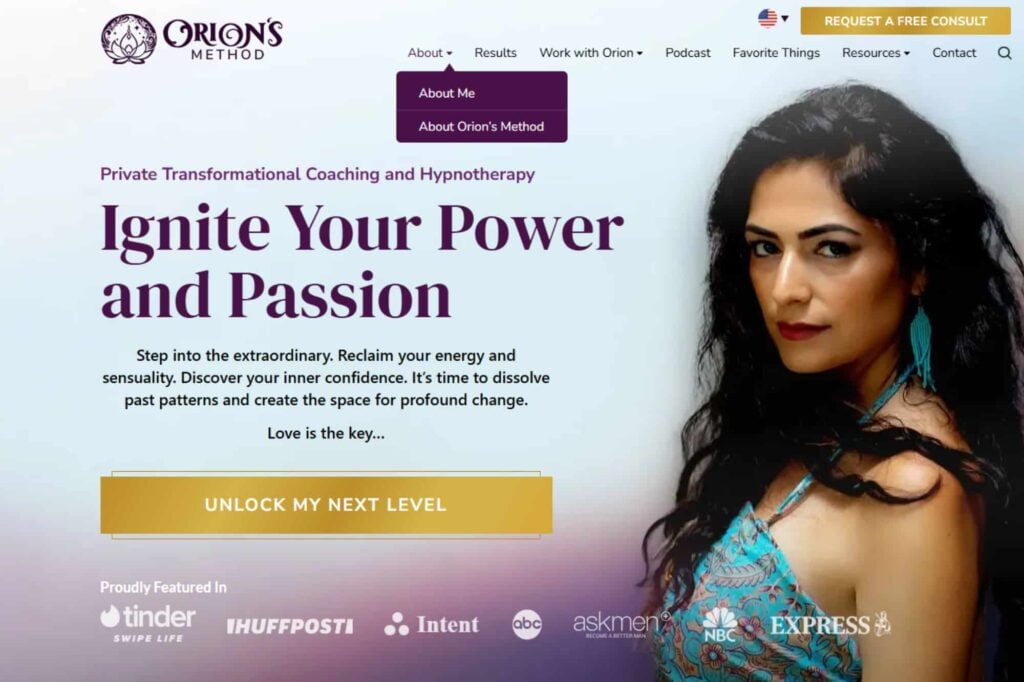
So let’s go to her personal About page. And as you can see, a similar timeline format, but with a different style and flavor. So highly recommend doing something like this, not just for personal brand, but for your company as well, so that they get to know that hero’s journey story arc. How did the founders go from scrappy to multi-millions? Oh, and one more thing related to this is when you have a page like that, not just a stub, a thin content About page. When you have something really extensive like this, then you can feed it to an LLM like Grok to make a Grokipedia page for you. Grokipedia, if you haven’t heard of it, is Elon Musk’s competitor to Wikipedia that he and his team at Grok created. So I have a Grokipedia page that’s quite extensive, and I didn’t have anything to do with it. And the reason why it got created automatically was because I’m on Wikipedia. So, if you want to see my Wikipedia page, it’s much shorter. So that’s it. Cool. Whereas the Grokipedia page, much more extensive, I think, more interesting, with more references, more, I don’t know, more of the human element, ironically, even though an AI wrote it. And it’s surprisingly easy to be notable enough to get into Grokipedia. There’s a lower threshold for Grokipedia notability than for Wikipedia notability. It’s very hard to get into Wikipedia. So let’s, just for fun, let’s see how this works. So Brian, you’re not in here.
Brian: Right.
Stephan: If we Google you, you have a website. But we want to look for notability. Just because you have a website doesn’t mean you have enough money or resources to maintain it. Doesn’t mean that you’re notable.
Brian: Right. And I’m only one of those faces. I have beard envy, I’m telling you.
Stephan: So this isn’t you then?
Brian: No, it is. I’m still working on it. Don’t look at that. It’s embarrassing.
Stephan: Okay, never mind.
Brian: I don’t have one of those special pens that the men in black have.
Stephan: Right. We can’t get it.
Brian: The cat’s out of the bag, I think. Right.
Stephan: It’s okay. It’s all good. Okay. But if I find some podcast interviews, for example. If I find some feature stories about you, they don’t have to be in “The New York Times” or anything. It could be on really easy-to-get sites like IdeaMensch. Hmm. It’s basically pay-to-play. And then they interview you, and it’s actually a pretty interesting read. And you feed Grokipedia these items, maybe it’s only a half dozen of these things, and there you go. You have a Grokipedia article created by Grok from that content, whatever else it finds online. But you’ve got to give it the starting point. It’s especially important to find these sorts of resources, like the podcast interviews and the feature stories, the media mentions and all that, and feed that all specifically into Grokipedia if you don’t have a press page. So best practice really is to have a press page, but not everybody does. Here’s what a press page could look like.
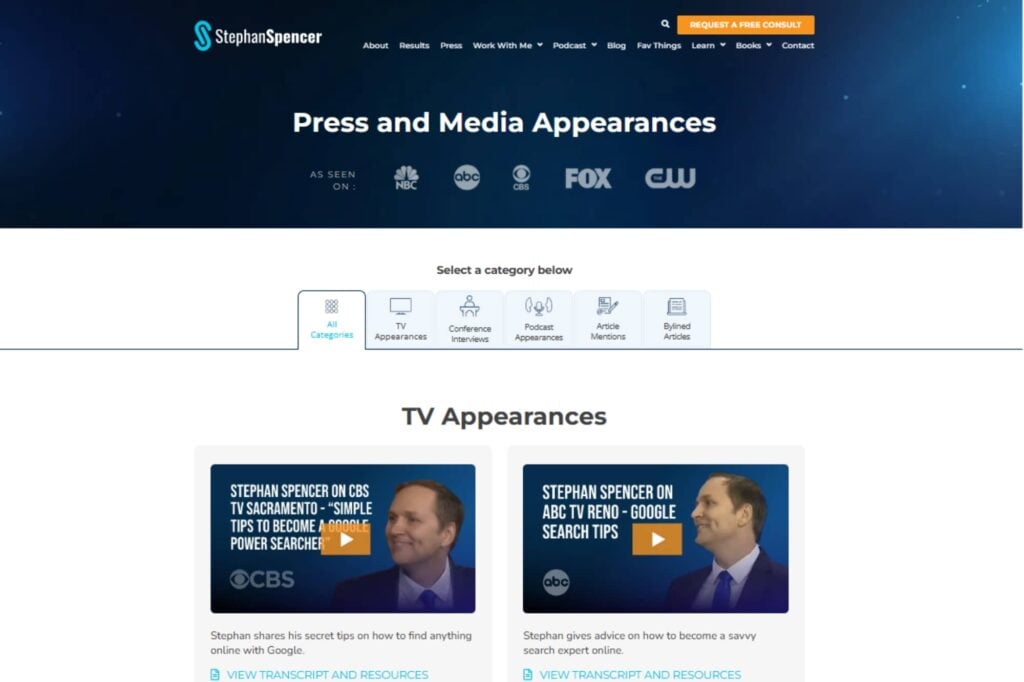
Because I have TV appearances, as well as going to speak at a lot of conferences, and I’m on a lot of podcasts and so forth. And this technically isn’t press being published as a columnist, but I included it anyway. Because I got in the “Harvard Business Review” with an article I wrote, I wanted to put it there anyway, even though technically it’s not press. The article mentions podcast interviews, conference interviews and TV appearances. And for AEO and SEO purposes, I actually took the transcript of each of those videos, like the TV appearance and turned that into a long-form article. And this was a very short TV appearance, so that was three minutes or something like that. So there’s not a lot of content there, but this is the transcript, and it just reads like an article, and of course, with an embed of the YouTube video. So this is great for AEO and for SEO. Instead of just saying, “Here are some appearances,” I’m giving the crawlers a lot of fodder to process.
Brian: So Stephan, if somebody submits a research paper or article or they have a Substack thing, how do you amplify that so it’s more likely to actually get on those crawlers?
Stephan: Yeah. So let’s talk specifically about Grokipedia for a second, then we’ll go broader. Let’s use an example. Is Robert from Telecom4Good on the call?
Brian: Yep. I saw him earlier. Robert, are you still on? If so, just type yes in the chat.
Stephan: Yeah. If you’re game for me to, in real-time, create a Grokipedia page, either for you or for your brand, Telecom4Good, then give me a yes on that, and then we’ll do it.
Brian: You got the yes.
Stephan: Okay. So hi, Robert. Thanks for playing. So let’s do this. So first, we’re going to go to Grokipedia and make sure that you are not already in. Probably you aren’t. So there’s a Robert Anderson, but it’s not the same Robert Anderson. Let’s see.
Brian: Is that the one from “The Matrix?”
Stephan: You are on fire, Brian. Hey, let’s have fun. Yeah. Okay, so this is a different Robert Anderson than Telecom for Good. So we’d have to create Robert Anderson, entrepreneur, or what would you prefer? An entrepreneur or a…
Participant: Entrepreneur works. I’ve owned many different companies. Okay. Started and founded.
Stephan: Okay, perfect. So let’s suggest to you, Robert Anderson, entrepreneur, to differentiate from the playwright that we just saw. And then here’s where we help the AI figure this out, that you are notable. Going to put in your brand, Telecom4Good, and we’re going to type in a podcast. We’re going to type in an interview. We’re going to type in… All right, another thing we can do is put this into Google News, so news.google.com, and then search for your name in quotes and see if you.
Participant: It’s me, though.
Stephan: That is you?
Participant: Oh, that was me.
Stephan: Oh, wow.
Participant: I’m at a conference in Africa, in Senegal, and we were talking about this, and they interviewed me.
Stephan: Nice. Okay. That looks legit. Good job. Okay. So we’re going to add… Let’s see, where would be… Okay. We don’t even have to include a synopsis. We could say the founder of Telecom for Good, but we don’t have to because it’s going to figure that out. We could provide content in the form of paragraphs and other things, but it’s unlikely we’ll be used. It might. So it’s as simple as just providing proof of notability. So we’re going to do that here with podcast appearances. So that’s a different media mention. That’s cool.
Participant: That was a great guy.
Stephan: Oh, okay. So you wrote a testimonial.
Participant: Correct.
Stephan: Okay. So that doesn’t really help you with your notability, so we’ll skip over that. Is this your YouTube channel?
Participant: Yes. Wait a minute. Another one. I would’ve clicked on it. Thought it said something about Cisco Meraki underneath it. Results with Telecom4Good. No, right above it. In that same one, Robert, there’s a link in the bottom right-hand corner, right underneath Remark. That one.
Stephan: Okay. But, yeah.
Participant: That’s probably not what you’re looking for.
Stephan: Yeah, I wanted to see if you have a YouTube channel or not?
Participant: Telecom4Good does, but not myself, no. That’s me, too.
Stephan: And this one?
Participant: That’s a company we started for an AI assistant for websites.
Stephan: Okay. Even though this isn’t really for notability, I’ll put it in there anyway. Do you have a personal brand website? So when you were talking about the brand earlier, no, I don’t. I was actually utilizing, um, Clock to help try to create one for me.
Stephan: Okay. All right. Well, that’ll be a good thing to do. But for now, let’s find… Is there a page about you on Telecom4Good?
Participant: On the About page, yeah. It should be at the very bottom. Goes through the journey, which you were talking about before.
Stephan: Okay. And this website.
Participant: actually was built by the people you recommended.
Stephan: Okay, cool. So here’s your little bio. Put that in here as well. Were you on any podcasts?
Participant: No, not that I’m aware of.
Stephan: Have you ever been on a podcast?
Participant: No.
Stephan: Okay. Well, I recommend it.
Participant: You’ve told me for a million years to do it, and I haven’t done it, and I apologize.
Stephan: So has Jay. Okay. Well, you know what they say: the best time to plant a tree was 20 years ago. Yes. The second-best time is today. Or, since we’re in the middle of a seminar right now, how about you start setting something up right after it finishes?
Participant: I’ll do that. I need to do that.
Stephan: You can get your AI agent to do that for you, you know?
Participant: Yes. That’s true.
Stephan: It’ll even build you your dream list of all the podcasts and things you should be on, collect all the… Tell it to build a spreadsheet of all the metrics that you care about, like how many Instagram followers, YouTube subscribers and how many reviews on Apple Podcasts they have and then on Spotify, what the website URL is for the podcast, the description of the podcast, name of the podcast, all that sort of stuff into a big spreadsheet. And then it can prioritize the list for you and say, “Start with this one. These are highly relevant, and they’ve got good reach, and these would be the lower priority ones on the list.”
Participant: Awesome. Thank you.
Stephan: And you can start hitting them up, or have your AI do it, right? Pulls the contact details from the web, puts them in the spreadsheet, and then you could tell your agent to go and do the stuff. Go draft the emails. Let me see the first one before you send it, and then go ahead and use the unity principle and other principles of influence to get a response, a positive response. And then it’ll bake that into the draft, and then you can have it send all the emails.
Participant: Thank you.
Stephan: Okay. So I don’t know if this will be sufficient. We’re short on time. I would’ve spent more time if this were like the client situation, or whatever. Yep. I’m just going to hit Submit and see if it meets the notability threshold. I didn’t give it much to work off of, but I gave it a little bit. So I’d say there’s less than a 50% chance it’ll actually create it from that, but we’ll see. It takes about an hour. We can see the status. By the way, Grokipedia, you don’t have to set up a brand-new account. You can just log in with your Twitter or your X account. Log in, then start suggesting articles and edits to existing articles if you want. And once your article is created, you can suggest edits and additions. And you don’t have to worry about conflicts of interest like with Wikipedia.
A very strict set of Wikipedia guidelines around conflict of interest. You’re not allowed to edit or create pages on Wikipedia that are related to you and your business or to an employee, or to have an employee, a contractor or an agency create a page for you or edit a page about you or about your brand or about your industry to work in a link to you. Like all that’s forbidden. Very strict guidelines around that. And they will hunt you down. They come with pitchforks, these Wikipedia zealots. Grokipedia, because Grok is writing it, they don’t care. It’ll decide whether you’re notable. It’ll decide whether you’re a good guy or a bad guy. So there’s no conflict of interest.
Participant: Really cool.
Stephan: So we go here to Your Activity, and under Article Requests, you can see that it’s currently in review. So this is pretty light. I would’ve done a better job if I had more time, but as you can see, I’ve had a really good hit rate with creating articles. Rarely do I get rejected. Like this one, I got rejected. Joel Weldon is a friend in the Genius Network. I cited him as a co-founder of the National Speakers Association, but that was not correct. Technically, he was a founding member, so I got rejected for not being accurate, an inaccurate claim. He was a charter or founding member. Okay, so I resubmitted, and you can see this is not that long. That’s all I needed to provide. Oh, no. Sorry, that’s not the one. There’s Joel. Look at that. Just changed it to a founding member of the National Speakers Association, a Hall of Fame speaker, and so on. So that created this article. How cool is that?
Brian: Pretty cool. And someone was asking earlier, can you edit Stephan? And if you look in the upper-right corner, it says “Suggest Edit.” So that is how you would go about editing things.
Stephan: Yeah. Or you can just highlight the thing that you want to edit. Oh, okay. So let’s say that we wanted to change the 48 years to 50 years. I can highlight the 48 years. I can click on Suggest Edit because now that’s highlighted, this little tool tip shows up, and then I can suggest 50 years instead, if that’s correct, and provide my supporting source. And if his article is referenced, you can see there are two footnotes here. One of them is his About page on his Joel Weldon site or Ultimate Speaker site. If I tell him, “Hey, change 48 to 50 on your About page and then tell me when you’re done,” and then I’ll submit the edit to Grokipedia, it will get approved because I will mention it in that edit request. If I highlight this and then suggest the edit, there’s the summary of what I want: change the number of years from 48 to 50. I can provide the exact edit to make: instead of 48 years, delete it and change it to 50. Then I can provide the supporting source, and put the URL of his About page here after he’s made the edit. Super simple. And then it does its magic over the course of minutes, and then it’s changed. So we don’t know yet if Robert’s going to make the cut, but we’ll check back here in another 30 minutes and see. Thanks, Robert, for playing. And yeah, that’s basically the process. You can do this for a company. You can do it for a person. You can do it for a book or a podcast.
So my wife, Orion, I got her not just Orion Talmay, which is her name. I also got her in with Orion’s Method, which is her brand. And as you can see, these are extensive pages. Really cool. By the way, a tip to make this even more effective is to link to your Grokipedia article in your footer, so it gets indexed by Google and ranks in search results for your brand, hopefully. So we have Orion’s Method. We have Orion’s World. That’s her podcast. Yeah. Some of her guests include Dr. Cialdini, author of the book “Influence.” And then I think I got one more for her. Maybe that’s all of them. Anyway, I linked all that. You can see how it works if you. This is my client, with 13 million visits per month. And you can see that we have a Grokipedia? Oh, I think it’s in the Content Pages section. Yeah. Think Grokipedia.
So that helps him make sure Google indexes this and shows up in Google search results, because otherwise, who else is going to link to his brand’s Grokipedia page if he doesn’t? So this is a two-step process. Create the article for you in Grokipedia, and then link to it.
All right. So let’s start doing more hot seats here, where we try out different aspects of AEO and use different tools. Okay. So you can put Robert back into the regular part of the room, and I’m going to pick… Thank you, Robert, by the way. I’m going to pick, let’s see. Okay, we have Maria and Chad, co-founders of United Tiny Homes. Are you guys here?
Brian: I see a Maria
Stephan: Oh, yeah. You raised your hand. Okay, awesome. Thank you, Maria. So we’re going to put you on the hot seat.
Brian: And Maria, you can unmute yourself. Okay. There you go.
Participant: Let’s see if we come on screen. No, there we go. Doesn’t matter. Okay. I’m very nervous, by the way, after listening to you for the past few hours.
Stephan: Well, then I’m nervous for you.
Participant: There’s a lot there. So, we love all your information. There’s some great depth we’re looking to explore further.
Stephan: Awesome. Well, thank you. Okay. So first off, I’m having a weird technical glitch. I can’t really see your homepage.
Participant: Well, that’s weird. Yeah. Oh yeah, it’s dark. No, it doesn’t come out like that. Interesting.
Stephan: Yeah. So something wonky is going on. Yeah. Uh. So this might have- Well … something to do with an interstitial or some sort of pop-up that has
Participant: Actually, I just did it. Mine came up fine. Yeah. We’re in it. Yeah, there is a pop-up. That’s right.
Stephan: So that pop-up might not work on all browsers. I’m on Safari.
Participant: Oh, yeah. We do it on Chrome. Yeah. Oh, there you go.

Stephan: I have a look and see if that works fine.
Participant: Oh, there he is. Yeah.
Stephan: Got it. It’s working now, but if this happens to anybody else, that’s not a good look.
Participant: No, that’s not a good look. Okay. I’m going to remind them.
Stephan: Okay. So let’s think about this from both a conversion and an AEO/SEO angle at the same time, because we want to make sure it’s a good experience for a human when they come to your site. Right. And not only do we want to not have any glitchy stuff happen, like not being able to see what’s happening in the homepage content because of the black background or pop-up thing that failed to load correctly, but we don’t want to hide the high-value content and all the social proof and everything by a big pop-up that they’re not ready for.
So I’m not a big fan of an immediate pop-up, like a timed pop-up with a second or zero seconds or whatever. It’s not best practice. I would use an exit-intent pop-up. That means when I, as a first-time visitor, am looking at your site and then I start to leave, I move my cursor to hit the back button or type something into the location bar in my browser, like another website, that’s when the pop-up gets triggered.
Participant: Oh, that makes sense.
Stephan: And there are plenty of tools that support pop-ups, like OptinMonster, et cetera, that will do exit intent much more superior to a timed pop-up. It will not. Another thing I make sure you do iStephan: you see, I’m clicking outside the pop-up, and nothing happens. It’s best practice that the pop-up should go away. You’re making me click right inside this tiny little box- called Close to close it. I should be able to click outside the pop-up to close it and get out. And the pop-up is obscuring a lot of important content, as I said. So let’s see what’s happening once I close the pop… And by the way, this isn’t the strongest way to position your offer. If you want to give people a freebie, like this $19 value of an e-book or something have a visual of that e-book.
So let me show you what that might look like. So I mentioned my client, whatismyipaddress.com. He has a new book out called “Privacy Crisis.” It’s on Amazon and elsewhere, but it’s also available for free on his website, on this book website. So what does the pop-up look like? I’ll trigger it here. See? That looks credible. It looks like a real legit book. It’s in audiobook format, with a companion workbook and available in paperback and hardcover. And you can get the digital version, the audiobook MP3, and the companion workbook all for free.
And if you’re concerned about your privacy, you don’t even have to enter your first name or email. You can click on the Download Anonymously link. So, it’s an irresistible offer. So I would do something along those lines of making it look more enticing, more irresistible, like this is the essential guide if you’re a first-time tiny home buyer. And then show a visual of the cover, with some depth, like a 3D rendering. So if it’s a 100-page E-book, make it look like 100 pages, and not like a tiny little five-page booklet.
Participant: And you’re correct.
Stephan: And this is a lot of information to ask for. What I think is best practice is to actually let me show you an example. I actually have a case study about pop-ups on my stephanspencer.com site. So if we go to Results, then to the Case Studies section. The case study I have for Neil Strauss is a pop-up case study, and it includes some best practices. And it might seem like I’m spending too much time on this, but a well-executed pop-up can really accelerate the growth of your business and brand. Like what Frank Kern has been saying for decades, the money is in the list. If you’re successful with an irresistible offer and you’re building a list at lightning speed, that can really transform your business. So this was the before pop-up. Ugly, kind of garish and disturbing. It’s like a blood-red color. It was weird. Yeah. Not a very friendly look there, Neil. He’s much more approachable than that. And some disingenuous copy. Like you’re going to get his undying respect by putting in your name and email? Let’s look at the after. Oh, there we go. There’s the really nice guy. And we removed the fields for name and email. That still pops up when you click on, Yes, I want access. That little bottom left corner populates with the fields, first name and email, once you click on the orange button. So it’s like you’re already kind of in. You’re committed. You’re halfway through the progress bar. Because you clicked on, Yes, I want it. And now you’re getting asked for the email address and first name.
Participant: I like that. Yeah.
Stephan: And the much better copy. This way outperformed the previous. 125% increase in conversions just by switching out that pop-up.
Participant: Wow. Okay. So let’s close the pop-up. And again, I’m going to give you some conversion advice because it’s going to really help you take in the customers and prospects who are already coming, and leverage that existing audience. What you have going on right now is a lot of cognitive overload. This happens when you have autoplay homepage videos, rotating sliders or carousels. It’s too much information, and it’s just like, “Ah, I don’t know what to do here.” They enjoy it. The paradox of choice. If you give a person a bunch of flavors to choose from and taste test in a grocery store, let’s say 20, they’re not going to put any of them in their cart to purchase them. And the reason why is that it’s overwhelming. It’s too much. Decision fatigue, right? Whereas if you had a lot fewer flavors to choose from, you’d get less sampling, but not a ton less sampling. You’d get a bit less sampling, but you’d get way more conversion of people putting it in their shopping cart and then going to the register with it. So this was legit research done. They conducted a study to show that this is the case. So what you’re doing is you’re overwhelming their brain. And don’t just take my word for it. There are many conversion experts who say not to use sliders or carousels. They kill conversion.
So we have the author of the book “Landing Page Conversion” or “Landing Page Optimization,” Tim Ash, saying, “Rotating banners are absolutely evil and should be removed immediately.” Chris Goward, who also wrote a book on Conversion Optimization, said, “We have tested rotating offers many times and have found it to be a poor way of presenting homepage content.”
All these guys are experts, and they all agree, don’t do it. And then we have Wistia, which is in the business of providing, like Vimeo, a platform for hosting videos if you don’t want to just put it on YouTube and use the YouTube player. Wistia, don’t do it. Do not have auto-playing homepage videos. They kill conversion. So the good news is, this is easy to fix. And I’m not telling you your baby’s ugly. I’m telling you, just stop the rotation and stop the auto-play, and more money will be rolling in.
Participant: I did not expect that.
Stephan: Yeah. Take your best frame from your best video and just use that. Or have maybe a montage if you really need to show a few examples or whatever. But, yeah. This is cognitive overload.This As Seen On, I like, and it’s also adding more cognitive load because it’s so colorful, and they look clickable. There’s a reason why As Seen On logos are usually grayscale. It’s so they don’t draw the visitor to click. So what happens if I click on them? Nothing. They’re not clickable, and there’s way too much emphasis on them. Again, if we look at my site, you’ll see how I’ve incorporated As Seen On logos in grayscale.
I am seeing my team and Studio1, who designed the site. Studio1 Design. So, see that? These are subtle, not overwhelming, but very strong social proof. If we go to a different page where different logos are more appropriate, say, the results page. By the way, I think everybody should have a results page rather than a testimonials or praise page, because people want results. Hmm. They don’t want to just read a bunch of puff pieces. So, praise or testimonials, those don’t land as well. I like that. So, clients served. Look at that. Again, grayscale.
Hmm. How about the press? That’s where the As Seen On logos are appropriate again. What’s another one?
Participant: Yeah. I forgot. Grayscale is elegant and understated, yet it definitely registers in my brain. I’m very aware of it, and it’s not overwhelming, so I agree.
Stephan: Yeah. Awesome. So here’s another one. So this logo bar is relevant to my speaking. These are conferences I’ve spoken at and universities. It’s not as relevant to include client logos or As Seen On media appearances, because I’m trying to convey to a conference organizer that I’d be a great keynote speaker for them. All right. And by the way, you can save on some screen real estate by having that still image with the overlay of those logos in grayscale right on top of it. You can even add impact metrics, which are another form of social proof. You often see 500 five-star reviews or in business for 36 years, that sort of stuff. These are impact metrics. 5,812 customers served, et cetera.
So again, if you look at my site as an example of what the R&D looks like, as the page loads, I don’t know why it’s loading so slowly right now, but as the page loads, you can have the numbers increment. So that’s interesting. That’s a cool effect. But you can see this is a set of impact metrics. Another thing you can do is take these Inc. 5000 data points and make them more cohesive, and work that into the section above as well. So, As Seen On can be much smaller, more subtle, grayscale, on top of the image, a still image, doesn’t rotate, and it doesn’t auto-play. And then featuring the Inc. 5000. This is too much cognitive load. I don’t know how to process all this. So I would say, three consecutive years on Inc. 5000, I have to figure out that this was in the Phoenix metro area. This is for the state of Arizona. This is in the construction industry. Oh, these are all for 2025. Like, ah, too much.
Participant: Yeah, I agree.
Stephan: And then the Inc. 5000, that doesn’t have to be all colorful. It could be grayscale as well. And I don’t think the wheel adds anything. Just do the Inc. 5000 logo from the middle. Okay. So, from a content standpoint, are your best-selling tiny homes the ones that are featured first? Or is it just kind of like alphabetical order?
Participant: No, those are our top ones. I don’t like the imagery. I didn’t participate in this. I feel the imagery is off and not representative of- They’re not the best pictures, but those are our top sellers.
Stephan: Yeah, they look like renderings. They don’t look real.
Participant: The one on the left and the one on the right are actual photographs. The middle one was a rendering.
Stephan: Okay. It makes the other two look less real.
Participant: Got it. All the others are photographs.
Stephan: Okay. To me, it seems these are in alphabetical order, not in order of top sellers. There’s nothing outside of the alphabetical order. They are. C, D, D. Oh, I guess the D, R is… And then D. Okay. I would also have more social proof in the form of testimonials. You’ve got, again, an automated slider. Death to sliders. There’s no social proof here around, like, who is Jenna Hall? Okay. Who is Lindsay Wood? Oh, okay. So you say, the Tiny Home Lady. So that kind of conveys something, but I don’t know who the Tiny Home Lady is.
Participant: Head of the association, the Tiny Home Association. But yeah, you’re right.
Stephan: Yeah. That’s way more credible sounding. Yeah. President of the Tiny Home Association. Right.
Participant: We have testimonials from cities and other associations we haven’t put up there. Yeah. We haven’t branched out much.
Stephan: There’s so much opportunity here.
Participant: So if you don’t do sliders, what’s the better option if you’re not doing?
Stephan: I’m glad you asked. I’ve got just the thing. So again, back to my site. So you’ll see I have… there’s Jay. And there’s Tony Robbins. So you can have a little section for each person. I also like using highlighting.
Participant: Because Daymond John is a friend, and I just realized they don’t even have Daymond on there giving us video testimonials. No, it’s buried in there somewhere, so I guess.
Stephan: What? That’s insane. That’s great. That is insane. If you have Daymond John saying nice things about… Do you have audio of him?
Participant: Yeah. We have video of him in the factory, actually, talking. Yeah. Haven’t put that on there.
Stephan: You’ve got a sleeper of a business there. Just imagine if you stopped letting the sales prevention department run the company.
Participant: That is a very good point.
Stephan: Yeah. Okay. Let me show you another way to add social proof in a really elegant, space-saving way. So this is one of my podcast websites. I have Get Yourself Optimized and Marketing Speak. So this one has that Tony Robbins quote and a little audio. So what happens if I play that? Here, let me turn on the audio. Share computer sound.
“But I know Stephan, and I want to tell you something. This man is a genius. He’s considered to be the top guy in the SEO business.”
Stephan: So you could do something like that, where Damon is just saying, “This is the company to watch in the tiny home industry. If you’re looking to buy a tiny home, talk to these guys.” And whatever he said. Take that little snippet. Put it right in, prominently above the fold, but not overstated, just kind of a little bit subtle like this.
Participant: How does that affect your AEO, though, the audio? Wouldn’t you want it in writing? Well, remember, we’re talking about conversion, which helps turn existing traffic into dollars. Yeah. So there is an indirect side benefit for SEO and AEO. If you have a highly referable, credible-looking website, you’ll get more links, more citations, more media coverage, more invites to keynote at conferences, all the things, but it’s indirect. So I didn’t give you the AEO specifics yet. This is just basic blocking-and-tackling advice for having an effective website that I’m giving you right now.
Participant: Right. Got it.
Stephan: Okay. Look here, there’s another autoplay homepage video. So we definitely got some low-hanging fruit here. Also, I love Eugene Schwartz and his whole marketing approach. He’s the author of Breakthrough Advertising. I mean, he’s passed away now, but he’s brilliant. One of the best copywriters of all time. And maybe not up there with Jay Abraham, maybe a little bit lower than Jay. But this quote from him, I’m going to kind of butcher it, is really profound, and that is that, “The only job of a headline is to get the reader to keep reading.” Is this going to keep the reader reading? Is there curiosity? Is there intrigue? Is there mystery in there? I think that’s missing, so why choose us? Eh. It’s pretty clear what you’re trying to accomplish there, but there’s no curiosity-inducing going on there that makes me want to keep reading. Mm. “Go tiny, live large.” Cute, but let me see if I can come up with a better headline for you off the cuff. “Why tiny is the new black.” Makes me want to read the bullets. I’m not saying that’s the best headline. I could pull Jay in here and have him rewrite your headline, but this is just to get your creative juices flowing. We want to create curiosity.
Okay. So I spent a lot of time on conversion. Let’s cover a few AEO/SEO things. Remember, with bad SEO, you have bad AEO. So if you have, for example, bad schema markup in the website’s architecture, you’re not going to do as well with AEO either. So I’m going to view source, and we’re going to look at schema markup. As you can see here, we have some schema markup. I bet you didn’t even know you had it. This comes from the Yoast SEO plugin that you have installed on your WordPress site. But there’s a missed opportunity here. Now, it’s not just specific to this one page, the homepage, or this particular schema markup related to the organization and the webpage and so forth. If you want to see the valid schema markup separated without viewing the HTML source, you can put the URL into this schema validator. It’s at validator.schema.org. So we’ll go ahead and paste that homepage URL into this tool. So it’s checking just the homepage. It’s not going deep into the site. If I wanted to crawl through the whole site and analyze all the schema markup, I’d use a tool like Screaming Frog. This is one of those essential tools for SEO and AEO.
So I’m pasting the URL for your site here. There are some configuration things you’d probably set up as well, but for speed, for right now, I’m going to just tell it to go. As you can see, it’s going through all the links on your site. It’s already found a broken link. I can sort by status code, so any 404s will appear at the bottom. Oh, interesting. It’ll also find overly large images. Wow. See? These are way too big. You shouldn’t have images over 100K, I’d say. I’ve seen websites with 5- and 10-megabyte images, and they didn’t have to be more than 100K. And that massively slows the site down for a user. What if they’re on a mobile phone with a slow connection? They’re not going to stick around while that loads. Like this is a 448K image, that’s pretty big. Wow. Here’s a 500K one.
Let’s see what this looks like, so we can open it in a browser. Come on. It didn’t need to be that big. Interesting. That’s a big image. Wow. So if you use Screaming Frog, you can look at the schema markup across the entire site, which is really handy. Schema is really important for AEO. But if we’re just going to look at using a free tool on just one page, as you can see, I can use the schema.org validator. These are the elements on the homepage. We have a webpage schema, and that looks like that’s it. Whereas, let’s go to the About page and see if you have an organization or company schema. Let’s take a look. Okay. Where’s your About? Okay. Normally, About goes after Home. It’s About Us on one end, and Contact Us on the other. That’s how most sites are designed. And where’s the search box or field? A lot of people want to search and type in a keyword into your site. So, yeah. The way I think about it iStephan: if I’m going to rent a car, I don’t want the rental car company to be super creative and, like, “Oh, let’s surprise the first-time driver of our car by putting the turn signal in a non-intuitive place.” Or, “Let’s make it really tricky for them to start the car in a certain way of hitting the buttons and doing other things simultaneously.”
It should be standard across every model. Like, this is where the turn signal is. This is how you turn the wipers on. This is how you start the ignition. Most websites have About Us on the left, Contact Us on the right, Services, Products, or whatever. They’ve got certain terminology. They’ve got a certain order of things. And when you break that paradigm, you add cognitive load, make it less intuitive and more confusing, and get fewer conversions. Also, if you want people to call you… Do you want people to call you?
Participant: Yes.
Stephan: How do I get to your phone number? I don’t need your physical address. I need your phone number to be clickable and look like a button, so if I click it, especially on mobile, I can start a phone call with you. Even on a desktop computer, I should be able to do that.
Participant: I guess that’s why we get walk-ins instead of phone calls.
This used to all be there. This is kind of a new arrangement, so interesting.
Stephan: Yeah. And don’t put social chiclets so prominently. They should be buried in the footer. That’s the wrong direction to send people. From social media to your website, yes. From your website to social media, no. They’re going to start watching cat videos and who knows what, and they’ll forget all about you. They’re never coming back.
Participant: It’s true. That’s a good point. That’s a very good point. Darn those cat videos.
Stephan: Yeah. Okay, so schema markup. Now I’m going to put it in the About page. Here’s the About URL, About Us. Okay, I’m not… All right. I’m going to paste that in. Run test. And I’m hoping for a company or organization schema, not just a webpage schema. And I don’t have it. Okay. Bummer. Hmm. Let me show you what an organization schema looks like. Hmm. Okay. It looks something like this.
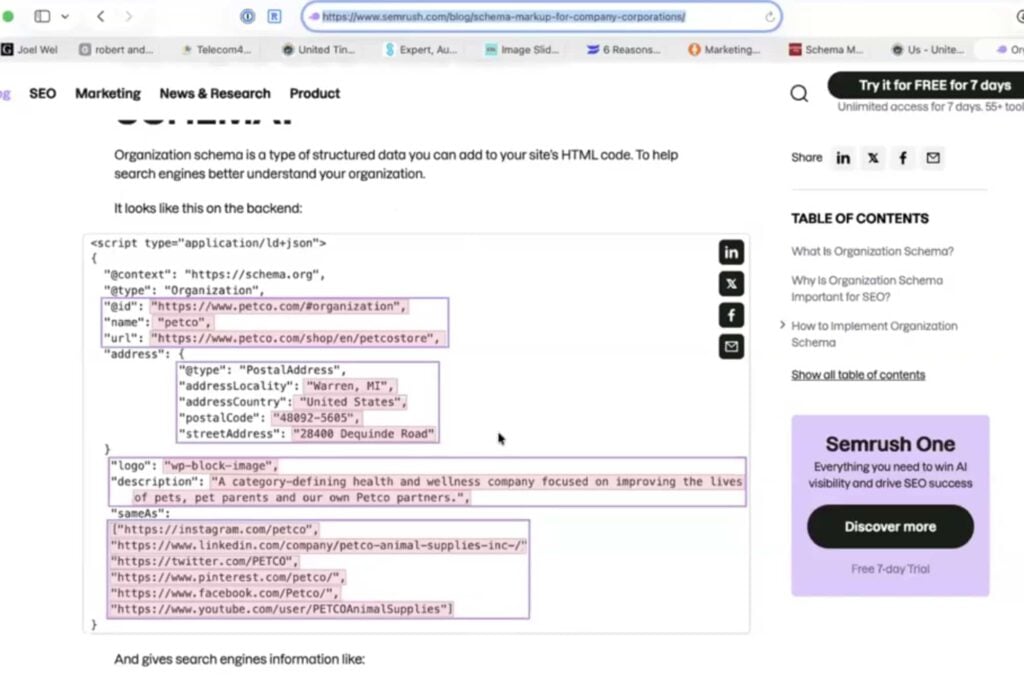
Remember, stick around to the end. You’re going to get the replay, the link list and everything. But you see how the schema markup for an organization includes your website URL, your company name, your address, your social profiles and a whole bunch of other information. Description, your logo. If you had a Wikipedia page, you could add it to the list here. This is called the same as an attribute. So your Instagram, your LinkedIn, your X account, your Facebook, your YouTube channel, et cetera. And if you have a Crunchbase profile, a Bloomberg profile, et cetera, you could put all of those in there. And you don’t have to do much heavy lifting to make this happen. You just need to go into Yoast settings (if you’ve got the Yoast SEO plugin, which you do) and then populate this additional information. There’s a place in Yoast to add the Organization Schema. In Yoast SEO, go to Settings, then Site Representation, select Organization, enter your company name, upload a logo, add the social profiles, and hit Save. Boom. Now you have an organization schema, which helps with Google Knowledge Panel and with all sorts of things. It’s, of course, important for ChatGPT, Claude, Perplexity and all that as well. have
And it’s super simple, and you already the plugin that supports doing this. But you could also just paste in the code into your template. Now, I wouldn’t add it to every page of your site. I’d only add it to either the homepage or the about page. You don’t need it everywhere, and it’s not really best practice to use it everywhere. But this is an example of many, many, many schemas. schema.org provides more details on schema. Let’s see. Schema markup, full list. Mm. Over 800 types of schema for everything from recipes to events, to articles, to products, et cetera.
Podcasts, you name it. Reviews. One’s called aggregate for review rating or aggregate rating. Tons of things. And when you do schema markup, you’re much more likely to see things like this happen, where a tiny home by a tiny… Let’s see if we can find some star ratings in the search results. Maybe they don’t come up. Yeah. That’s- Tiny homes for sale, Arizona. Anyway, I’m sure you’ve seen plenty of these where, in the search results, there are star ratings with the number of reviews, the average rating and the result. That happens from schema markup. If you…
Participant: Yeah, I don’t see it. I know, that’s why I reached out to Stephan because I couldn’t find it.
Stephan: Yeah. See that? How cool is that? 4.9 stars, 79 reviews. Oh, interesting. Here’s another 4.9 with 85 reviews, 4.8 with 94. So that looks really good. So that happens when you have schema markup, and you do everything correctly, you’re much more likely to get those. Very unlikely to get those without schema markup. But then a lot of stuff won’t get picked up and processed properly, also if you’re not using schema markup from an AEO perspective with ChatGPT, et cetera. Okay, so we spent a lot of time on one site, but I think everybody learned a ton, hopefully, in the process. Let’s move on to another site. Hope that was helpful.
Participant: Thank you so much, Stephan. This was amazing. We appreciate it so much. Incredibly helpful. Yeah. And we’ll give you a before-and-after.
Stephan: Okay, awesome. Thank you.
Participant: Thank you
Brian: All right. As Stephan is finding the next volunteer, capture right now in the chat, what is one thing you’re going to apply from what you learned? And you can list more than one. But please start capturing the ideas for what you’re going to do to improve. Are you going to get rid of something? Are you going to test something? Digesting this into action is what we want for you. We want this to create momentum for you and a transformation. People are begging to be roasted. I love it. “So I will not just generate my website through Vibe.” Excellent. “Put client logs into Grayscale.” Excellent. Cool. Talking to your team, I like that. That’s important. “Update schema for all pages.” Excellent. “Grokipedia,” fantastic. Somebody already created a Grok article. Another one did the schema markup. Excellent.
Stephan: That’s great. How about signing up for Screaming Frog, right? There you go, which is, I think, 220 bucks a year or something like that. It’s an app you install on your computer, so it’s not a hosted service, and it’s very affordable. That’s a no-brainer, I think. Okay, so I have potentially our next hot seat candidate if he’s here.
Brian: Who am I looking for?
Stephan: Dan Silverberg. Dan.
Brian: I do not see Silverberg there.
Stephan: All right. He missed his opportunity. Okay. How about Aden? A-D-E-N, and the site is Construction Solutions with AI.
Brian: Aden, are you here? Put it in the chat if you are, or raise your hand. I do not see an Aiden in the list either.
Stephan: Okay. How about Fred Moskowitz?
Brian: Fred Moskowitz. All right. He raised his hand.
Stephan: You are our lucky winner. You get a car, and you get a car, and you get a car. Except for those people who didn’t show up, they don’t get anything.
Brian: Welcome, Fred. All right.
Stephan: Fred, we’re going to cover some different things that we didn’t cover with other folks, so I hope you’re game for that. If we can, maybe start with some citation and link building. It looks like you’ve gotten some coverage on podcasts, which is great. You’ve got a book. That’s awesome. So let’s see if we can really amp this up and get you mega authority. And the way I want to frame this is, I love this example, it’s from Peter Diamandis, who is the founder of the XPRIZE and the founder of Abundance 360, a conference that happens every year. And what he did when he announced the XPRIZE was a $10 million prize for the first reusable passenger spaceship launched within two weeks. It can be relaunched with another set of passengers, something like that. When he announced that, he was on stage with the former deputy director of NASA and 10 astronauts, all of them and nobody in the media, like, they’re all there, taking it all in and everything. Nobody asked, “Peter, do you have the money?” He did not. He was announcing a $10 million purse for the XPRIZE, which didn’t exist. Because there was so much super credibility with all these astronauts on stage announcing it with him, nobody asked. That’s the power of super credibility. Well, thankfully, he did find a funder. It took him a couple of years. He eventually got a billionaire to pony up the $10 million, but he didn’t have any funding for this for the first couple of years. So thankfully, nobody won the prize until years later. So what kind of super credibility can you create? And so we’ll pose this to Fred here in the form of how can we make Fred look super credible to the AIs, to the ChatGPTs, Perplexities and Groks of the world? Okay.
So one of the first things we’re going to want to do is have a press page. So do I see a press page? I do not. How many pages are there on this website? This looks
Participant: Everything’s on one page on the right here. It’s a single page.
Stephan: Okay. So this is important. Single-page websites never perform well on Google, ever. It looks like an under-construction page, even if it’s full of content. It doesn’t look credible to the Google algorithm. So you really need to retool this site. Do you get any organic traffic?
Participant: No.
Stephan: No. Okay. So you
Participant: The only traffic I get is people looking me up.
Stephan: So if somebody looks you up, but they don’t have your contact details, they would expect to be able to contact you with a contact form. Hit a contact us page or a contact- Yeah … me page. Where do I get that?
Participant: Yeah, it’s at the bottom.
Stephan: Okay. It really should be on a separate page. There should be additional information on that page to make it easy for them to agree to enter their details. So let me show you what I consider to be best practice. Again, I’m going to use my site as an example. Bear with me here because it’s just the easiest one for me to think about. See, what I’m doing here is I am kind of dialing up the pain a bit with the copy. Now, you don’t need a copy on a contact page, but I would highly recommend it because you can build relatedness and amp up the pain, urgency and all that sort of stuff in a legit, effective way. And then here’s the form. And try not to have too many fields. Try not to have too many required fields so you lower friction and increase the likelihood they’ll fill out the form. You can always have a two-part form, and you could also have a separate form for entering an engagement with you for a free consult, a discovery call or whatever.
So I do have a separate page for that. So you might want to consider something like that. And that is actually a two-part form. So there’s a bunch of questions here, but then if they click that button, that information gets captured and stored in my CRM, and they go to a second page of questions as well. If they abandon at that point, I’m still going to chase them. I got plenty of info with the first form fill, but I didn’t overwhelm them with, okay, tell me what your Google ad monthly budget is, how many websites we’re talking about, and how big is your site? Like, ah, too much. Okay? So a two-part form, and that’s only for people who are raising their hand for interest in working with you. Everyone else, like a conference organizer or the media, the podcaster, et cetera, they’re going to get your contact form, which is a lot simpler and less onerous. Okay, so with a one-page website, you don’t really have a whole lot to feed to an AI around all your press appearances. So, how many podcast appearances have you had? More than four?
Participant: Oh, yeah. Over 150.
Stephan: Over 150, okay. So how am I going to see all that on this page?
Participant: You won’t. There’s no way to see it.
Stephan: So here’s what I would do. Again, if you emulate what I’m doing, I think that would be good. If you look at the Press page and go specifically to the Podcast section, you’ll see how I’ve incorporated this so it doesn’t just bounce them to another site. So see what happens here? If I click Listen to Episode, a player pops up, and I can listen to the episode right from my site. Welcome to “Before the Bestseller,” the podcast that takes you- Okay, so that’s what I would… And if I were on a video on their YouTube channel, it would be embedded this way. If it’s audio-only, then the other way you just saw. So I keep them on my site instead of bouncing them to another podcaster’s site, but I can have dozens and dozens and dozens of these appearances. So that’s what I would do.
Participant: So you would recommend putting as many as possible on there?
Stephan: Yes. Okay. And I would also recommend you grab those while they’re still live. Don’t assume those will be live five years from now. If you did a podcast appearance five years ago, that might be gone. If you don’t have a copy of that audio or video, you just may never be able to retrieve it. It’s possible you could get it from archive.org. Do you guys know about archive.org? This is a fabulous tool.
So check this out. If I put in, let’s put Fred’s website in here. What this does is go back in time and find all past versions of the site, not just the homepage. Like the whole site gets crawled and indexed and stored, and it keeps refreshing that. So it looks like you started your site, Fred, in 2020.
Participant: Yes. Yeah.
Stephan: So I started netconcepts.com in 1995. Look how far back it goes in the WayBack Machine. All the way back to the first capture, which was in 1996. Isn’t that crazy? You can see my website from 1997. Let’s have a look. It’s surprisingly not that embarrassing. Now, because this is massive, this repository is huge, which powers archive.org, so stuff takes a while to load. It’s really slow, but… Look at that. Netscape, NetObjects and Excite, the search engine. I don’t know if you guys are old enough to remember search engines like Infoseek, Lycos and Excite, but look at that. That was in June of 1997. That was my Net Concepts site.
Participant: Yeah. I see a mention of RealPlayer. Yeah. That’s definitely from another time.
Stephan: But how cool is that? And it’s free. It’s on archive.org. Anyway, I would definitely expand your site. I’d make it at least a 10-page website. Make a press page, a results page or something like a testimonials page. You do speaking appearances as well, yes?
Participant: Yes.
Stephan: So I would have a separate page for sure, a separate page for speaking, and that can have testimonials specific to conference organizers and from audiences, et cetera. Again, you can use my speaking page as a template. So I have a speaker reel of me speaking on stage, like for more than just a couple of minutes, so you can get a sense for my storytelling and all that. So I would do something like that. A highlights reel or a sizzle reel is like a bunch of media appearances, like little snippets of the TV producers introducing you and the conference organizers introducing you as you come on stage and that sort of stuff. It’s just like a lot of little snippets.
So then, when you get to the attendee feedback, you could have a montage of different attendees talking about you. You could have conference organizers talking about you. That’s the guy who ran Internet Retailer. You could have, like, audience scores (4.9 out of 5 speaker score), Content Marketing World and potential speaking topics. As you can see, you can have a massive page just on speaking, rather than just a little mention of speaking on a single-page website. And this gives you so much more opportunity to sell your value, credibility, history and unique point of difference.
And that’s going to help you to get a much more prominent listing or a recommendation in an answer engine when people are asking, “Who’s Fred Moskowitz? And what are his areas of specialization?” “Oh, well, did you know he’s a keynote speaker? He’s spoken at all these different events, and here are some of the topics he’s spoken about. And he’s been speaking for X number of years, and he’s done all these amazing events, and he gets all this great feedback, and he’s in the Speakers Hall of Fame,” and da, da, da, da, da. All that could be part of the output from ChatGPT, Grok or whatever, if you had it all on your site. All right. So I’m going to say we probably need to take another short break. Well, let’s see. When was our last break, Brian?
Brian: It was at ten thirty
Stephan: And it’s twelve now?
Brian: Yeah, it’s noon.
Stephan: So that’s another hour and a half. Okay, so I think it’s time for another five minutes. What do you think?
Brian: Why not? Let’s take a break and capture, digest some of the elephant. So, please share some of the insights you’ve gained in the chat, because here’s where the rubber meets the road. When you’re seeing these hot seats, it’s really easy to see someone else getting burned nicely. But the real burn, the real fire, is when you make the change to your website. Please list two or three things you plan to change on your site. You’re going to test. Maybe you’ll add a page. Maybe you’ll feature something. Maybe you’ll make some adjustments. But what are you going to do? And notice your peers are taking action. So I want you to feel the pressure because nothing transforms if you don’t take action. So that is why I am your advocate. I want you to benefit from today, not just make this intellectual entertainment like Jay always says, and really take the action that makes a difference in your life, in your business. And we will be back at twelve seven Pacific Time, so five minutes, everyone. Take a five-minute break and put something in the chat that will make your business, website and everything a little bit better. We’ll see you in five minutes.
Stephan: All right. And I love this chat message that just came in. “I will have AI analyze Stephan’s site and clone mine off of it.”
Brian: That’s awesome.
Stephan: Yeah. So it’s called R&D: rip-off and duplication.
Brian: I love that. All right. See you in five.
Stephan: All right. Bye everyone. We’ll see you in five.
Brian: So Stephan, I just wanted to bring your attention. We have a live Q&A button. One of the questions here was really interesting. “What’s the best protocol for entering your portfolio of work, meetings, interviews, webinars and podcasts into AI without it getting out into the world?” So what is the best way to keep that offline? So I think that might be a good one to address.
Stephan: Yeah. So. Great. Looks good.
Brian: We are coming back into the room, everybody. Suppose I can get you to bring back your coffees, your waters, your feet, and everything else you need. So let’s get back into it. All right. Welcome back, everyone. Stephan, do you want to address that question of ours
Stephan: Yeah, why don’t we restate it because I don’t know if everyone was in the room yet. And while you’re doing that, I’m going to pull up my browser, log in to ChatGPT or pull up ChatGPT and Claude, and then I’ll show you where to address this. Okay. Go ahead.
Brian: Great. So the question iStephan: What’s the best way to enter your stuff, your portfolio of work, your meetings, your interviews, your webinars and podcasts into an AI without that information getting into the world? So what’s the best way to keep it offline?
Stephan: Okay, so everyone should be doing this. I’m going to show you what I’m talking about here. So we’ll start with ChatGPT, but the place where you’ll find it varies by LLM. So we’re going to go down here to your name. We’re going to click that, then choose Settings. And then we’ll choose Data Controls. And then we’re going to improve the model for everyone; unfortunately, that is set to on by default. We’re going to turn that off. As you can see, I’ve already turned it off. I’m clued into OpenAI’s sneaky, by default, ‘let’s use everybody’s data for training’ policy. So we’re going to turn that off. Okay, so that’s ChatGPT.
Here’s what you do with Claude. Again, a similar thing. You’re going to go to your settings in the bottom left. And where is it? Privacy. And then you’re going to choose to opt out of the help to improve Claude. That’s the last question. Turn that off. As you can see, I’ve already turned it off.
So I’m curious Stephan: who in the room here has already turned these off? Anyone?
Brian: We’re getting some yeses. Yep. A couple of noes.
Stephan: Nice. So hopefully by the end of this session, all of you will have turned this off. OpenAI and Anthropic do not have the right to use your data. That’s not fair. You didn’t opt in to training data; they opted you in and snuck it into a buried setting. Now, even with this turned off, I’m still reticent to upload sensitive documents to an AI-hosted service. You can install an AI on a computer, have it be part of your own little network. And that’s more work, more complicated, but much more secure. So this is especially important if you’re dealing with client stuff. We have clients who give us confidential documents, and we’re under NDA. We can’t be uploading that into the cloud. Sensitive stuff with financials and things like that, you’ve got to be very mindful of that. Very good question. Thank you. All right. What else did we get in the chat or the Q&A?
Brian: Okay. So, how do you focus on what needs to be added to a page to improve it? How do you prioritize these things?
Stephan: Yeah. So one of the ways we do it at Netconcepts is by looking at the top-performing pages. We use tools like Semrush and Ahrefs. So let’s use Ahrefs again as an example. Do I still have that open? Okay. Let’s go to Ahrefs. Actually, let me pull up Fred’s site because we went a little short on his. Fred Moskowitz. There are two tools inside of Ahrefs that I would use for this. One is Top Pages, and the other is Best by Links. Top PageStephan: These are the pages that are performing the best in terms of getting organic traffic. Because this is only a one-page website, we’re only seeing one page. But if you had 50 pages, you’d order them from highest to lowest traffic, and prioritize the ones that are already getting the most traffic. Like, how do I win even more with the pages that are already winning? Right? It’s like work on your strengths, don’t work on your weaknesses. So that’s Top Pages, and then Best by Links. If you have, let’s say, your top-performing pages that are getting the most links, not in terms of traffic, but getting the most links because let’s say it had some interesting research on it, or it’s a really cool tool, and everybody linked to it.
Back in the day, a long time ago, I developed a WordPress SEO plugin that did quite well. It was completely free, and I got a ton of links to my Netconcepts site because I had hosted the plugin there. So that was one of my best pages by links. Was that page about the SEO title tag plugin? Sorry, I clicked on the wrong place. If you clicked on Best by Links and then you have multiple pages to your site, you’re going to see which ones are performing the best in terms of getting the most links, and the ones that get the most links, you’d want to prioritize and see what you could do to make them perform even better. Nice. So, some of the things you would do to improve the page: we already talked about having a TLDR (too long, didn’t read) summary at the top or key highlights, key insights and a top takeaways section with bullets. A TLDR is really short, it’s maybe one sentence. I prefer a key takeaways bullet list of highlights at the beginning of the article and then the FAQs at the end of the article or on a product page, service page or whatever it is.
And I also would have, if the article was written by, let’s say, just a staff person or a contractor or the content team or whatever, I would have it reviewed by or change the authorship to somebody who’s a thought leader in your organization, the CEO or founder or co-founder or VP of ops or director of strategy or whatever, some legit-sounding title, or the actual founder. And in the case where it’s going to be the junior person who wrote it, then reviewed by someone as an additional field. And also, you want to keep updating the article. So if I’m looking to rank for, let’s say, biohacking podcasts. So I’m on page one for biohacking podcasts, and I just updated it yesterday, so it hasn’t been reflected in Google yet. But now it says 2026 because this article was originally written in 2019 and then updated again in 2022. The title changed. Some details about the seven top podcasts that I recommended in the biohacking field.
And surprise, surprise, my podcast, “Get Yourself Optimized,” is one of the seven, and my wife’s podcast, formerly called “Stellar Life,” but now “Orion’s World,” is in there, too. And I have Dave Asprey with “The Human Upgrade” and so forth. But this is a recently updated page, and notice what I do here at the bottom, I give a last updated date. You could put it at the top, too, but I don’t want to give it too much emphasis if it’s an old article I haven’t updated in 3 years. I don’t want to scream that from the rooftops. I probably shouldn’t have put it in the title if I wasn’t planning to update it every year, because up until yesterday, it still said 2022.
Another thing I would do to optimize this even more would be to add the podcast show art for each show to add some visual interest to this page. And if you want it to rank higher than it already does, it’s already on page one, which is pretty cool. But if I want to rank it higher on page one, I might feature this on my homepage. My homepage has a lot of weight and authority. Most homepages are the highest authority page on the site and the most important page on the site, as far as search engines and answer engines are concerned. So if you feature, mention or draw attention to that particular article or piece of content on the homepage, it’s going to increase its visibility and the likelihood it will be cited. It’s going to get linked to and show up in answer engines and search engines. All right. Did I answer that?
Brian: I thought that was great.
Stephan: Cool. All right. What else do you have?
Brian: So I’m not sure we’re going to be able to get to all the questions. Is there a way to get answers to questions when you’re trying to find something about how to train something? What about other AIs, enterprise things? Like, how do you do that on this browser versus that browser? What’s a good way to research these technical kinds of things?
Stephan: Well, you use the AI to tell you what to do. Sure, you could search on YouTube for videos on how to use Claude Code and how to interface with an MCP server, da, da, da, da, da. Right? Right. Or you could just ask the tool that you’re used to, right? ChatGPT or Claude or Perplexity, whatever. You just ask it, “How do I do this? I want to create awesome, high-converting thumbnails for my YouTube videos. How do I do that with AI?” And I don’t need to watch a YouTube video. I could. I could certainly use YouTube to find videos on that. Or I could just ask ChatGPT or Claude, “How do I do it?” And it’ll lay it out, give me some tool recommendations, and so forth.
So, as an example, there’s pikzels.com. It’s a little pricey, but it’s an AI tool that generates really high-performing thumbnails. Hmm. And you can give it a channel that you particularly like as inspiration. There’s so much you can do with it. You can give it different styles to emulate, and so on.
Brian: That’s cool.
Stephan: How do you find a tool like that? You go to an AI, and you ask it for a tool recommendation.
Brian: Nice.
Stephan: Yeah. How do you improve your prompting? You ask the tool to improve your prompting. There are tools from OpenAI, Anthropic and so forth that do this for you. So, for example, let me find, I think I’ve got screenshots of this already. Yeah. Here we go. So this is what some people would refer to as super prompt, you think of everything, you throw the kitchen sink into the prompt. And the output, gold in, gold out. It becomes markedly better. How was it created? Oftentimes, using the AI itself. So here, you’ve got some options. From OpenAI, the prompt optimizer. Here’s a direct link to it. I’ll drop that in the chat.
Oh, why did it not copy? There we go. And then the Anthropic version for Claude right here. And what that looks like is this. So here’s the prompt optimizer for ChatGPT from OpenAI. This is the version that I gave it. “Evaluate all the Amazon comments from Joe Polish‘s book, what’s in it for them, and provide Joe with strategic feedback he would benefit from.” I wrote that. It’s okay. It’s pretty good. You want awesome, hit Go, and tell it to do its magic with your original prompt, and there’s the end version, where it came up with all sorts of things, like, “Assess the relevance, tone, and actionable insights. Provide Joe with strategic feedback that addresses both individual comments and any recurring patterns. If you encounter missing comments, irrelevant content, or duplicates, clearly indicate this in your output.” Format the output as a JSON object so you can use it and feed it into other AIs to further process it. Brilliant. I didn’t think of any of that stuff. Nice.
Brian: So there’s another question in here about LLMS.text or TXT as a standard markdown file. What are your thoughts on that?
Stephan: It’s garbage. Absolute nonsense. It’s a made-up thing. The LLMs never used it. Okay. That was somebody selling snake oil, and a bunch of people believed it. Now, robots.txt, that’s real. T That’s been the standard for decades. LLMs.txt: the LLMs never agreed to a standard like this or implemented anything like it.
Brian: Is that R-O-B-U-S-T.txt?
Stephan: No, robots. Like a robot.
Brian: Okay.
Stephan: Do we want to talk a bit about video and leveraging video with AI? I think that would be good. Okay. Because video’s the future. Because many people will be unemployed and watching a lot of YouTube. I’m only half-joking. So, if you think about it, how do I leverage textual content to turn it into long-form videos, or how do I take long-form videos and turn them into short-form videos, or turn them into textual content? You can go all sorts of different directions with this. But let’s just say you already have long-form video. You can use tools like CapCut to turn long-form videos into short-form videos. Inside YouTube, it already transcribes all the videos. Did you know that, Brian?
Brian: I didn’t. I’ve been seeing it, yeah.
Stephan: Yeah. So you can see the whole transcript. It’s kind of tucked away, so I’ll show you where to see it, but you can feed that transcript to an AI. You don’t have to watch an hour-long video if you don’t have the time. You can also feed it to NotebookLM, which is a free tool from Google, and it is amazing. It will take, let’s say, dozens of hours of video watching that you don’t have time for. You feed it to NotebookLM, and you say, “I want you to synopsize this and turn this into something highly actionable, Give it your prompt. And then it will turn it into a very engaging, easily listened to podcast episode with these two fake, very real-sounding AI co-hosts riffing back and forth about all the research and all the stuff that you’ve dumped, like research reports and studies and scientific papers that would just burn your eyeballs to read all of it. Just get it as a 60-minute podcast riff on all the highlights. Super cool. NotebookLM is from Google and is free.
So, let’s see here. So CapCut, that’s a tool you might want to check out. Another one is called Rask, which takes a video and generates a translation into a foreign language. So this little four-hour thing we’re doing together, that could be turned into French, German, Italian, Polish, you name it, Russian. And I don’t speak those languages, but it’ll sound like I did. It’ll be in my voice with a pretty darn good convincing accent. So that’s Rask, R-A-S-K. In fact, let’s see. I think I might have an example of that.
Yeah. Here we go. Check this out. I’m going to make sure I’m sharing sound. Yeah. Okay. Here we go. This is me in English. I recently, maybe a year ago, learned of a term called IBR, which is a Hebrew word. How about I had French. Now, I did take three years of French in college, so I could probably have pulled that off, but I didn’t have to lift a finger. I just had to hit a button. So Rask.ai. And if there’s no tool for what you want, you can vibe-code it, or just wait a month, and then it’ll appear. Because that’s how fast things are advancing.
If you wanted to have an AI avatar of yourself, and you don’t want to get camera-ready, put on makeup and all that, you can just have the AI pretend to be you, and it looks like you, it sounds like you, it’s got your mannerisms. Here’s HeyGen, which is probably one of the leading platforms for doing this. A great example of somebody who does really well with this is Julia McCoy. This is her, and it’s actually not her. That’s her AI avatar. Dr. McCoy, from Star Trek, Dr. McCoy? So when you see Dr. McCoy, that is her AI clone. So let’s have a listen to a little sample of her. So some of these videos have done really well. If I sort by Popular, look at this 856,000 views, 754,000 views, 460,000 views, 417,000 views. Those are all AI.
Stephan: How cool is that? That’s cool. Wow. We are rapidly getting to the point where you will not know what is real and what is not real online, which brings me to a really cool quote, or maybe it’s scary, I don’t know, scary or cool quote. It’s from Mark Cuban. Let me find it real quick here. “Within three years, within the next three years, there will be so much AI, in particular AI video, people won’t know if what they see or hear is real, which will lead to an explosion of face-to-face engagement, events, and jobs. Those who were in the office will be in the field.” Mark Cuban.
Brian: So it sounds like credibility is going to include live events, live happenings. How can you get someone else to verify that you’re a human being who’s been on a stage, at an event, at a happening or at a meet-and-greet? So I think that the new form of credibility is are you a human?
Stephan: Yeah. Face-to-face is the new black. And so if you can start planning for this, again, skate to where the puck is going. Get on stages. Do pitches for keynotes and for conference breakouts and all sorts of things. Get in front of live audiences in person. Hone up your speaking skills, because this is such a manufactured world we’re entering into. Nothing will necessarily be real. This is a fun, tongue-in-cheek take on how good AI is at video. But this is for my client, Chris Parker. Remember, we talked about his Privacy Crisis book and his website, whatismyipaddress.com? Well, check out this book trailer, which we created for him.
Stephan: It’s a really great video. So I won’t waste our time with the rest of it, but if you’re curious, go to privacycrisis.com to watch the rest. But this is an obviously tongue-in-cheek version. This is the real Chris Parker, right? He’s having fun and isn’t trying to fool or scam you. You will get calls that will absolutely sound like your loved one with all the intonations and all the things that make it sound real and human, and they’re going to say, “I’m in jail,” or, “I’ve been abducted,” or whatever, “and I need money fast.” And it’s not real. This is a crazy world we’re heading into. So face-to-face is the new black.
All right. Other questions coming in?
Brian: Look, we may have time for one more hot seat. What do you think?
Stephan: Sure. Let’s do it.
Brian: Okay.
Stephan: So let’s see who. Why don’t we, instead of using somebody who sent me an email, because a lot of those folks don’t seem to be here, let’s use somebody who stuck around through the whole time from the beginning and is available in the chat to put in their URL, and just randomly pick one of them.
Brian: I’m going to let you do it. So put your clickable website in the chat. And we’ll give people a second so Stephan can scroll through and randomly, there’s no value judgment here, choose one.
Stephan: Okay. Oh, that’s so funny. Okay, let’s pick Robin Heppell. I pulled this website up by mistake earlier. Do you remember that?
Brian: Yes. And he said, “Hi.”
Stephan: He’s in the room. Yeah. What are the odds? Oh. And it’s not because I was researching his website for the hot seat, it was because I know him, and I referred him to somebody I had met at a conference I spoke at called DealCon, and this guy is in the funeral industry, and I’m like, “Oh, you’ve got to talk to Robin. Do you know who Robin is? He’s like the funeral futurist. He’s like a super strategic, super futuristic kind of guy in your industry.” So I introduced the two of them, which is why the website was in my history and why it came up instead of going to Google to search for a funeral, and now here he is. Hey, Robin.
Brian: Oh, let me do one little thing here.
Stephan: Yeah. So let’s put him in the room so he can talk to us. So let’s see here.
Brian: All right, Robin, you should be able to unmute yourself. There you go.
Participant: Hey. Great.
Stephan: Hey, Robin. What’s up, Brian?
Participant: Hey, Stephan. How are you?
Stephan: Good. It’s been a while.
Participant: Yeah, and thanks for the intro. We chatted last month. So thank you for that.
Stephan: Yeah, you bet. Awesome. So what have you done from an AEO perspective so far? What have you done as far as citation building, as far as schema markup, or any of the kind of traditional AEO things?
Participant: Well, I have made some notes along with today’s presentation to even do that further, such as the timeline. And I’ve seen Greg’s before, and I just never did anything about that. I do have some schema, but I don’t think it’s as good as… Well, it’s not as good as what you talked about today, because it’s always improving, and you’re the expert here. The other thing too that I didn’t get, I’ve heard about it, about getting more FAQs onto your website, but how to then put them on, like on the various pages, like kind of more associated with that topic within your website. I just never knew that, so that’s on the list too, to spread them out over various pages.
Stephan: Yeah. And you can also spread them across multiple sites.
Participant: Oh, okay, yeah.
Stephan: So if you had, let’s say, a Medium account, and you had a Reddit account, and you had, I don’t know, a columnist opportunity with Read Write or with one of these other platforms that has a lot of readers and visitors. You could post content there too, and maybe make it unique, I would say, not just copy and paste it from your regular website. There’s this concept called the evil twin that could be used here, and this term and concept come from Andy Crestodina. So it’s basically like having the five best practices of the biggest, most successful funeral homes in the United States. That would probably be a solid piece of content.
If you do an evil twin, you flip it, and it’s based on the same research, it’s based on the same content, but just kind of rewritten, so it sounds unique and not the same thing. And that would be like the five biggest mistakes that newbie funeral home directors make, and it’s essentially the same article, but rewritten. Okay. And you post that one to medium.com, or you post that one to the funeralhomemagazine.com site or whatever site you’re a columnist at. So it’s not duplicate content, but it helps establish your content elsewhere. And one of the reasons this is so effective, especially when you’re posting to a site like Medium.com or LinkedIn, is that these are among the most cited sites in ChatGPT.
Participant: Oh, okay.
Stephan: Most cited domains in a three-month study, according to Semrush, in ChatGPT were Wikipedia, Reddit, medium.com, Forbes, and LinkedIn. So you all should be posting a lot more on LinkedIn, and if you don’t have a Medium account, sign up and start posting there. And don’t just copy and paste your blog posts from your site over to Medium. Make it unique. This is another way to think about it. This was posted on the Ahrefs blog about a couple of months ago here. Where is it? Semantic. Okay. Yeah.
Brian: Can you expand on how you get featured on these articles or on someone else’s blog?
Stephan: Yeah. Well, you can create the content and then post it. It’s that easy, like on Medium. If you’re on somebody’s very popular website as a columnist, then you have to go through whatever vetting process and pitch and all that. But there’s nothing to stop you from signing up with Medium.com. Right. So, this was what I was looking for on the Ahrefs blog. So this was posted on December 10th.
It was a study they conducted for 2 months. They made up a fake brand and had it believed by all these AIs. Like, “Oh, this is a real legit brand.” And funny enough, there’s an FAQ page on the official website of this fake brand. A Medium article superseded it. So ChatGPT used a Medium article as the definitive answer instead of the official FAQ on the fake brand website. So there was conflicting information, and the Medium article won, which is what the AI used. Crazy, right? Don’t do this, obviously. This is just a thought experiment; they actually played it out and figured out what worked and what didn’t. But the lesson here is that Medium.com is a powerful platform. You could make it a place for your personal brand and opinions, separate from the official company website. You could have a persona, like a pseudonym, with that Medium.com account, or there are lots of options here. Don’t do anything unethical, but consider this part of your wheelhouse, part of your tool set.
Participant: So, would you keep Stephan Spencer, or would you come up with a different brand?
Stephan: Oh, yeah … Different brand. Yeah. Okay. So, personally, I don’t want to come up with a pseudonym or persona because I feel that’s not in integrity with who I am. But everyone has their own standards, so I’m not judging. I’m just saying, these are some of the options available to you. You can create an account under whatever name you want and start publishing there. It’ll get snuffed up or snuffled up, whatever the word is, scarfed up by the AI and utilized probably, especially if there’s not a lot of highly competitive information. So one of the things Robin has a real advantage in is that there aren’t many really forward-thinking futurists, marketers or strategists in the funeral home industry. It’s a very old-school, kind of, I don’t know, not super-innovative industry. Am I correct in saying that, Robin?
Participant: Yeah, they’re pretty slow to get going.
Stephan: So that puts Robin at a real advantage, and he just needs to shout this from the rooftops in a way that doesn’t look hypey, looks credible, and comes from multiple angles, not just from his own personal brand website from funeralfuturist.com. So medium.com, LinkedIn, maybe Reddit. You’ve got to be very careful about Reddit because they hate spammers and marketers, so yeah, that’s a delicate dance there on Reddit, but you can potentially pull that off. And so, yeah, there’s a lot of opportunity. One thing I would recommend is really building up the brand on YouTube. How active are you on YouTube, Robin?
Participant: Yeah, not active lately. I used to be more so, would put my short podcasts up there, but not as much in the past. Okay. Sorry, in the recent past.
Stephan: So is this a matter of time, or is it a matter of you’re just not comfortable getting in front of the camera, or you don’t have enough ideas for videos to shoot, or it’s just been a low priority, or what?
Participant: Well, yeah. In a nutshell, I sold the marketing business in 2020, but the partnership didn’t work out, and I left after 2022. And then in 2023, I got a bunch of the clients back and was able to kind of restart. So I’m kind of relaunching it. I always kept this brand, Funeral Futurist, but it was my other brand, Funeral Results Marketing, that was sold. So anyway, I’ve been kind of growing back up, and now I’m ready to get back into more marketing and direct marketing, like podcasts and YouTube videos, et cetera.
Stephan: Yeah. Awesome. Okay. Yeah. So, by the way, here’s a super quick little hack that everyone can do if you have a YouTube channel, and you’re linking to it from your website, which you’re doing here at the bottom of the right-hand corner in the footer. Notice on my site what I do. I add, at the end of the YouTube channel URL, a question mark or no, ampersand sub_confirmation=1. You don’t have to remember that. You just need to look at how I link in my footer. So you can see how I’m mousing over it now, and in the bottom left, the URL is youtube.com/stephanspencer?sub_confirmation=1.
So what that does is when I click, or your visitor goes to click, they’re on the channel, and they get prompted immediately to confirm their subscription. “Are you sure you’d like to subscribe to Robin Heppell’s channel?” You will get so many more people who clicked that link and said yes than you currently have, because they’re not thinking about subscribing. They’re just thinking of checking out your channel. But when they’re prompted like, “Hey, are you sure you want to subscribe?” “Oh, yeah, sure.” They can click No, but you’ve already kind of greased the wheels. So that’s a really simple hack that I don’t think is at all illegitimate or sneaky, because they can click No and it will definitely increase the rate of your channel’s subscriptions.
Participant: Great. I’ll do that. I just subscribed to yours, so I’ll add that on. Oh, well, thank you.
Stephan: In fact, if everyone can do that, that’d be awesome. You know, I’m at 750,000 views, and I really want to get to a million, so if you guys can all team up and just binge-watch a bunch of my content. I have about 1,000 podcast episodes across my two channels over 10 years. I’d love for you to watch 100 videos each. I’d be so indebted. Okay, let’s take a look at your channel and see how we can leverage it even further. Because you already have a channel, you already have content. You’ve been around for 12 years now. Now, here’s a simple thing you can do. You’ve got your featured video. So there are two types of YouTube videos that are featured: the channel trailer or the intro video. So one is for people who are subscribed, and one is for people who have not subscribed. And I would ideally recommend that you have a different video for each. And I certainly wouldn’t keep the same video as the featured video for 12 years.
Participant: Yes.
Stephan: Because it’s very tired. So let’s go to the videos and let’s sort by popular. Wow, you have been on here forever. 18 years ago? Were you one of the first 100 people on YouTube? It’s amazing. Wow. Okay. So
Participant: Hey, Stephan, just super quick. I got this idea from going to the conventions with a camera, and that from WebProNews. You’ll remember that. Yeah. And I forgot the guy, a taller guy, and he would do these, and I thought, “Hey, I could do the same thing at the funeral conferences.” So that’s where I got this idea from, video numbers three, four, five, and eight there. They’re all based on WebProNews way back in the day.
Stephan: Oh, that’s funny. Yeah. Very cool. So these all have really tired-looking thumbnails. They’re usually just frames from the video. At a minimum, you can go in, choose a different frame, and you don’t have to do anything else, and just changing the thumbnail will reinvigorate these videos to get more views and more watch time.
Participant: Okay.
Stephan: You can change the titles as well. So you’re already in there, change the thumbnail and change the title. I’d suggest a custom thumbnail that’s not just a different frame from the video, but a proper-looking video thumbnail. It looks like you did that for this one. Or is that just like a webinar recording?
Participant: Well, they’re more recent, right? So yeah, and it’s just a webinar. Then you pick one of the four offerings, or upload the title.
Stephan: So what I’d recommend is mix it up a bit more with less boring thumbnails that all look the same. Like these Q&A ones look very similar to each other, and they’re not performing well. If you look at Evan Carmichael, he’s a very successful YouTuber. You can see that his thumbnails are much more engaging-looking. I mean, these are a little too AI for my taste, but if you go back to a slightly older style from, I don’t know, 6 months or 10 months prior, you’ll see they’re a little more human. But this is kind of like the MrBeast style, which is doing really well. It’s performing well for a lot of YouTubers, and I’m not a fan, personally. It feels a little too uncanny valley for me. Mm-hmm. So let’s go back a bit more. Maybe it’s more than a year ago now. Yeah. Oh, he’s been doing this for a while now. Okay. Maybe it’s a year and a bit. Yeah.
See that? He’s got a few words. One of the words is kind of set apart with a different font treatment. “Stop thinking this way.” And it’s a different text from the title. The title is “How to Reprogram Your Mind: Dr. Joe Dispenza’s Guide,” and then the thumbnail text is, “Stop thinking this way.” So I would recommend doing something like that, where if you’re the star in the video, it should be a big-head picture of you. It shouldn’t be a headshot. The professional headshot looks really stilted and stiff. It should be you in it with an engaging facial expression, and from the video itself, and then add that little bit of text. Two, three, four, five words that intrigue and build curiosity and kind of feed in with the title. And then those first few seconds of the video, you want to make sure that it is in sync, like in alignment with the promise of the title and the promise of the thumbnail text. So how does this relate to AEO? Well, if these videos perform well, it’s much more likely that they’ll be used as fodder by the answer engines. So, for example, when I feed YouTube videos to Grokipedia, they often end up being cited and used in the Grokipedia write-up for that person or company. I don’t have to give it a full transcript and everything, because YouTube already has all that. It has the transcript already.
The AI can, of course, create its own. I’m afraid, but it doesn’t need to because it’s all there. Here’s where you get to it. When you view more under the description and at the bottom, there’s a view transcript and a show transcript button. So click that, and boom, you’ve got the transcript over on the right-hand rail. And when you click on something, it’ll take you right to that exact spot in the video where those words are said. But you can copy and paste all this. You can search within the text transcript for the part of the video. You can copy and paste the whole transcript, paste it into an AI, and have it do all sorts of magic.
So we’re just scratching the surface. This is just, I know, a little bit like drinking from the fire hose, but you don’t have to do all of this at once. You just take some nugget that you learned from today and apply it in your business, apply it in your life, tell it to a loved one if you think it’s going to help them, and how do you eat an elephant? A bite at a time. That’s right. So I did promise a giveaway. I’ve got a free copy of my book, “Google Power Search.” Let me find that link. Okay. Here we go. So you would email me at stephanspencer.com, which I’m going to put in the chat right now. And I’ll send you, or my assistant will send you, a free copy of “Google Power Search, Third Edition.” Now, this is specific to searching, not prompting, but it’s still applicable. If you’re a really good searcher, you’re going to be a really good prompter. But if you’re a really bad searcher, you’re probably not going to be a good prompter either.
So, you’ll definitely learn some ninja tips, like how you can find Forrester research reports that normally cost thousands of dollars, get them for free on Google, just with the right search queries. You can find confidential business plans of competitors, all sorts of crazy stuff. I’ve found files with real credit card numbers and their expiration dates, just by clever Google searches. It’s crazy what’s in Google. Okay. So there you go. There’s the freebie. Plus, of course, we’re going to send you a replay, plus all the links in a nice list. I know this was a lot, but I hope you got some value from it. You don’t have to learn everything. Take it a bite at a time. And I really appreciate you guys for sticking around all the way to the end, and almost everybody did. Looks like it was very little drop-off, so congrats to you guys.
Brian: Yeah. Thank you, everyone, and please give us some time to render the video. It’s not going to come immediately. We have a lot of things on our plate. So give us maybe a couple of days, let’s say 48 hours, to get this stuff out to you, because there’s a lot of great content. But in the meantime, take immediate action: subscribe to Stephan Spencer’s YouTube channel and help make his dream of reaching 1 million subscribers possible. You can look at his site. You can look at your site, and that’s really where it starts. Take a look at your site and think about if you were your client, what would you notice? Where is your credibility? How would you engage? And that’s the beginning: start looking for ways to better interact with your clients, and make it happen. So again, thank you, thank you, thank you. Any last words, Stephan, about how not to be afraid, how to have courage, how to stay engaged, or insights about where that puck of AI is going?
Stephan: Well, I’m an optimist, and I hope you are, too. There’s a lot of dystopian stuff in the media, on Netflix, and just watch any kind of sci-fi movie, and it’s typically dystopian. Don’t buy into the lies. Don’t buy into the hype. If it bleeds, it leads. That’s why they sell it to you. Know and trust that you’re divinely guided, and that everything is working for your highest good, and that this is a game rigged in your favor. And look at things with positive expectancy, know and look for the hand of your creator in everything that happens, even if it doesn’t initially look like a great thing. Know that it’s for your soul’s refinement and not just to put you through an uncomfortable situation. Everything’s for a higher purpose. That’s my view; if that serves you, great. Anything in what I just said that doesn’t serve you or doesn’t resonate, feel free to discard.
Brian: Thank you. Thank you all, and until we meet again, be well. Bye.
Stephan: Bye, everyone.