

Over the past decade, Google’s approach to links has changed significantly.
There was a time when a single algorithm update could wipe out a site’s visibility overnight. Today, the process is less abrupt but no less important. Instead of dramatic penalties, Google now evaluates link quality continuously. Weak or manipulative links are more likely to be ignored or discounted, while strong, relevant links continue to influence visibility.
That shift hasn’t reduced the importance of links. It has raised the bar.
Managing your backlink profile is no longer about chasing volume or reacting to penalties. It’s about maintaining a healthy, trustworthy profile over time, something I cover in depth in my SEO audit course. That’s where link risk management comes in.
Introducing Link Risk Management
Link risk management is the practice of monitoring, evaluating, and shaping your backlink profile so that it supports your visibility rather than undermines it.
SEO isn’t just about gaining traffic. It’s about protecting the asset that generates that traffic.
Most sites don’t run into trouble because of one bad decision. Issues tend to build gradually:
- low-quality links accumulated over time
- aggressive tactics that worked temporarily
- neglect of the backlink profile once rankings improved
By the time visibility drops, the underlying causes have often been in place for months or years.
A structured approach to link risk management typically includes:
- recovering from link-related issues (if necessary)
- monitoring and maintaining backlink quality
- building strong, relevant links
- reviewing and adjusting the profile over time
Recovery
Sites rarely collapse overnight anymore, but declines in visibility still happen, and links are often part of the cause. A typical pattern looks something like this.
A mid-sized e-commerce site in the home fitness space saw a steady decline in organic traffic over a period of several months. There was no manual action in Google Search Console, and no single technical issue that explained the drop.
When the backlink profile was reviewed, a pattern emerged. Over the previous year, the site had accumulated a large number of links from low-quality blogs and directories. Many of these links used overly optimized anchor text, repeating the same commercial phrases.
Individually, none of these links were significant. Collectively, they created a signal that the site’s link profile was not entirely natural.
The recovery process focused on two things. First, the most clearly problematic links were identified and addressed, either through removal requests or, where necessary, disavowal. Second, the site shifted its efforts toward earning links from relevant publications in the fitness space through content and partnerships.
Over time, as the link profile improved in both quality and balance, visibility began to stabilize and gradually recover.
Recovery is possible, but it requires careful analysis.
Step 1: Collect Your Backlink Data
No single tool provides a complete view of your backlink profile.
To get a clearer picture, you should combine data from multiple sources, such as:
- Google Search Console
- Ahrefs or similar platforms
- other link intelligence tools
Each source captures a different portion of the link graph. Consolidating them gives you a more reliable dataset.
Step 2: Analyze Your Backlinks
Once you have the data, the goal is not to label every link as “good” or “bad,” but to understand patterns.
Look for:
- clusters of low-quality or irrelevant sites
- unnatural anchor text distributions
- sudden spikes in link acquisition
- links from sites that exist solely to link out
For smaller profiles, manual review is realistic. For larger sites, you’ll need to rely on tools to prioritize what to examine more closely.
Step 3: Clean Up Where Necessary
If you identify clearly problematic links, there are two options:
- remove them, if you have control
- request removal from the site owner
The disavow tool is still available, but it should be used selectively. In most cases, Google is capable of ignoring low-quality links without intervention. Disavow becomes relevant when there is a clear pattern of manipulative or harmful links that cannot be addressed otherwise.
Step 4: Allow Time for Reassessment
Once changes are made, recovery is not immediate.
Google needs time to re-crawl, re-evaluate, and adjust its understanding of your site. This process is gradual and may not result in a full return to previous performance levels, particularly if earlier rankings were supported by links that are no longer counted.
Protection
Recovery is time-consuming. Prevention is far more efficient.
Link risk management as an ongoing practice is what protects your site.
Backlink profiles are not static. New links appear continuously, and not all of them are beneficial. Even if you are not actively building links, your site will accumulate them.
Regular monitoring allows you to:
- detect unusual patterns early
- identify low-quality sources
- maintain a consistent level of quality
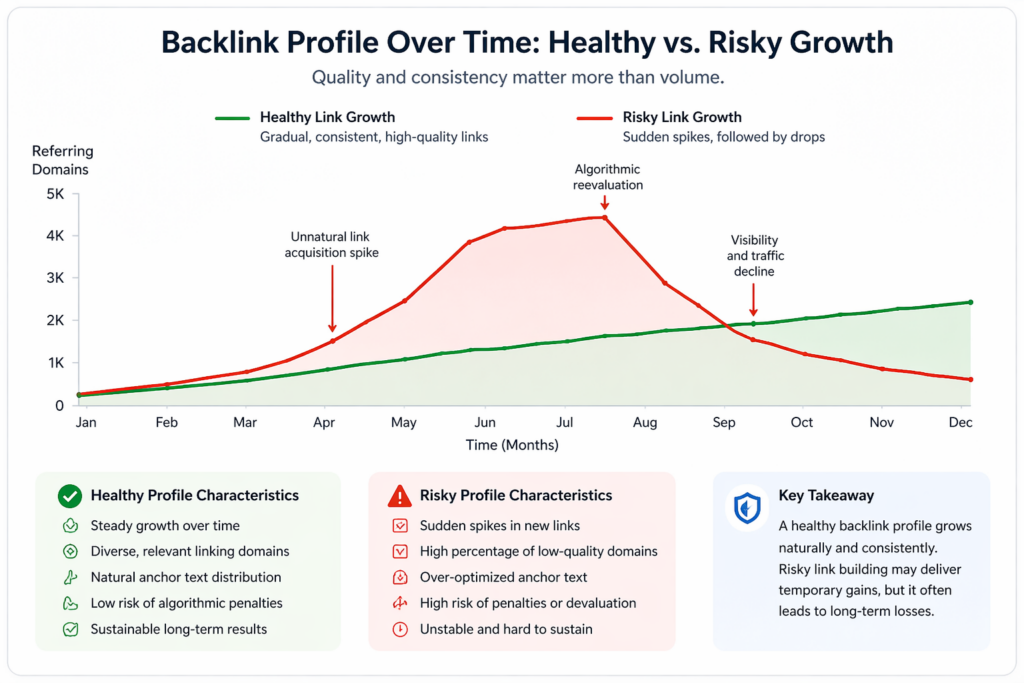
The idea of “negative SEO” is often overstated, but it is still possible for a backlink profile to drift in an unhealthy direction over time. Monitoring ensures that this does not go unnoticed.
Building New Links
Managing risk is only part of the equation.
A backlink profile also needs to grow.
Removing or discounting weak links without adding strong ones can reduce your overall authority. The goal is not just to eliminate risk, but to improve quality.
Safe and effective link acquisition tends to follow a few consistent patterns:
- publishing content that attracts editorial links
- earning coverage through newsworthy or distinctive initiatives
- building relationships within your industry
- analyzing competitors to understand where strong links originate
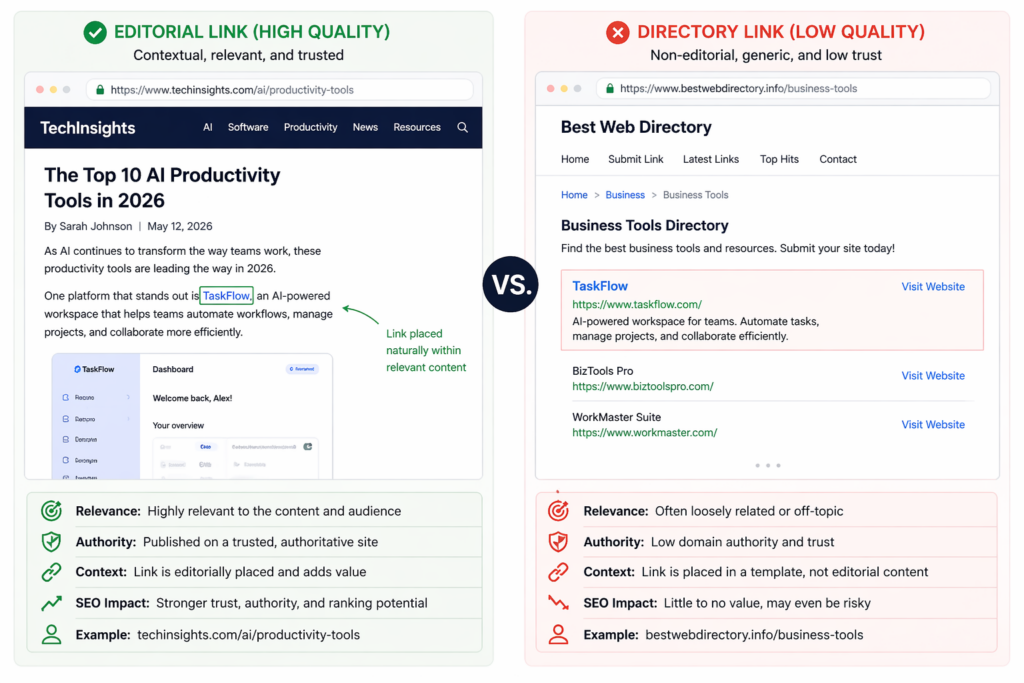
The emphasis has shifted away from tactics and toward relevance. Links that come from sites closely aligned with your topic carry more weight than large volumes of unrelated links. A good illustration of this can be seen in how companies approach link acquisition in practice.
Consider a project management software company that publishes a data-backed report on remote work trends, based on anonymized usage data from its platform. The report is cited by industry blogs, referenced in articles about workplace productivity, and occasionally picked up by larger publications. Over time, it attracts links from relevant, authoritative sources that reinforce the company’s position in its space.
Now compare that to a different approach, where the same company focuses on acquiring links through low-cost guest posts, directories, or unrelated blogs. Those links may increase the total number of backlinks, but they tend to come from weaker, less relevant sources and offer little long-term value.
Both approaches result in links. Only one improves the overall quality and resilience of the backlink profile.
Review Your Work
A backlink profile is not fixed.
Links change over time. Sites that were once low quality may improve. Others may decline. Ownership, content, and relevance can all shift.
For that reason, periodic review is necessary.
This includes:
- revisiting previously disavowed links in rare cases
- reassessing link sources as sites evolve
- identifying patterns that may not have been obvious earlier
This does not need to be constant, but it should be consistent.
Conclusion
Link risk management is no longer a reactive process tied to specific algorithm updates.
It is an ongoing discipline.
Search visibility depends not just on the number of links pointing to your site, but on their quality, relevance, and consistency over time. Ignoring that reality can lead to gradual declines that are difficult to diagnose after the fact.
Managing your backlink profile with the same care you would apply to any other business asset is the most reliable way to maintain and grow organic visibility.