
Who would you invest in?
I’d always put my money on companies that “get it” over ones that don’t. Companies that “get it” ride the Cluetrain. Google gets it, and did in the early years. It has already borne fruit. When Google IPO’d, the stock opened at $85 a share and now sells for around $180, down from its 52-week high of $216. Not bad. I believe Google will still “get it” in 5 years time, so there’s still time to make a buck off of Google. Steve Rubel suggests a mutual fund of the blogging Fortune 500. That’s a clever idea. And how about Weblogs Inc., with 75 blogs in their stable? I think they’ve got big potential. Scott Kessler of BusinessWeek seems to like the company too, as it made his five Net companies to watch in ’05 list. What I don’t comprehend is the New York Times buying About.com for $410 million. About.com is past its prime, and spectacularly overvalued (by an order of magnitude, The Register reckons). They were the equivalent of a Weblogs Inc. back in 1997, but no longer.
So, where do you put your money?
SMA-NA search engine marketing association

SMA-NA is already a force to be reckoned with. Just out of the gates, its membership already represents over $65 million of paid search advertising buying power. I attended their inaugural meeting at Search Engine Strategies earlier this month and was really impressed with the caliber of the search marketers in attendance. From what I picked up at the meeting, SMA-NA is about furthering good business practices within the industry, helping buyers of search engine marketing services confirm that people who claim they’re search marketers really are, delivering benefits to members, educating people about search engine marketing (pre-prepared syllabi, Powerpoint slide decks, …), and more. Looks like it’s going to be a great organization. If you’re into search engine marketing and optimization, whether you’re a vendor or on the client-side, you should consider joining.
Talkin ’bout RSS… on the Chris Pirillo Show

Want to listen to me rant and rave about the power of RSS as a content delivery channel for search marketers? That was a rhetorical question. Frankly, who wouldn’t!
So now you get your chance, on my interview on the Chris Pirillo Show, which was just podcasted today. Chris interviewed me last week at Search Engine Strategies. Have a listen.
New eyetracking study: where Google searchers look and click
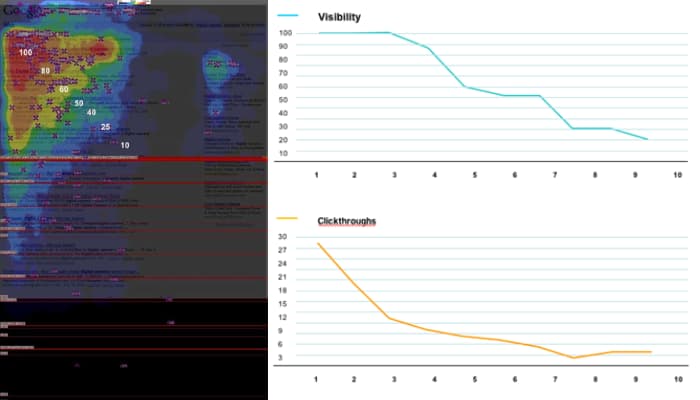
I found the eyetracking study from Enquiro and Did-It unveiled last week at Search Engine Strategies and covered in Search Day fascinating. The aggregate heat map shown on the right (larger version here) shows where participants focused their eyes (and their attention) the most. As you can see, the first listing not only drew the most attention; the full listing was read more fully from left to right, than other listings.
Visibility drops the further down the search results you go, and clickthroughs drop even more markedly (as you can see from the graphs below). This got me thinking about Zipf’s Law. Zipf’s Law is applicable to Top Ten Lists, as Seth Godin explains, perhaps Zipf’s Law might be applicable to the SERPs (search engine results pages) too? (In general terms, Zipf’s Law states that being #1 is much, much better than being #2 which is much, much better than being #3 and so on. So dominating a Top 10 list is critical.) Although these graphs don’t follow Zipf’s Law exactly, nonetheless given this data I’d consider it foolish to be complacent if your search listings are not at the very top of the SERPs.
What is it about searchers that makes them so blind to relevant results further down the page? Is this due to the “implied endorsement” effect, where searchers tend to simply trust Google to point them to the right thing? Or is it just the way humans are wired, to make snap decisions, as Malcolm Gladwell insightfully explains in his new book, Blink? According to the study, 72% of searchers click on the first link of interest, whereas 25.5% read all listings first, then decide. My guess is that both effects (“implied endorsement” and “rapid cognition”) play a role in searcher behavior.
A few other important take-aways from the study:
- 6/7 (85%) of searchers click on natural (“organic”) results (not 60/40 as the search engines and PPC (pay-per-click) vendors would have you believe).
- The top 4 sponsored slots are equivalent in views to being ranked at #7 – #10 natural.
- (corollary to #2): This means if you need to make a business case for natural search, then (assuming you can attain at least #3 rank in natural for the same keywords you bid on) natural search could be worth two to three times your PPC results.
In all, a superb research study. Great job Did-It, Enquiro, and EyeTools!


Retailers and Catalogers: Sign up for this free webinar from Catalog Age on SEO

If you’re interested in practical, no B.S. advice on how to achieve higher rankings in the natural search results, this is the webinar for you: Wednesday, March 9 at 2pm Eastern / 11am Pacific. It’s brought to you by Catalog Age magazine. I’ll be the main presenter, with Joan Broughton, VP of Multichannel Programs/Online at REI, presenting a case study (Disclosure: yes, REI is a client), and Shaun Ryan, CEO of SLI Systems expounding on keyword research tools and tactics. At the reasonable price of FREE, you’d be a mug to pass this up! Sign up here, and do it now.
Become.com shopping search engine coming into its own

Become.com is a pretty cool little new shopping search engine, specializing in product reviews and other info for the research-oriented consumer. Its index is now up to 2.2 billion pages in size, all of it taken from shopping-related web sites in the US. It’s in public beta now, so give it a whirl. You’ll need to register as a beta user before you can start using it. www.become.com