
This article was originally published under Search Engine Land.
The currency of the SEO industry is, and has always been, “dollars for hours” — in other words, the traditional consulting model that is in use at accounting and law firms around the globe. Just think of what would be possible if it were to change to something more tied to the value being delivered!
SEOs aspire to “knock it out of the park” for their clients. But they can’t always do so because fixed-rate contracts constrain them, limiting the resources they can feasibly (profitably) apply to any one campaign or client. For clients, it’s common for their SEO budgets to be nowhere near that of their AdWords budgets. And how could you blame them? Compared to PPC, it’s so much harder to isolate the impact of previous SEO activities, or to prove in advance the business case for an upcoming SEO initiative.
However, this becomes a self-fulfilling prophesy; it’s amazing how difficult it is to “move the needle” when you have insufficient resources. If only SEO could work like paid search and other direct marketing channels, i.e. like a veritable cash machine where you put $1 in and it spits $10 out…! Keep putting one dollar bills in, keep getting ten dollar bills out. You’d want to do that all day; certainly the CFO would. Problem is, it’s difficult to demonstrate unambiguously and reliably such a cash machine scenario with SEO. Until that changes, SEO will continue to be underfunded.
How do you shift the opinions of those who hold the purse strings — from SEO being an unpredictable “black art” to it being an accountable marketing channel? Simple: a pay-for-performance pricing model similar to that of paid search. This can only be possible when there is clear, comprehensive and objective tracking and measurement of SEO efforts and results. What I’m talking about is “search analytics” (including predictive analytics). This is different from “web analytics,” which wasn’t built by SEOs, gives short shrift to SEO, and really only tells you what you’ve already been getting rather than what you could be getting. Industrial-strength search analytics isn’t something we, as an industry, have historically had at our disposal. Until we do, the SEO agencies won’t be able to truly capitalize on the immense value created for their clients.
At Netconcepts, we have started down this road of accountable marketing. The way we “cracked the code” of pay-for-performance was by developing a scalable, automated natural search technology solution (GravityStream) and pricing it on a cost-per-click basis. Nonetheless, we still have flat-fee pricing for our SEO audits and monthly retainers for our ongoing SEO consulting, just like everyone else. Whether you’re client side or agency side, the Holy Grail is a pricing model based on the value delivered. It’s a win-win for both sides: for the vendor there is upside potential when they over-deliver (although ceilings or caps on that upside potential quickly evaporate much of the incentive), for the client much of the risk has been removed (i.e. only pay for actual clicks or other actions).
Today, this model is fraught with problems. An SEO might be reluctant to enter into such a performance-based arrangement because the actual implementation of his or her recommendations falls to the client (and, as such, is outside their control). The SEO is at the mercy of the client and its IT Department, and the implementation (or lack thereof) directly impacts revenue opportunity. In this scenario, the vendor is betting his/her paycheck on whether IT “gets it” and considers these modifications mission-critical. That is a bet with very bad odds.
So as an SEO consultant, how could you possibly adopt a performance-based pricing model without a crystal ball? By employing the newly launched (predictive) search analytics platform Enquisite Campaign. Let’s see how…
With this application, the first step is to create “opportunities” to help you determine whether a given SEO campaign is worth going after. You can estimate the number of potential referrals available, the revenue impact of those referrals, the amount of work required, and the resulting ROI. All these variables may be customized to the unique situation of a given vendor or client.
The potential — in terms of referrals, dollar value, and ROI — is calculated by Enquisite Campaign for all the keywords in your defined campaign list. In addition – here’s the crystal ball part – the application exposes keywords not on your original list that are either currently driving traffic or not currently driving traffic but related. Importantly, this is done without having any data on conversion rate, bounce rate, time on site, or pages viewed — data points which you normally need to determine the potential for keywords currently driving traffic. The number of referrals are estimated for keywords that are off your radar, based on keyword popularity data from Google and Yahoo (via their APIs) and click-through rate (CTR). If there is traffic already coming in to your site for a keyword, those referrals are pulled out and shown separately in the reporting so that you can clearly see the upside potential versus baseline traffic.
Here is where the customized variables come into effect. Client revenue from new transactions (i.e. selling stuff) is estimated on that potential traffic by multiplying the incremental search referrals, the conversion rate (as defined by you in a configuration screen) and the average order value (AOV, also defined by you). A value for a non-monetary action, such as a white paper download, can also be defined, along with the revenue potential for you. For example, if you’re IBM, you might value a white paper download as worth $200 based on how likely a white paper downloader is likely to become a six or seven figure consulting contract, some months down the line. Once the campaign is live, Enquisite Campaign then tracks all the incremental referrals, actions, and transactional conversions based on the real traffic and sales data from your site.
Currently, pay-for-performance is also tricky because when you’re trying to estimate ROI on a particular keyword, you need have a reasonable sense of what the cost of optimizing will be in man-hours. How do you do this when you don’t know the particular page to be optimized and what needs to be done to optimize it? As a vendor, you somehow need to know the “cost” (effort required) to acquire the associated revenue. The answer lies in estimating the “optimization difficulty” for each keyword.
Turns out there is a solid correlation between paid search competitiveness and organic optimization difficulty. So, by taking paid search data points, like the number of pages competing for the term, the number of search queries daily on Google and Yahoo, the number of bidders on paid search, the bids, and the CTR, Enquisite Campaign comes up with a reasonable approximation for optimization difficulty. Further, it’s completely independent of the tactics you’ll be employing or your particular circumstances — whether your challenges lie with the CMS, the IT department, or whatever.
Once the SEO nominates a budget in hours for the campaign, Enquisite’s application then allocates the hours across the identified keywords. If for example, you specify that you want to perform a maximum of 20 hours of SEO work in a month, Enquisite will divvy those 20 hours up across the keywords, assigning more time to the keywords that have the greatest upside for the least amount of effort. Now the ROI for each keyword can be calculated. In Campaign, the ROI is displayed as a percentage and calculated based on: revenue potential divided by the effective hourly rate times the estimated number of hours.
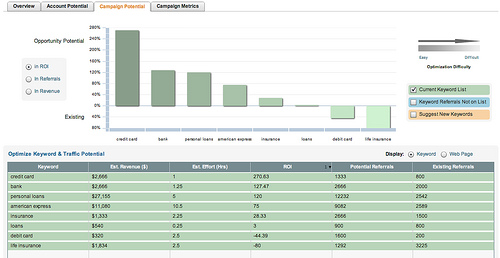
Once you know the ROI potential for any campaign, you can decide on what is the most appropriate performance-based pricing model to pitch to the client — whether it’s search referrals, sales, actions, or even website referrals.
Armed with the above intelligence, SEO practitioners are able to make a case internally for performance-based pricing. And by removing risk for the prospect, the barriers to saying “no” are removed. In a competitive bid situation, a performance-based pitch (presumably informed by data and analysis from Enquisite Campaign or similar) will make you stand out from the crowd because you have some serious “skin in the game.” Essentially, vendor and client incentives are aligned. If you drive incremental action, you participate in the value that is created. The client only pays for incremental upside, all clearly linked to objective data and results.
If you’ve read the book Freakonomics — one of my favorite business books of all time — you’ll know the extreme importance of such alignment. As with any competitive advantage, eventually others in the industry will take notice and decide to adopt (copy) the model. “Embrace and extend,” as Microsoft likes to say!
So there’s a window of opportunity here not to miss. First movers will be the biggest winners, as they will establish themselves as the true performers who are willing to bet on themselves.