
I’m all about systems and processes. That’s the only way to scale. You could be the best link builder in the world, but how are you going to scale that? Until you remove the bottleneck — namely yourself — from the system, you can’t achieve true scale.
Low quality link building is easy to scale. Robotic scripts, mass email blasts, offshore link farms — all of it can be automated. But that is the path to Google penalties and long-term damage to your site’s authority.
Building high quality links — editorial links that are earned by merit — requires high-quality human interaction. Bloggers, journalists, and social media influencers are smart people. They relate to other smart people, not to scripts or bots. In many cases, the strongest links today come from content that is inherently worth referencing: original research, useful tools, or distinctive insights that can’t be found elsewhere.
So how do you scale human interaction?
There’s no shortcut. You need people who can communicate intelligently and persuasively, and you need a team of them. You need a way to train them, delegate to them, and empower them while maintaining quality and measuring performance.
Creating a replicable team empowered with clear methodologies, workflow, and routines is the key to scaling high-quality link building. Essentially, you are building a machine that runs by itself, with as little of your own intervention as possible.
At its core is a workflow-based system that makes it easy to find, capture, and efficiently manage your outreach to online influencers.
Your Foundation: The Workflow
First, let’s talk about the idea of workflow. Workflow is predicated upon having your project or process mapped out. What’s the path from A to B to C? What are the inputs and outputs at each juncture?
Consider this: you undoubtedly have a to-do list on your mind at this very moment. That is inherently inefficient. One of the biggest mistakes I see people make is maintaining a list of to-dos in their head. The human brain simply isn’t good at that. Your brain operates at peak efficiency when it’s clear of the minutia. That minutia (information) in your head must all be dumped into your “trusted system.”
You organize that system in a way that it facilitates your turning that sea of information into decisions and actions. I subscribe to an approach referred to by its followers as “GTD” (which stands for Getting Things Done) that was developed by best-selling author David Allen, and it’s based on his book that just so happens to have been named Getting Things Done.
Please excuse me while I do a bit of proselytizing about the value of GTD — in managing your link building, your time, your business and the rest of your life. GTD is life-changing. It makes you more efficient and more effective. In GTD, you have to understand that most things that you think of as actions aren’t really actions; they are projects. A project is anything requiring more than a single action to complete. A “next action” is the next single activity required to move a project forward.
Let’s look at a real-world example, like selling a house. That is clearly a project, not an action. Even finding a realtor is a project. Now, calling your ex-neighbor who sold their house quickly for a good price to get the name and number of their realtor — that is a “next action.”
When it comes to your workflow, “next actions” are the units of progress that you and your team will deal with. My GTD tool of choice for managing my link building workflow is Pitchbox, but there are a number of excellent tools out there. (Full disclosure: I am an advisor to Pitchbox and have free account access.)
Workflow is absolutely everything when it comes to effectively executing an SEO campaign or initiative. Now, here’s my GTD process for influencer marketing and outreach:
Step 1. Find Potential Targets/Check Their Authority
This can be as simple as running Google searches to identify relevant blogs in your market or niche. I look for sites that are topically relevant, authoritative and trusted.I use a number of third-party tools, each with their own proprietary metrics, to gauge authority and trust of these sites:
- LinkResearchTools, which has Power*Trust
- Moz Link Explorer, which has Domain Authority and Page Authority
- Majestic, which has Citation Flow and Trust Flow
Pitchbox integrates with all of the above via API calls, so pulling the metrics and filtering out low quality sites is fully automated.
Step 2. Get Contact Info Of Potential Targets
Now that I’ve identified the relevant websites based on various criteria, I retrieve contact details from the websites, domain records and other sources. I’m not just talking about names and emails.I’m talking about platforms such as LinkedIn, X (formerly Twitter), YouTube, and other relevant social and content channels.
I grab not just one contact per site, but several (when possible). That way, I have multiple points of contact for when I don’t get a response from the first contact I try.
Of course, this too is an automatic process, not manual. Pitchbox, Buzzstream, or any number of similar tools can automatically search for contact info.
Step 3. Build Intelligent Templates
Obviously, I am not going to write from scratch every email that goes out. That’s not exactly scalable. This is where a smart template and personalization system comes in.
Each attempt in a series gets its own template. Always attempt more than once, but never more than three times to the same person. Most likely, you won’t get a response the first time. By having a follow-up sequence with one or two follow-up attempts, you will increase your response rate.
Creativity in your approach here is key. We all get those stupid emails asking to guest blog on our sites. Even if these emails are well-written, we discard them, right? I will never accept a boilerplate request to guest post on any of my blogs.
What if instead you asked the blogger about their favorite tools in your industry for an article that you are writing? You offer to cite them as a source and even quote them. Of course they are going to respond to that, and they will want to link to your article because it references and quotes them.
Or, perhaps ask them if they are going to the next industry conference. If you are both going, then you could meet in person. If they respond that they aren’t going, you could then ask them what conferences they recommend. Starting such a dialogue is a great way to build rapport and relationships with influencers.
Step 4. Personalize
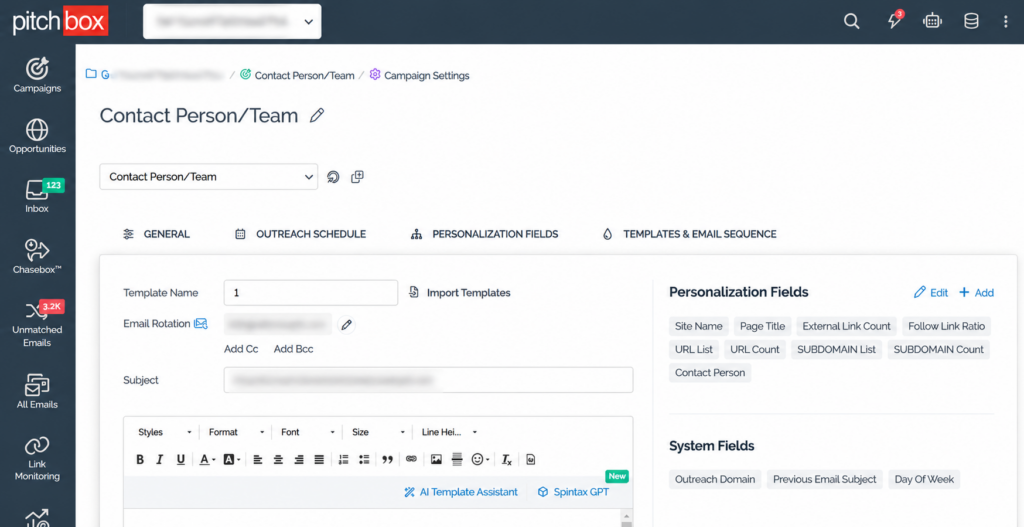
With these templates on hand, I can now think about personalizing them to make them even more effective. Think mail merge, but on steroids.
The goal is to make each email feel singularly handcrafted for that one recipient, demonstrating that real time and thought has gone into it. That is what drives response rates up.
For example, I might include an insightful comment about the recipient’s most recent article or post, showing that I genuinely follow and engage with their content. That comment becomes one of the merge fields, inserted into the template automatically.
Today there are more tools than ever for this. Pitchbox handles personalization fields natively within its outreach workflow. For email marketing more broadly, tools like Mailchimp and AWeber offer solid mail merge functionality, though they are better suited for list-based campaigns than targeted influencer outreach.
The legwork of populating those merge fields still requires a human touch. That is where the outreach team comes in. They visit each site, read the content, and populate the personalization fields with observations that make each email feel considered rather than automated.
Step 5. Utilize A Moderation Queue
The outreach team gets these emails ready to send by marrying the templates with their web research and thoughtful commentary. But these emails don’t get sent just yet.
They go into a holding tank first. From there, I or one of my managers reviews each message, approving it to move into a second queue. This moderation step is what separates a professional outreach operation from a spray-and-pray campaign. It ensures that nothing embarrassing, off-brand, or poorly personalized goes out under your name.
Step 6. Send The Messages
From the second holding tank, queued messages await their scheduled delivery window, going out during the hours and days previously specified in the campaign settings, for example 7 a.m. to 4 p.m. Monday through Friday.
Anyone who sends significant outreach volume knows you don’t email when recipients aren’t working, and you never blast everything at once. Sending too many emails in a short window gets flagged by spam filters at Gmail, Microsoft, and other major providers. Instead you throttle delivery so it mimics natural human sending behavior.
Step 7. Maintain The CRM (Customer Relationship Management) Database
Anyone in sales will tell you how critical it is to have a CRM and to actually use it. Without one, opportunities slip through the cracks constantly.
Traditional CRM systems are not a natural fit for link building workflows, which is why I use the CRM built directly into Pitchbox. It is designed specifically for outreach pipelines rather than generic sales processes.
I track every opportunity from first contact to close. In the CRM, I maintain contacts, outreach requests, and recipients’ responses. I treat it like a sales pipeline. The goal is to move each prospect through the funnel to a close, except in this context a close is an article placement, a citation, or a link.
Step 8. Automate Your Follow-Up
Imagine following up with prospects even when you are not around, like when you are sitting on a beach in Costa Rica. That is exactly the situation I have been in while building this out, and the pipeline kept moving without me.
Follow-up is scheduled in advance. Seven days with no response? The target receives the second email in the sequence. Another week of silence? They receive the third and final one. Do not let any outreach go three weeks without a follow-up, unless you have already maxed out that prospect with no response across all three attempts.
Your “Machine,” Powered By An End-to-End Toolset
The reality of influencer outreach is that it is messy, tedious, and has a high failure rate. Without powerful tools, you are dead in the water. A collection of disconnected point solutions adds to the chaos rather than reducing it.
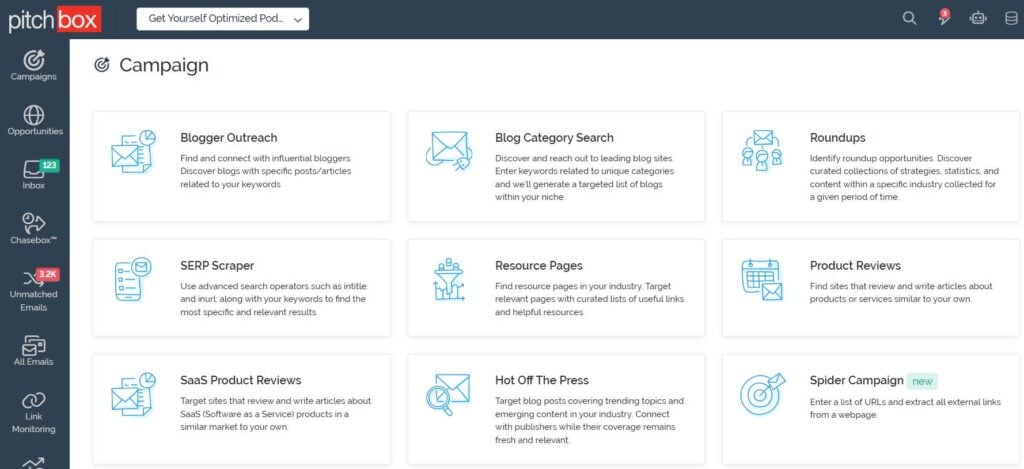
An end-to-end solution is what this job requires. With a unified toolset, you build and run the outreach campaign in its entirety, from creating the prospect list, to gathering contact information, to preparing and sending emails, to organizing responses, to maintaining a CRM and link pipeline. Prospecting, SEO metrics, personalization, automated follow-up, and relationship management all operate within a single workflow.
Letting hot outreach leads go cold is a waste of both money and opportunity. Even if you are not yet using an end-to-end solution, at minimum set tasks and reminders to keep things from falling through the cracks.
As David Allen says, “Your mind is for having ideas, not holding them.”
Employ GTD, a CRM, and this eight-step process. It will save you time, protect your sanity, and make you considerably more money.
No tool, however powerful, will ever eliminate the need for creativity in producing content worth linking to. But with the right systems and workflow in place, you will achieve scale with your outreach in ways you never thought possible.