

You’ve done your basic keyword research and strategized a plan to tackle the keywords for which you want to rank. You are working that plan to increase your rankings, traffic, and of course, conversions.
You’re good on your keyword plan, right? Not so fast. Are you sure there are no opportunities you are missing out on? What about keywords that aren’t in your plan yet? If you aren’t sure that you are squeezing all the juice out of your keywords, then I have a few tips and techniques to suggest.
If you haven’t done your basic keyword research and strategy yet, why not? One of the most critical steps to having a search engine-friendly website is to choose the keywords or phrases that are most relevant and popular with your target audience.
There are a number of tools to assist you in identifying the best opportunities, including Semrush, Ahrefs, and Google’s own Keyword Planner. For a deeper grounding in keyword research and strategy, Chapter 5 of The Art of SEO covers the subject comprehensively. I am one of the authors, so I may be biased, but the guidance there has held up well.
Mine Your Existing Site Search
One of the most overlooked sources of keyword insight is your own site search.
When users search on your site, they are revealing intent with a level of clarity you rarely get elsewhere. They are telling you one of three things:
- They believe the content exists, but they cannot find it
- They expect you to have it, but you do not
- They know it exists, but search is faster than navigation
Each of these signals points to opportunity.
If large numbers of users are searching for something that already exists, your navigation or internal linking may be failing. If they are using terminology you did not anticipate, that is a direct clue into how your audience actually thinks and searches.
In many cases, you will uncover high-intent phrases that were never part of your keyword strategy.
Those are not just keywords. They are conversion opportunities.
How to act on it
- Identify recurring search terms from your internal search data
- Compare those terms to your existing pages
- Improve visibility through navigation, internal links, or page optimization
- Create new pages when intent is not properly served
In GA4, this data typically lives under enhanced measurement or custom events tied to internal search. In Google Search Console, you can validate whether those same queries exist externally and whether you already receive impressions.
When internal demand aligns with external search behavior, you have a clear path to capturing additional traffic and conversions.
Keywords You Didn’t Know You Were Ranking For
Another underutilized opportunity is the set of queries you already rank for but have never explicitly targeted.
Search engines now interpret content at a topical level. That means your pages often rank for dozens or even hundreds of related queries, many of which never appear in your keyword tracking.
Some of these rankings sit just outside page one. Others exist without any deliberate optimization at all.
This is where the most efficient gains often live.
What to look for
In Google Search Console:
- Queries with high impressions but low clicks
- Rankings in positions 8 through 15
- Pages that rank for a wide range of loosely related terms
These are signals that your content is already considered relevant, but not yet strong enough to dominate.
What happens next
Small adjustments can make a disproportionate impact:
- Expanding sections to better address intent
- Refining headings to reflect how users search
- Strengthening internal links to the page
- Clarifying topical coverage by incorporating closely related concepts
It is not uncommon to see a page move from position 11 to position 6 with relatively minor improvements. That shift alone can significantly increase traffic.
Look Beyond Individual Keywords
Keyword research used to be about finding the exact phrase to target.
That is no longer sufficient.
Search engines now evaluate how well a page covers a topic, not just whether it includes a specific phrase. As a result, the real opportunity lies in identifying clusters of related queries and the intent behind them.
For example, instead of optimizing for a single phrase like “running shoes,” a stronger approach would be to cover:
- how to choose running shoes
- running shoes for different foot types
- common mistakes when buying running shoes
- comparisons between models or brands
Each of these queries reflects a different stage of decision-making. Together, they form a more complete picture of user intent.
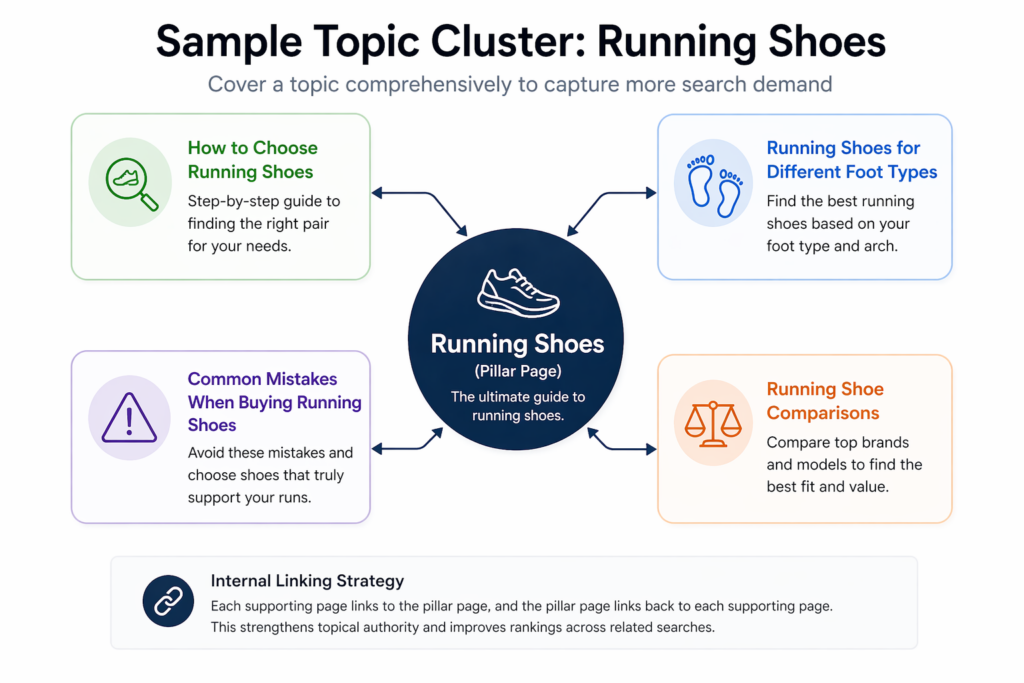
When your content aligns with that broader context, it becomes more resilient in search results and more likely to surface across a wider range of queries.
Focus on Page-Level Opportunity
Not all pages are equal.
Some pages are already close to breaking through, while others would require a complete rebuild. The key is knowing where to invest effort.
Two areas tend to produce the highest return:
1. Positions just outside page one
Pages ranking in positions 11, 12, or 13 often require less effort to improve than pages buried deeper in the results.
Even a modest lift can move them into page one, where visibility and click-through rates increase significantly.
2. Positions near the top
Moving from position 2 to position 1 can have a noticeable impact on traffic. While more competitive, these opportunities are still worth evaluating, especially when the query has commercial intent.
The goal is not to chase every keyword. It is to identify where incremental gains produce meaningful results.
Use Data as a Feedback Loop
SEO is not a one-time process. It is an ongoing cycle of observation and adjustment.
As you uncover new keyword opportunities, track how changes affect performance:
- Which pages gained visibility
- Which queries improved in ranking
- Which updates led to increased engagement or conversions
Over time, patterns emerge. You begin to understand which types of content perform best, which topics resonate, and where your competitive advantages lie.
This is where SEO shifts from execution to strategy.
Final Thoughts
Most keyword strategies focus on what to target next. Fewer take the time to fully extract value from what is already there.
Hidden within your site are signals from real users, partial rankings that can be improved, and topics that have not yet been fully developed.
If you take the time to surface and act on these opportunities, you are not starting from zero. You are building on existing momentum.
And that is often where the most efficient growth happens.