If you’ve been following along, you already know that SEO is no longer confined to traditional content formats. Articles and blog posts still matter, but they are no longer the only vehicles for visibility.
Podcasting, when approached strategically, can play a powerful role in both audience growth and search performance.
A podcast is not just an audio file. It is a content engine. When properly structured and distributed, it contributes to topical authority, brand visibility, and link acquisition.
Below are six ways to align your podcast strategy with SEO so that both reinforce each other.
1. It’s all in the title
Discovery starts with clarity.
Your podcast title needs to communicate what the show is about in a way that both users and platforms can understand immediately. Obscure or overly clever titles may be memorable, but they often fail at discoverability.
The goal is not to “optimize for keywords” in the old sense, but to ensure that your topic and positioning are unmistakable.
For example, a podcast titled “The Growth Lab” may sound compelling, but without additional context, it lacks specificity. Adding a subtitle such as “Marketing and SEO Strategies for Scaling Businesses” makes the intent clear and improves discoverability across platforms.
At the same time, avoid the opposite extreme. A title that is overly generic will struggle to stand out. The balance is clarity with distinction.
2. Your feed is your foundation
Your podcast feed is the infrastructure that distributes your content across platforms such as Apple Podcasts, Spotify, and others.
While listeners rarely interact with it directly, it controls how your podcast is presented, categorized, and updated across every directory it appears in.
This includes show title and description, episode titles and summaries, and categorization and metadata. Inconsistent or poorly structured information at this level can limit discoverability across platforms.
For WordPress users, the PowerPress plugin by Blubrry remains the most reliable way to manage your podcast RSS feed. It handles feed generation, episode metadata, and directory submissions in one place, and integrates directly with Apple Podcasts and Spotify. If you want to validate that your feed is correctly structured before submitting it to directories, tools like Podbase can surface issues before they cause problems downstream.
Think of your feed as the source of truth for your podcast’s identity. Keep it clean, accurate, and consistent.
3. Leverage your website as the primary asset
Your podcast should not live only on external platforms.
If your episodes exist exclusively on podcast directories, you are building visibility without owning the asset. The real SEO value comes from anchoring your podcast to your own site.
Each episode should have a dedicated page that includes a summary or recap, structured show notes, a full transcript, and supporting media where relevant.
The transcript, in particular, is critical. It transforms audio into indexable content, allowing search engines to understand the full depth of the discussion. On my own Marketing Speak podcast, every episode page includes a full transcript alongside show notes and timestamps. That structure means each episode has a text-rich destination that can rank, attract links, and remain useful long after publication rather than disappearing into a podcast directory.
Each episode should also have unique episode art. A well-produced cover image gives each episode its own visual identity and makes it more shareable across social platforms. A great example of this done well is Orion’s Method, the podcast hosted by my wife Orion Talmay, where consistent, distinctive episode art makes each entry feel like a standalone asset rather than a generic feed item.

4. Repurpose your content systematically
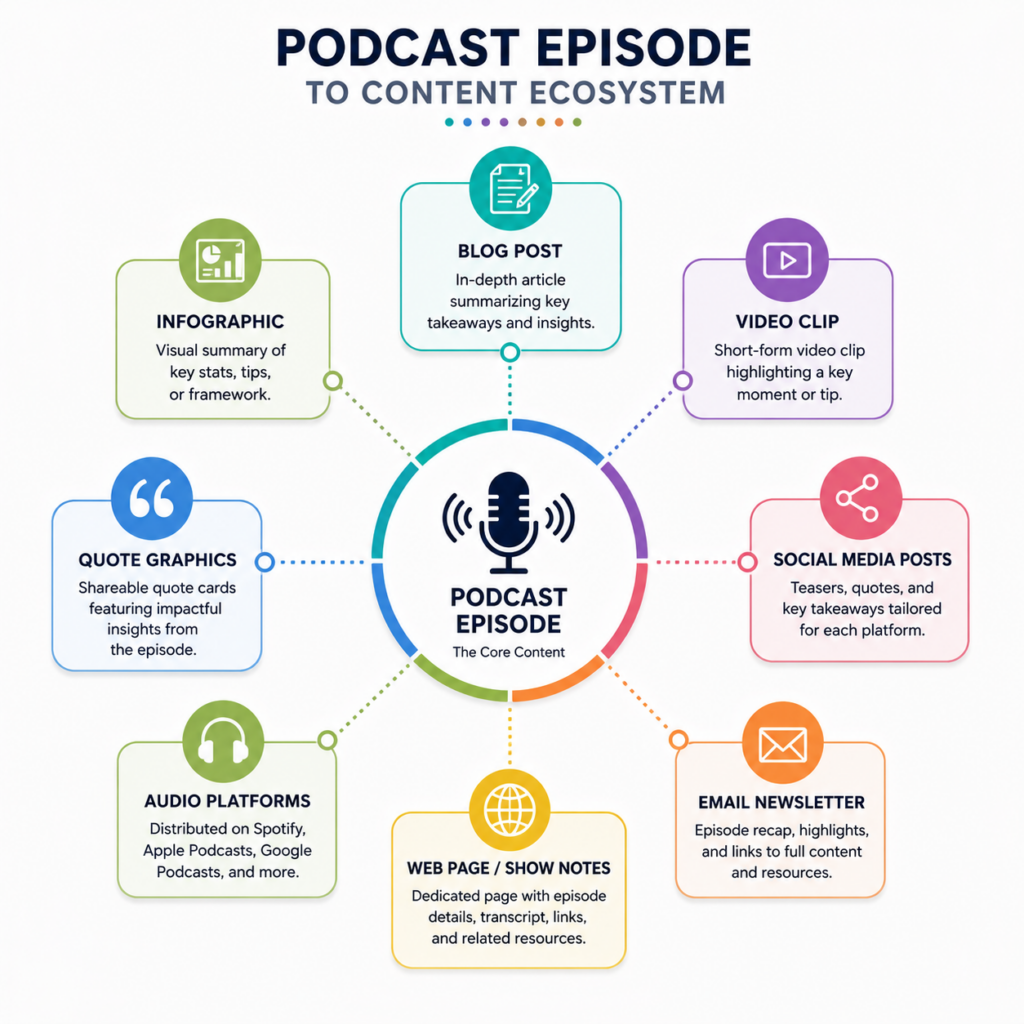
A single podcast episode contains far more value than its audio file alone.
In fact, many of the tips in this article were drawn directly from episodes of my Marketing Speak podcast, including interviews with Daniel J. Lewis on growing your podcast audience through SEO, and Rob Walch on building a successful show. That is repurposing in practice.
A single recorded conversation can become:
- a written article or blog post
- a transcript that stands alone as a reference resource
- a slide presentation or visual summary
- short-form clips for social distribution
- an infographic distilling the key points
Each format reaches a different audience and serves a different search purpose. A transcript supports long-tail search queries. A video clip drives discovery on YouTube and social platforms. A written article earns links. Together they extend the reach of content you have already produced.
The goal is not to create more work. It is to extract the full value from work already done.
5. Don’t overlook YouTube
YouTube is no longer just a video platform. It is a major search environment that is tightly integrated into Google’s results.
Podcast content fits naturally into this ecosystem.
A clear example of this can be seen with The Diary of a CEO. The show publishes full-length podcast episodes on YouTube, often accompanied by strong titles, structured descriptions, and consistent branding. Many of these episodes rank not only within YouTube search, but also appear directly in Google results for topics related to business, psychology, and personal development.

This visibility is not driven by video production alone, but by how the content is positioned and described. Each episode targets a clear topic, making it easier for both platforms and users to understand its relevance.
Even if you do not record video, your audio can be paired with:
- static visuals
- slides or supporting graphics
- simple branded video formats
More importantly, YouTube functions as one of the largest search engines in the world, often described as second only to Google itself . This creates an additional pathway for discovery beyond traditional podcast platforms.
To maximize this:
- use clear, descriptive titles
- write detailed descriptions that link back to your site
- include accurate transcripts or captions
Publishing podcast content on YouTube broadens its visibility and increases the likelihood of appearing in both video search results and standard Google listings.
6. Use podcasting as a link and authority driver
Podcasting can play a direct role in building authority.
One of the most effective ways to do this is through guest participation. When you feature guests who have their own audience, you create a natural opportunity for amplification.
Guests often:
- share the episode with their audience
- reference it on their site
- include it in newsletters or social posts
This creates both visibility and potential links back to your episode pages.
For example, when a well-known author or industry expert appears on a podcast, they frequently promote that appearance as part of their broader media presence. This can result in mentions and links from multiple sources.
The key is to structure your episodes so that they provide value not just to listeners, but also to participants.
Podcasting, in this sense, becomes a form of network-driven content distribution.
Final thoughts
Podcasting and SEO are not separate strategies. When aligned properly, they reinforce each other.
Your podcast builds authority, expands your reach, and creates new content opportunities. Your SEO strategy ensures that content is discoverable, structured, and able to accumulate long-term value.
Together, they create a system where each new episode contributes to something larger.
Done well, podcasting is not just a channel. It is a long-term asset that compounds over time.