I am tired of hearing various pundits proclaim that SEO is dead. Perhaps they are simply being provocative. Maybe they need to fill seats at their events, so they resort to bait session titles like “Why SEO Is Fundamentally Dead.” (Yes, that was an actual keynote title at a major conference.) Or perhaps they have come to believe their own rhetoric.
SEO is not dead. But the way many people still practice it very well might be.
If your approach consists of optimizing a few headings, tweaking meta tags, building a handful of links, and then waiting for rankings to improve, the problem is not search engines. The problem is your model of how search works.
This kind of cookie-cutter approach treats SEO as if it were a mechanical checklist, like tuning a guitar or following a recipe. That worldview no longer reflects reality, if it ever truly did.
Traditional SEO Is Dead
It is human nature to want a repeatable formula. Unfortunately, there is no deterministic formula for SEO anymore. Best practices still matter. Technical competence still matters. The fundamentals of on-page and off-page SEO remain the prerequisite for everything else. But guarantees do not exist.
They never really did.
Anyone promising rankings should still be avoided at all costs.
For years, many practitioners operated under the assumption that incremental tweaks would inevitably be rewarded. One more keyword in a title tag. One more link. One more on-page adjustment. The belief was that these actions could reliably produce predictable outcomes.
That assumption no longer holds.
So if SEO outcomes cannot be precisely predicted, does that mean SEO is dead? In a narrow sense, yes. SEO as an exercise in outsmarting search engines is largely obsolete. But SEO itself has not disappeared. It has evolved into something broader, more nuanced, and more demanding.
To understand what SEO is today, it helps to understand how search itself changed.
The Shift Toward Quality Evaluation at Scale
The release of Google Panda in early 2011 marked a fundamental turning point. While Panda was often summarized as a thin content filter, that framing missed the deeper shift.
Panda operationalized human quality judgments at web scale.
Google gathered large-scale human evaluations based on questions related to trust, usefulness, depth, and overall experience. Those judgments were then generalized across the index. The important takeaway was not the specific factors, but the realization that subjective assessments of quality could be modeled and applied algorithmically.
It is easy to manipulate a keyword signal. It is much harder to manipulate perceived quality.
Humans form trust judgments almost instantaneously. As Malcolm Gladwell explored in Blink, these snap assessments happen beneath conscious reasoning. Whether a site feels credible, manipulative, thin, or authoritative is often decided in moments. That kind of judgment is inherently resistant to gaming.
From Keywords to Meaning
In 2013, Google introduced Hummingbird, a major reworking of its core search systems. Unlike Panda or Penguin, Hummingbird did not cause dramatic visible penalties for most sites. Yet it quietly affected approximately 90 percent of all searches, a far greater reach than Panda’s 12 percent, which tells you something important about the scale of what changed.
The reason was that search was no longer primarily about matching strings of text. Search engines needed to understand what a query meant, not just which words it contained.
Conversational search, voice input, and increasingly complex queries forced search systems to interpret intent, context, and relationships between concepts. This required a shift from keywords to meaning. That transition marked the rise of semantic search, and it remains the foundation of how search operates today.
Semantic search allows a system to understand topics holistically, including the relationships between concepts within a subject area. Queries are no longer treated as isolated keyword strings but as expressions of intent within a broader context.
That is why pages can rank for queries that never appear verbatim in their content. Meaning is inferred from topical coverage, not from exact phrasing.
Interpreting Queries That Have Never Been Seen Before
Search systems also needed a way to handle queries they had never encountered. Even today, a meaningful percentage of daily searches are entirely new. Systems built around static keyword mappings cannot handle this.
This is where machine learning based query interpretation became critical. Starting with RankBrain and continuing through more recent systems including MUM and the large language model integrations now embedded in Google’s core infrastructure, the ability to interpret unfamiliar or ambiguous queries by mapping them into known concepts and patterns has become fundamental to how search works.
As a result, search engines became far better at understanding what content is about, even when the phrasing does not align neatly with traditional optimization targets. This evolution reduced the marginal value of obsessing over exact keyword placement while increasing the importance of topical clarity and depth.
Why On-Page Optimization Matters Less Than It Used To
Studies over the years have consistently shown that having an exact match keyword in a title tag is no longer a strong differentiator.
This does not mean title tags are unimportant. They still influence click behavior and help establish relevance. But they are no longer the primary mechanism by which a page communicates its topic.
Search engines now infer topic understanding from a constellation of signals: related concepts, contextual language, structural coherence, and how comprehensively a subject is addressed. A page that clearly and thoroughly covers a topic will often rank for a wide range of related queries, even if individual terms are never explicitly targeted.
SEO Is Now About Entities and Relationships
Modern search systems organize understanding around entities rather than isolated keywords. An entity is a thing with meaning and relationships: a person, a concept, a brand, a place, a technology.
If you write about list building, you naturally reference subscribers, email platforms, deliverability, opt-in mechanics, and compliance considerations. These are not synonyms. They are contextual entities that collectively define the topic. The word “email,” for example, adds specificity to “list building” in a way that distinguishes it from building a Facebook audience. That relationship between terms creates meaning beyond just the words themselves.
This is why longer-form content often performs better. Not because length itself is rewarded, but because depth allows for richer entity coverage, clearer topical boundaries, and stronger contextual signals. Effective SEO today requires thinking beyond keyword research and toward topic modeling and conceptual completeness.
What Actually Wins in Search Today
Once the technical foundation is sound, SEO stops being a mechanical discipline and becomes a marketing and product problem.
Winning is no longer about discovering which buttons to push. It is about answering harder questions: Does this content genuinely solve the user’s problem? Does it reflect real experience and demonstrable authority? Is it clearly superior to competing resources? Would someone choose it even if search engines did not exist?
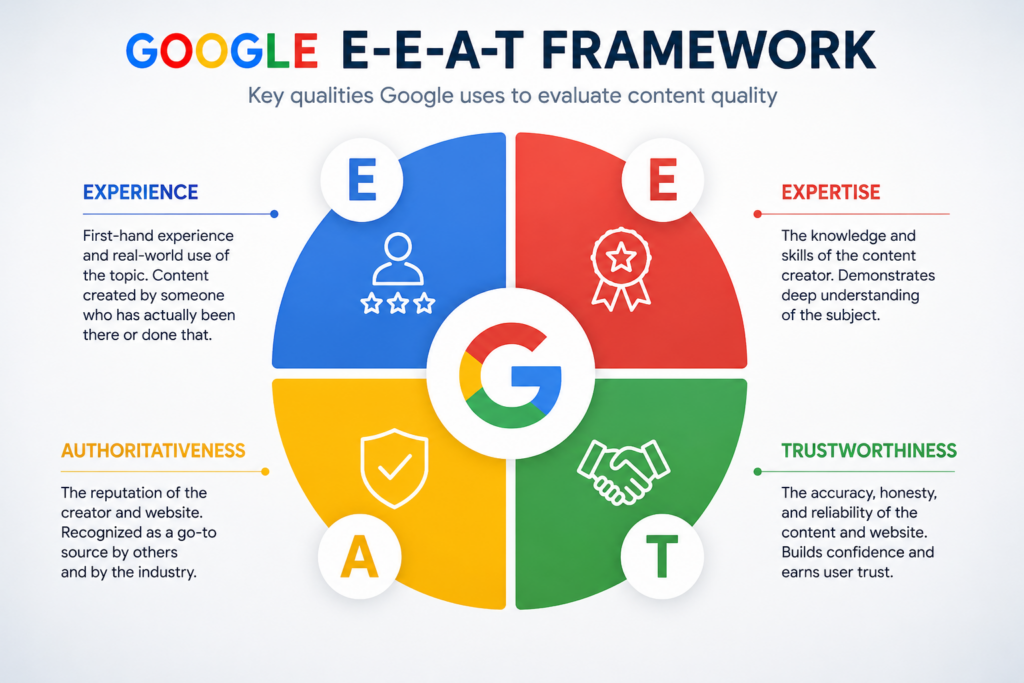
These questions map directly to what Google’s E-E-A-T framework, which evaluates content across dimensions of Experience, Expertise, Authoritativeness, and Trustworthiness, is designed to surface. It is not a direct ranking factor in the mechanical sense, but it reflects the qualities that Google’s systems are increasingly calibrated to reward.
Keyword placement still matters, but precision matters far less than coherence. Manipulation has diminishing returns. Clarity, usefulness, and trust compound over time.
The goal is not to optimize for algorithms. The goal is to deserve visibility.
Extraordinary content has always mattered. What has changed is that search systems are now far better at recognizing it.
SEO is not dead. The simplistic version of it is.
SEO is no longer about control. It is about alignment.
SEO is not dead. Long live SEO.