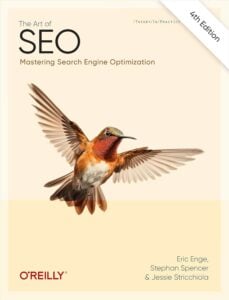
Here we go. Alright, let’s get started. I think we have our first speaker in the room. It’s Stephan Spencer. Please welcome Stephan. He is a world-renowned SEO expert, Best-Selling Author and founder of the digital agency Netconcepts. He optimized sites for major brands like Chanel, Sony and Zappos, and is the author of The Art of SEO. Stephan also hosts the popular podcast, Marketing Speak and Get Yourself Optimized. So let’s dive in. Welcome Stephan. Let’s get him on a big screen.
Hi there, Stephan. Good morning. How are you doing today?
I’m doing great. Thanks for having me.
Alright, let’s just go ahead and dive right into the fun stuff. Okay, so what’s the most surprising or unconventional way you’ve seen AI drive real results in traffic or lead gen?
Yeah. Well, there are so many easy, easy little tricks and tips that you can implement, that most people don’t know about, that you know anyone can do without any real experience. For example, I don’t know if you knew this, but Mapbox actually powers ChatGPT, a local data repository for local businesses. So if you don’t have all your locations, let’s say you have them all in Google Maps. But if you don’t have them all in Mapbox, you don’t have them all in ChatGPT. So, just go in and add those additional listings or make changes to the ones already in Mapbox. Now you have that presence built out in ChatGPT.
For the people who don’t know about Mapbox. Can you share a little bit about that?
Yeah, so Mapbox is a repository. It’s like a competitor to Google Maps, but it is community-maintained and has many uses beyond ChatGPT. It’s been around for quite a while. It’s that. It’s just the tool that ChatGPT utilizes. So when you go to mapbox.com, you can look up your business by putting in a keyword search for your business name, and then you’ll find out if it has all the locations or not. You can add the ones that are missing. You can make updates to the ones that have incorrect information or obsolete information.
So it’s just a way of getting your local data into ChatGPT, because ChatGPT is not using Google Maps data; it’s using Mapbox.
Gotcha, okay, well, that’s great information. New users out there. You’ve worked with some of the biggest brands in the world. How are forward-thinking businesses waving AI into their strategy in ways that set them apart?
Yeah, so unfortunately, most businesses —let’s say 70% —aren’t using AI strategically, meaning they haven’t actually come up with a plan. So that’s a real missed opportunity, because what’s the quote? Fail to plan, and you plan to fail, right? So if you don’t have a strategy around your use of AI, then you’re kind of shooting in the dark. It’s kind of random acts instead of marketing random or, you know, random acts of AI usage or AI integration.
To have a truly AI-first mindset, you need to know what goal posts you’re heading towards. So that’s the first thing to do. And, you know, there are plenty of tools out there. Still, the most obvious ones are the ones that you’re already using ChatGPT, you know, Gemini, Claude and Grok, because even if the only tool you’re using consistently, from an SEO or from just a day-to-day perspective, is ChatGPT, it’s incredible what you can accomplish just with ChatGPT.
Realistically, most people are not using all the other LLMs. They’re pretty much using ChatGPT. So the market penetration for ChatGPT is around 60%, with nearly 70% usage. The next big competitor is Claude, which has about a 5 or 6% market share, so focus on getting one thing right. Dial it in, and that would be, let’s say, ChatGPT for most of you, which means getting your prompting right. So garbage in, garbage out, as programmers have said for decades, but it’s also gold in, gold out. So when your prompts are really finely tuned, you’re going to get great output.
And also another kind of secret hack for getting great output from ChatGPT or whatever your LLM is, is that your tool of choice could be Perplexity, for example, is to just simply be more connected to your higher purpose, connected to your higher power, while you are connecting with your LLM.
So you’re actually seeing the LLM as just an interface to infinite intelligence. You know, it’s just you’re using it as a tool. Some people like to use AI as a therapist or a coach. I think that’s very dangerous. It’s not your friend. It’s a tool.
When you use it as a tool and connect to your higher power while typing with that powerful intention, I guarantee you’re going to get better results. So that’s my favorite of the prompt engineering tips. And I don’t hear people talking about that. I think I’m the only one who ever talks about that. And it’s just to me, it’s so obvious.
I can’t agree with you more. Yeah, connect with your power. Get your intention very clear. Get focused, and then use what you know. And if that’s ChatGPT, since it’s the most popular one by far, then learn how to use it and prompt it effectively. Yes, I think that’s good. It’s solid advice, for sure, when it comes to prompting AI. Most people are just scratching the surface, like, what are your top prompt secrets for unlocking genius-level output?
Yeah, so one is to give a best-in-class template or example along with your prompt. So, as an example, let’s say you wanted a life plan or a vision map for your future in the next five years. If you ask it to spitball with you on a vision board or a plan like that, it will potentially do a good job.
But if you want to guarantee a much better output, upload a best practice example. For example, when I took the AI Mastery Course from Mindvalley, they provided Lifebook founder, Jon Butcher‘s several-page life manifesto detailing what his life will be like in five years. This was actually written back, I think, in 2017, or something like that, so it already came to pass. This was the example that Vishen Lakhiani offered, and he let us use that as a basis for our own prompt.
So we pasted that in, along with a bullet list of these are the things I want to accomplish. Use this John Butcher write-up as a best practice example. But of course, it needs to be relevant to me, not to him in his life. I want it to be relevant, relevant to my life based on everything you know about me from all the previous interactions we’ve had and all the information you can find about me online, and these 10 or 15 bullet points that I’ve provided about what my I want my future to be like in five years, create the most compelling, Awesome life map, or whatever you want to call it Life Plan for me for five years from now. It’ll do an incredible job because you gave it gold to work with. Remember, gold in, gold out. So that’s an easy, easy win.
If you want to, let’s say, create a bunch of blog posts for your blog and have ChatGPT or Claude write them for you. Instead of just saying, “Write me blog posts,” let’s say a draft manuscript of the the book that you’re working on, your memoir, or some other examples of your writing so better understands your voice, tone, style,humor, etc, rather than just going off of some public information that it finds from some searches that it does.
So that’s, I think, pretty straightforward. Makes sense. But you know, common sense isn’t that common, right? You don’t really think about this stuff until somebody tells it to you, of course that would make total sense. Another one is to Top and Tail your prompts. Topping means at the beginning of the prompt. Add something extra that further fine-tunes what you get as output.
Instead of saying, “Write me a one-page marketing plan,” say, “Act as if you are the combination of Jay Abraham, Seth Godin, Dan Kennedy, and David Ogilvy, and then write me this, right?” Or, if you’re writing this for a specific audience, “Write me this marketing plan.” Or, you know, so that is the top.
Then the tail is stuff that would, you know, also add to the quality of the prompt. So let’s say you’re acting as an expert marketer, or whatever, and here’s your market. Here’s who you’re, you’re you’re writing this for. Here’s my target, our audience, etc. Ideal client avatar, so top and tail add some additional nuance or detail that makes the prompt more complete. You know, there are prompt frameworks out there with acronyms and things like that, but you don’t need to get fancy with it. This is just so simple. Add some detail at the beginning and end. Don’t just type it in as a Google search query, you know, with 10 words, really put some thought into it.
I like that. That’s great advice. So you can say, “put on your marketing brain and marketing hat and act like some good marketers out there, and it’ll kind of emulate their styles.” That’s awesome. So let’s talk blind spots. What common mistakes are you seeing entrepreneurs and businesses making when trying to adopt AI tools?
Well, there, besides the shotgun strategy or having no strategy, or just, you know, kind of random acts of strategy. What they’re doing is they’re not seeing how quickly this is evolving. If you can imagine three years from now, half of the planet is unemployed because of AI. That’s our future. Maybe it’s four years, five tops, but it’s not 10 or 15 years. You know, half the planet is unemployed. And maybe 10 years from now, the entire planet essentially is unemployed. I mean, it’s like trying to employ monkeys versus humans.
Of course, you’re going to employ humans, like maybe the monkey is going to feel really bored and like their life lacks meaning, but you don’t owe them a job, right? So that’s going to be us. We’re going to be like the monkeys, and the AI is going to be super intelligent, so it’s only a matter of time. So you need to skate to where the puck is going. You know, to use the Wayne Gretzky quote, where we are right now, where there are hallucinations and mistakes and essentially, blatant lies in the AI output, making up statistics, making up sources and that sort of stuff that’s only for right now.
You know, the quality or lack thereof, or the kind of hallmarks of AI-written copy, like long dashes, em dashes, and always using triplets or examples of three at a time, that sort of stuff’s going to disappear. You’re not going to be able to tell that an AI wrote it. Like this, the AIs are as dumb as they’re ever going to be right now.
So if you’re not skating to where the puck is going, you’re already obsolete, right? If you’re not spending at least 15 minutes a day, at least, I mean, that’s the bare minimum, maybe an hour. I know some people are spending three to four hours a day in ChatGPT, Gemini, or other AI-based platforms, prompting, brainstorming, using AI to bounce ideas off and finesse their plans, and looking for their blind spots.
Tell me what my blind spots are based on everything you know about me in terms of my business. Also, tell me what you see around the corner that most people don’t see. You know? Why are we not prompting AI to do this stuff daily?

I like that. Try to think ahead and ask AI to see your blind spots, like that. That sounds good. Yeah, that’s a good prompt.
Yeah, there are so many, and you’re not just going to get all this from downloading a prompt library or some nonsense like that, or a PDF with prompting tips, or something you have to do this. You know, it’s kinesthetic, it’s, it’s learning by doing, you finesse this, and you figure out what works and what doesn’t.
You know, just an example use case. So I created two podcast shows: Marketing Speak, and Get Yourself Optimized, which is a personal development podcast. So I’ll feed it the episode transcripts, and then I will ask the AI Claude, in this example, to write me a course outline for an online course based on the episode transcript. And then I’ll ask it to flesh out that outline, to come up with things like learning objectives, reflection questions, exercises, and quizzes for each of the modules.
And then I’ll get it to write the video scripts. I have to do all sorts of finessing with my prompting to get the right length, to get the amount of fact checking I want in there, so that it’s high quality and doesn’t have any misinformation in it, etc, and through that back and forth of me kind of figuring out what the best prompting is to use, I will end up saving dozens of hours what would have normally taken me. It just wouldn’t have been feasible to create courses from podcast episodes.
I’ve been doing these two podcasts for 10 years. I have over 1000 episodes, 1000 hours of content. There’s no way that I could scale my this particular project without AI to create a course like maybe three modules, 20 minutes each, not just based on the podcast audio, but pulling in other information as well from the internet and from the knowledge base of the AI create online courses video based with the the likeness of of the the guest, with their permission. You know, with their voice, you know, created through ElevenLabs, an AI, very close approximation of their voice narrating this course, like that’s mind-bogglingly amazing.
And so this is how you need to think, like I’m skating to where the puck is going. I’m providing something that no other podcast is providing. And I go back to my guests and I tell them what, you know, somebody I interviewed eight years ago, “Hey, it’s been a while. I’m working on creating an actual course using AI based on our hour-long conversation. Here’s what you know: the video script, the outline. If you grant your permission, I’ll create the course, and then you can use it for whatever purposes you want.” And that’ll just be like, “Whoa. I’ve never seen anybody offer this sort of thing. How innovative! Can I hire you, Stephan, to help us with our AI implementation in our company?” I mean, that’s the kind of outside-the-box thinking that you need to have.
How many hours do you think it’s saving you?
It’s not even like, it’s not even computable. Because I wouldn’t embark on these projects if I didn’t have AI, so it would be so immensely unprofitable and unsustainable to do those projects without AI, it’s just not in the realm of possibility. Now, for other things, let’s say I need a copy for 10 pages of my website, and I need it in an hour, AI is the only answer. I mean, you’re not going to just spew out AI-written copies. You’re going to finesse it. You’re going to add your own anecdotes and so forth.
You’re going to again, gold in, gold out. You’re going to give it some material. It could be video-based material that you use to base some of the personal stories, anecdotes, humor, and little bits right that you incorporate into your talks and so forth, into the copy. So then it’s you in an AI-generated rough draft form, and then asset. So that’s how you can do something that would normally take you 10 hours or 15 hours to write 10 pages of copy. You do it in 30 minutes or 45 minutes, right?
Well, that’s just amazing. It’s mind-blowing, everything that you can have AI do now, and you have to just keep contemplating, how can you go bigger? How can you stay on the leading edge? How can you do more? Like, it just seems like it’s really pushing the limits of what’s possible anymore.
Yea. So think of it this way, like this is the year of agentic AI, let’s say the next 12 months, meaning that you can have AI agents do a lot of the work, white collar work that you know you would normally think of as creative and technical, that is some of the easiest to automate with AI.

So if you’re at a desk all day in front of a computer, your job will be 100% automated; it’s just a matter of time. Do you have six months? Do you have 12 months at most? Maybe in 18 months, you’ll have to find a new way to add value. Maybe you’re an AI auditor. That’s your new job title or something. Or if you’re a business owner, how are you incorporating AI into your business? Because your competitors are, and those that are not will soon be out of business.
Even if you’re a local services company, landscape or snow removal or something, you need to automate as much as possible so that you can stay competitive, because there are companies that are going to out-automate you. Then your prices will be outrageously high compared to others, and no one will hire you, right? You’re going to see robots doing the landscaping very soon. That’s the next year, you know, after the year of agentic AI, is the year of robotics AI, right? I don’t know if you’ve seen any of these videos of, like, Boston Dynamics or, you know, Elon Musk’s Tesla bots that are already incredible. Imagine what they’re going to be like in 12 months.
Yeah, yeah. I was talking with my husband, actually, and I was like, “How long before robots are building houses because we build our homes like that, that’s what we do with developers.” And I’m like, “How long until the robots are building the house?”
Not long, not long. And so if you’re not skating to that puck, you’re already basically on your path, out the door, out of business,
Right? Well, it’s happening all faster than we know, I think, faster than most people realize. I think.
Yeah, so think of it this way, like, if you could fit the last 100 years of technology advancements into, you know, not the next 100 years, what would you do at today’s rate of change? Because it’s so much faster than it was 100 years ago. So, the last 100 years, according to Ray Kurzweil, the futurist and AI expert, it would actually fit into the next 20 years, 100 years of AI advance or not, AI just technology advances, you know, 100 years ago, like the toaster was being invented and things like that, right? So it was really an antiquated time in our history.
That was a big one.
Yeah, so if you could fit 100 years into the next 20 years, well, that’s assuming that the rate of advancement is the same. It’s, of course, going to accelerate. So it actually would be the next 12 years. So, 100 years fitting in the next 12 years, our heads are going to be spinning. This is the last normal year. This is what it’s going to be. Everything is going to seem so sci-fi and crazy from this point forward, and we’ve already hit what’s called the red line: you cannot put the genie back in the bottle.
In other words, the red line is where you can’t stop the AI advances. We’ve lost control. We’ve already lost control. It is inevitable. AIs will be 1000s or millions of times smarter than us, and there’s nothing we can do about it now.
Right, so I’m trying to stay on top of it.
Oh, I mean, the most important thing, I think, as a person of faith, is to maintain your connection with your Creator, with with the all that is with whatever you want to call it, the higher power, or, yeah, just develop and maintain that connection, because that makes everything meaningful and gives you purpose, gives you direction, and helps you not be in fear as this crazy future is coming.
Right? Yeah. I mean, what I take from what you’re saying is like, be the conduit, kind of like, source and power and AI and everything that’s going on through the content and stay connected. I like July. So, for say, someone’s ready to take action, like, right now, what are the first two to three moves you’d recommend that they take this week to boost traffic or visibility online using AI.
Yeah. So one of the easiest things you can do, besides setting things up with Mapbox and revising your site content to include key takeaways or a TLDR (too long to read). Didn’t reading synopses at the beginning of the articles make it more palatable to AI? You could just start using AI more often. And if you haven’t already installed the ChatGPT app on your phone, install it. And if you’re only typing to it, start talking to it and having conversations with it, let it speak back to you.
So you can be driving or out for a walk or something, and you can have a “conversation with it”. But remember, treat it as a tool, not as a friend or a colleague, because that is where the slippery slope of getting into dangerous territory comes in, you know, being overly reliant on it.
So I’m surprised how many people aren’t yet talking with ChatGPT. If you ask it to brainstorm with you through the app, it provides feedback and asks questions. You can say this is part of the prompting strategy. Say, ask me whatever questions. Clarifying questions will help you provide the best possible output for my request, you know. So it’ll ask you different things, and then you answer them while driving to work. So really cool.
Yeah, no, that’s great. Just start using it. Get familiar with it. Start talking to it.
Minimum of 15 minutes a day.

Have it ask you questions to get more clarification. I think that’s a good, really good tip for our guests, too. Well, amazing. Is this helpful to you guys? Put a V in the chat if you find it valuable. I think that this is just huge. Stephan has brought some big things that I think can totally change the game for you guys if you start actually implementing them.
So don’t just listen, go take action. That’s something you need to do, go take action like now, because Stephan said, like, this is the year. This is the last normal year we’re going to see, according to Stephan. And I think he’s probably right. So I think Stephan, you have a gift to give away a free digital audiobook. Do you want to tell us a little bit more about that, Stephan?
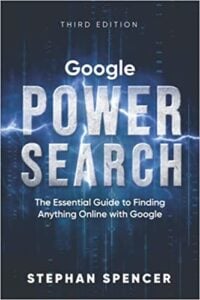
Yeah, so still, the most popular website on the planet is Google. So Google Power Search is a book all about how to get better output from Google searches. So, by being a better searcher, you get really high-value search results back. So I have a book on that. This is the third edition, and I’ve provided the audiobook and the PDF of it, yeah, so it was recently updated in the last couple of years, three years, and it’s not an AI book, it’s just normal Google searching, which is what I’d say a lot of people are still doing. Like I said, Google is the most popular website on the planet, so it might not hurt to get a little more sophisticated in your Google searching, as well as more sophisticated in your prompting with AI.
Yeah, super valuable. Well, thank you so much for that nice gift. You guys make sure to take that and use it. And how can people get a hold of you? Stephan, we’ll drop your socials in here. Feel free to share how people can get hold of you.
Yeah. So Stephanspencer.com is my main website, my personal website. I also have my two podcasts, marketingspeak.com. It is the website for my Marketing Show and the personal development podcast, I have getyourselfoptimized.com for that. My agency, an SEO and digital marketing agency specializing in AI is netconcepts.com, and yeah, I’m on all the socials and is Stephan Spencer.
Alright, you guys, thank you, Stephan. Go, go join us. Podcast. Download it. Listen to it. Check him out on all his socials, and maybe you can even get him to help you with your business and boost your SEO. Thank you so much, Stephan. That added so much value. We’re so grateful to have you.
Thank you so much. All right, perfect.
Well, wasn’t Stephan awesome? I mean, he had so much good, valuable insight, and we can take so much away from that and go make sure to take action. You guys. What he shared was huge, and if you actually go implement it, it can change your business, change your life, make sure that you’re not one of the people losing your job in the next year or two.
Important Links
Apps/Tools
ChatGPT
ElevenLabs
Claude
Gemini
Google Maps
Grok
Mapbox
Perplexity
Books
Google Power Search
The Art of SEO
Businesses/Organizations
Lifebook
Mindvalley
Netconcepts
People
Dan Kennedy
David Ogilvy
Jay Abraham
Jon Butcher
Ray Kurzweil
Seth Godin
Vishen Lakhiani
Wayne Gretzky
Podcasts
Get Yourself Optimized
Marketing Speak
YouTube Videos
Build with Mapbox
Introducing ElevenLabs Conversational AI 2.0
The Ultimate AI Battle!
Learn Practical Ways to Use AI for Your Business and Career | Mindvalley AI Summit