
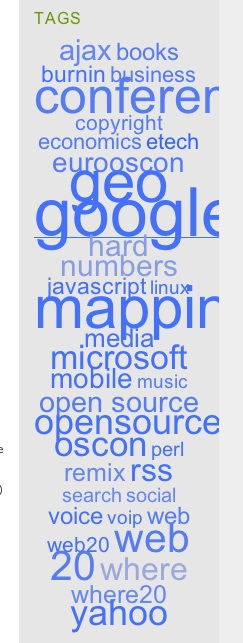
 Tag clouds, a Web 2.0 sort of user interface for navigating tagged content a.k.a. folksonomies, gives certain hyperlinked keywords a larger font size treatment than others. These links lead to various category pages, tag pages, or search results pages.
One of my favorite implementations of a tag cloud on a blog is on O’Reilly Radar (on the right).
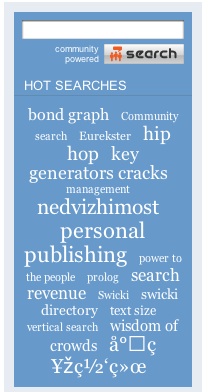 Another is the one on Eurekster’s blog (on the left).
The latter uses a new approach of “auto-tagging”. Eurekster calls this tag cloud of theirs a “BuzzCloud”. Webmasters can get one for free by signing up for their new Swicki service, which is a personalized Web search engine that is targeted and relevant to your site’s audience. You can seed your buzzcloud with search terms of your choosing, then Eurekster adds additional terms based on which searches are popular with your visitors. Visitors who click on the links are taken to a Eurekster search results page for that term. The results popular with you & your audience are promoted to the top of the search results and marked with an icon — in essence, tagging the results as well as the term.
Tagging that requires manual intervention such as del.icio.us and Technorati definitely have their use, but I think they are primarily for more web-intensive users; the combination of manual control and auto-tagging offered by Eurekster with swickis can potentially lead to mass uptake amongst web content editors. I’ve put a Eurekster swicki & buzzcloud here on my blog (on the right-hand column, near the bottom). Try it out and let me know what you think. Get your own free swicki for your blog or website here.