
My child SEO prodigy already seeing her SEO work bearing fruit
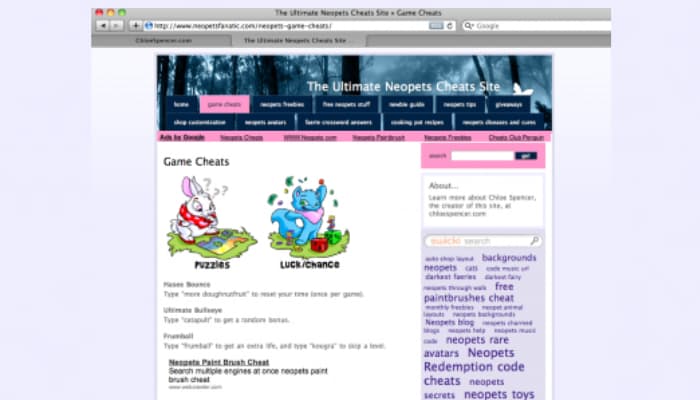
It’s been less than 2 weeks since my 14-year-old daughter Chloe built and SEO’d her first website, a Neopets Cheats site. And already she’s #16 in Google and #17 in Yahoo for her main targeted search term: “neopet cheats”. That was pretty fast considering the only link to it was from my blog. According to a linkdomain: query on Yahoo, there is one additional link now besides my blog, but it’s just from a splog where they siphoned off Google or another engine’s results pages that contained Chloe’s site.
This got me thinking: this was a bit too easy. The way that Google and Yahoo favor blogs, no wonder splogs (spam blogs) have become such a problem. And as long as it continues to be that easy, splogs will continue to be a scourge on the Internet.
Our history lies within The Machine
Better late than never… It’s still worth highlighting a fascinating article from last August by “senior maverick” Kevin Kelly who opens with:
The Netscape IPO wasn’t really about dot-commerce. At its heart was a new cultural force based on mass collaboration. Blogs, wikipedia, open source, peer to peer – behold the Power of the People.
Kevin predicts that within 10 years we will all be living inside the Machine – the Anticipation Machine, complete with its own immune system to fight off predators before they strike. We will never get the same answer to any given question any more. The Machine is always on. And by 2015 will make desktop operating systems irrelevant. The People will write the program. In fact, we are already doing it now.
Kevin says:
Of the 100 billion times per day humans clock on a webpage is a way of teaching the Machine what we think is important. Each time we forge a link between words, we teach it an idea.
Just like brain cells that program themselves simply by being used, likewise our questions program the Machine to answer questions. What will surprise us is how dependent we will be on what the Machine knows – about us and about what we want to know. It will become our memory. Our identity. Like having a lobotomy.
For me this conjures up in my head scenes from the Revisions episode of Stargate SG-1, where the people on the planet all have a gadget on their temples that link their brains to a central computer. They rely on the computer for instant recall of just about everything, including their entire history, However, what these inhabitants — who all live under the forcefield dome which protects them from the toxic atmosphere — fail to realize is that the central computer is compensating for a failing power source by shrinking the dome to fit available resources. In other words, the computer is commanding people to leave the protection of the dome and thus sending them to their deaths, then revising everyone’s memories so that the recently departed aren’t even remembered, let alone missed. (I guess I’ve given myself away as a Stargate nerd with this post!)
The moral of the story is: If we give our power to remember and think on our own to the Machine, it could happen to us!
![]()
The full article from Wired here.
Yahoo beats out Google?!
Just when you thought Google was the Big Kahuna, a report comes out to challenge your assumptions. Like this one from BIGresearch which yields some new insights into which search engines have the most influence on buying decisions. Hint: It’s not Google.
The study looked at the influence of Internet advertising on purchase decisions and the findings may surprise you. Yahoo was ranked overall the #1 search engine choice for influencing purchase decisions and Google #4. I’m not terribly surprised that Yahoo! leads the pack here. Even though you can’t (and shouldn’t) sterotype searchers, I nonetheless tend to imagine the prototypical Google searcher as more savvy and research-oriented and the prototypical Yahoo! searcher as a ready buyer easily parted from his/her money. What does it say about the average Yahooer that one of the most popular search terms entered into Yahoo! is the word “google”?
To the tune of 34,960,495 searches last month alone! This according to their Keyword Selector Tool. Can’t they figure out how to type google.com in the Location bar?
You also have to consider too that Yahoo puts the ads more in-your-face, so to speak, than Google.
Nonetheless, the rankings do move around once you start segmenting. Sometimes Google comes out in front — like in the Electronics sector. Here are some key sectors ranked in order of search engine preference:
Electronics
1. Google
2. Yahoo!
3. MSN
4. AOL
5. Ask Jeeves
Apparel/Clothing
1. Yahoo!
2. AOL
3. MSN
4. Google
5. Ask Jeeves
Car/Truck
1. MSN
2. Yahoo!
3. Google
4. Ask Jeeves
5. AOL
Grocery
1. AOL
2. Yahoo!
3. Ask Jeeves
4. MSN
5. Google
Hmm…. This might cause one to reassess his/her assumptions and priorities (and BUDGET) around paid search!
BIG hat tip to Shimon Sandler!
Capitalizing on trends in online marketing

Following on from my last post on Larry Chase’s predictions for how online marketing in 2006 will evolve…
I can’t stress enough how important it is to experiment with the new technologies that Larry discussed (RSS, podcasting, video downloads, mapping applications, etc.) so you’re not left in the dust. Sure, RSS or podcasts or video downloads won’t take over the world in 2006, but you can be sure you’ll be on the back foot if you do nothing and let your competitors establish a foothold with a popular podcast show or video blog.
What I’m talking about here is first mover advantage. Once your competitor becomes the next RocketBoom.com (a popular video blog which auctioned off their first video ad on eBay for $40,000!) or the next FrenchPodclass (a podcast of French language lessons offered by 26-year-old Sebastian Babolat, who recorded them in his living room and within several months had 10,000+ subscribers), it’ll be hard to catch up and overtake them.
Our client Steve Spangler is podcasting audio commentary, audio interviews, and video clips demonstrating some very cool science experiments to teachers and parents (his target audience). I reckon that his competitors won’t be upstaging him anytime soon, given the loyal following and buzz he’s already built up. And most importantly, now he’s got the momentum to keep evolving his podcasting/vodcasting at a faster and faster clip.
What are you doing to differentiate your brand and position yourself to capitalize on the whole “Web 2.0″ thing going forward?
Internet marketing trends in 2006
Larry Chase of WDFM pontificates about key trends for Internet marketing in 2006. These include, in summary:
- RSS? Yes, but…
Real Simple Syndication (RSS) finally takes off, and while great for stuff like sampling content, subscriber acquisition, product updates, and grabbing the attention of search engines, he contends that neither is it the second coming for advertising nor is it the replacement for email. - Podcast Means “Narrowcast”
It may have been the 2005 Word of the Year, but to employ “podcast” technology for marketing purposes? The ability to “timeshift” and consume content on-the-go on your schedule is innovative, but isn’t it possible most of these sound files are being listened to on desktop or laptop computers? And when considering podcasts as part of your marketing plan, think about the payback. A simple press release may be better. - Email Marketing – The Tower of Babble
Improve email campaign deliverability by adding your SPF text record to your domain’s DNS record. Mail servers look for the sending server’s IP address before passing the email through to the recipient. Also look into adopting SenderID and the other competing protocols put forward by inbox providers and ISPs, to further ensure your emails get delivered. And remember, the cleaner your list, the more emails will be delivered. - Video Downloads Will Be Huge
With millions of videos already being downloaded from iTunes, it’s a growing market. While folks are tapping into a missed episode of their favorite TV program sans commercials or downloading entire movies, what is the application for marketers? Video on the Internet featuring product demos, or how-to videos to help buyers with their purchase decision, perhaps? - Newspapers Get Bold
Print media has had to rev up its act to tap into the new generations. The world’s #1 most downloaded podcast The Ricky Gervais Show at Guardian Unlimited is a glimpse of great things to come from the newspaper industry. But where is the money? It’s got to be about more than traffic. - Multidimensional Marketing
Sure, mashing online maps with overlays of data have far-reaching implications for Internet Marketing. Mapping properties for sale or rent, visualizing where visitors to your website come from, or finding WiFi hotspots or dead zones for cellular networks, are all great applications. And there will be more exciting innovations to come. The rapid advances in Internet technology will be a boon to marketers and researchers alike. But in the urge to innovate or die, don’t make the classic mistake of assuming your audiences are adopting new technologies at the same rate you are. There’s still a place for the traditional.
What do I think about Larry’s predictions? I say he’s pretty much spot on. Of course we won’t know for sure until the end of the year.
Fast forward to the Year 2020: Jobs in search and blogging

You’ve probably heard it before, that the vast majority of the jobs that our children will hold when they grow up haven’t been invented yet. But what you may not have heard yet are some example future job functions being postulated.
According to the Office of the Future: 2020 report, these new roles will include:
- Virtual Meetings Organizer
who will help employees schedule conferences and set up the required cameras, projection systems, electronic whiteboards, meeting software, audio equipment and related tools - Contract Resource Coordinator
who will bring together the right contract workers for a given project, like a movie producer assembling a cast, camera crew and production team - Information Integrator/Abstractor
who will collect, compile, and index text, data and images so this content can be searched in a variety of ways
It was this last role that most intrigued me, since I am a search geek after all! I just imagine a scene from The Minority Report where the Information Integrator waves his/her hands in the air purposefully and talks to a computer while within a virtual world of information projected onto the back of his/her retinas. In this world he/she categorizes schemas for datasets, slices and dices incoming datastreams into more manageable segments, gives directions to an AI to do further categorization on its own, and so on.
As a business blogger, I also got to thinking that the business blogger of today is the predecessor to the “Information Integrator/Abstractor” of the future.
Think about this, what does a business blogger do but the following:
- identify a wide variety of trusted sources of novel and important news and commentary
- take in an overwhelming amount of information from these sources
- ruminate on this information, analyzing and making a judgment call on its value and relevance to his/her constituents
- cull, aggregate, categorize, prioritize, and comment on the information collected, in an effort to make it more relevant, timely, useful, and actionable
- republish it in a format that can be easily disseminated and further analyzed / commented on by others of his/her kind in disparate parts of the world
Sounds like a plausible job description for an Information Integrator/Abstractor of the Year 2020!
Link exchange requests that work… or not!

There’s an art to making an effective link request. For starters, you should not propose a reciprocal link, for 2 reasons: 1) the reciprocal nature of the link will basically nullify the SEO benefit you would have gotten, and 2) all the link request spams flooding webmasters’ inboxes are of a reciprocal nature and you need to differentiate yourself as much as possible from that rubbish. Say these sorts of things and rest assured that your link request will go straight into the recipient’s Trash:
- “Hi, Let’s swap links!”
- “I’ve already linked to you.”
- “Great site!”
- “You already link to our competitor XYZ.com and we offer a better/complementary product.”
- “Please use the following text in your link…”
When requesting links, think and act like a PR professional or a biz dev director, not an SEO. Or even think and act like an end-user of their site. “Hi, I found a broken link on _____. Have you thought about adding features like _____ to your ______ on your site? BTW, you might want to add xyz.com and abc.com as links.” Just don’t be disingenuous; provide real value with your suggestions. Even suggest links to competitors or sites that you have no vested interest in.
We all get link request spams, even Google engineers! (such as this one posted by Matt Cutts). Here’s one I got recently:
Subject: Quality link request
Hello,
I found your website www.stephanspencer.com on Google.
We have a quality website at www.ace-mobility.com that will be well ranked on Google.
We are happy to upload a link onto this website in any way you request in exchange for a return link. I’m sure you appreciate that this would be of great benefit to us both.
To go ahead with this exchange please upload our link information below to your links page.
Please reply to all@acemobilitychoice.co.uk to say where you have uploaded it.
If you would like your return link presenting in a particular way please include this information in your email.
I will then arrange for your link to be uploaded and email you again to let you know.
Thank you.
Regards
JessicaPlease note, the link needs to be set out as below in order for it to be returned.
[rest of email ommitted]
All I’ve got to say to that is, “Yeah, right!”
Eric Ward shared some secrets on how he crafts link requests that work in Thursday’s link building webinar for MarketingProfs which Eric and I co-presented. MarketingProfs will post the archive of the webinar in their Premium Library soon. And for those of you who aren’t MarketingProfs premium subscribers (you should join, btw, it’s well worth it!), I’ll see if I can get permission from MarketingProfs to post an archive of the webinar here on my blog.
Better living (searching) through meta data

Wouldn’t it be cool if business websites were all tagged with meta data like:
- business hours
- geolocation (latitude & longitude)
- NAICS code (the successor to SIC code)
- physical & mailing addresses
Just imagine what a search engine could do with such data. Searchers could restrict their results to just those businesses that are open late, for example.
What else would you add to the above list?
Webmasters the world over have already tagged their websites with meta keywords and meta descriptions, and many are rushing to post Google Sitemaps XML files, so the idea that they will also tag their sites with additional meta data seems pretty plausible to me. Particularly if there’s a ranking benefit to be had.
If this sort of thing becomes widely adopted and integrated into local search on the major engines, it could spell doom to the online Yellow Pages directories, at least those that fail to keep innovating. More and more, Google and Yahoo are becoming our universal “operating system” for the Internet, and I see that trend only continuing.
10 things to consider before getting started with RSS

If you’ve picked up the buzz and are considering adding RSS feeds to your site, Amanda Watlington has some pointers on how to approach it, which I’ve summarized:
- Add new content to your site
You need to be providing a steady flow of new information to readers who have subscribed to your feed. Without it, your subscribers will lose interest. Areas to update on your website may be news or press releases, and/or careers information. Do not offer RSS feeds until you are able to provide regularly updated content. - Offer multiple feeds
Most websites have multiple audiences. Content that interests reporters will be different to that of interest to job seekers. If you are releasing new products or service updates, consider having a separate feed for each. There is no limit to how many feeds you should offer. Look at it from a marketing standpoint. - Frequency and recency
Consider how often you update your website. This will dictate how often you update your feeds. Since the success of your RSS campaign depends on a regular flow of information, you may want to create a schedule that plans for regular updates. - RSS format for your feeds
What format or version of RSS you will use? Typically, the choices include RSS 1.0 and RSS 2.0. A third choice is Atom, which performs the same basic functions as RSS. Decide if your feed format is to support enclosures such as image and audio files, an important functionality that RSS 2.0 feeds provide. - How much will you syndicate in your feed
Decide how much content you will offer subscribers. Will it be a headline, a teaser, or more? If you are a content provider, you may want to offer headlines only, then readers will come to your site to read the entire article. Remember, however, that partial or headline-only feeds can be annoying to readers who expect to receive the entire article in their RSS reader. Know your audience and clarify your goals before deciding how much content to provide. - Encourage others to syndicate your content onto their site
Expand your readership dramatically by offering a feed syndication tool that enables other site owners to create a customized feed of your headlines on their site. Properly constructed, these feeds will drive traffic to your site and add valuable links for search marketing. - Yes or no to advertising
There are several schools of thought on this one, with arguments both in favor of carrying advertising and for creating feeds that are completely advertising free. You will want to take a stance on this during the planning process. - Measuring success
The three key metrics of circulation, readership and clickthrough rates apply here. Circulation measures the number of subscribers your feed has. Readership measures the number of readers who viewed your feed in their RSS aggregator. Clickthroughs measure the number of readers who click from the feed to your site. Determine how aggressively you want to measure feed performance, set benchmarks and put tools in place to enable you to gather the data you need to measure success. - Advising your audience about RSS
Letting readers know they can easily subscribe to your feeds may be as simple as putting an orange XML or RSS button prominently on your site, or providing extensive explanations and assistance to your readers. A press announcement about the availability of feeds on your site may be an option. - Monitor the rapidly changing RSS landscape
As uses for RSS expand and new tools arrive to make it easier to implement RSS on sites, be sure that someone in your organization is monitoring the landscape regularly to ensure that you are as up to date on this evolving technology as possible.
Great advice, Amanda! Amanda also says: “Just remember that RSS is a marketing solution, not a technical problem. If you approach getting started in RSS from this perspective, you will find RSS an exciting new marketing communications medium.”
You can also download her white paper, “The RSS Advertising Debate: Is It Just Commerce vs. Credibility?” at www.searchingforprofit.com/rssads.html.
Intention: the next evolution in search?
If you think SEO is hard now, just wait until search engines start varying the results for each individual, depending on their profile, search history, geographic location, and now… mindset. Yahoo Mindset is Yahoo Labs’ foray into intent-driven search, where sorting of the results are partially dependent upon the searcher’s intentions (whether they are in a shopping frame-of-mind or a research frame-of-mind). Yahoo is using machine learning to score web results as commercial or informational. Scores range from -2 (most commercial) to +2 (most informational).
It’s a pretty cool idea but I don’t think they’ve quite nailed it yet. (They do refer to it as a “demo” on the home page so I can’t be too hard on them!) The big question is: does Yahoo decide what each page is, or does it decide on the whole site? Imagine being a commercial site and Yahoo decides you are researching only.
A trawl through some common search queries reveals that results on the research end are no less commercial than the commercial end, but the slider bar on the left of each result is different, so maybe the machine learning algo is scoring the pages differently.
Fold in personalized search (where search results vary depending on the searcher’s profile and previous search behavior) and local search (where results vary by the searchers’ geographic location) and then it starts getting really interesting for us SEOs. It’ll make life a lot tougher for optimizers because we’ll need three times the content if we want to be found at the commercial and research ends of the search, as well as in the middle.
Just as with personalized search, local search, and other innovations coming out of the search engines’ labs, intent-driven search is yet another nail in the coffin of old-school SEO.